- Where to see one
- 6 U.S. zoos in our directory hold hellbender, confirmed against each zoo's own animal list.
- Native range
- Eastern and central United States, from southern New York to northern Georgia and west to the Ozarks
- Size
- 30–74 cm (12–29 in) total length; 1.5–2.5 kg (3.3–5.5 lb)
- Lifespan
- 25–30 years; up to 30 years in captivity
- Breathing
- Mostly through the skin, via wrinkled folds along the sides
- Other names
- Snot otter, devil dog, mud-devil, water dog, Allegheny alligator
Conservation status
Vulnerableassessed 2022
IUCN Red List category VU — step 3 of 7.
Vulnerable (VU); the Ozark subspecies is federally Endangered
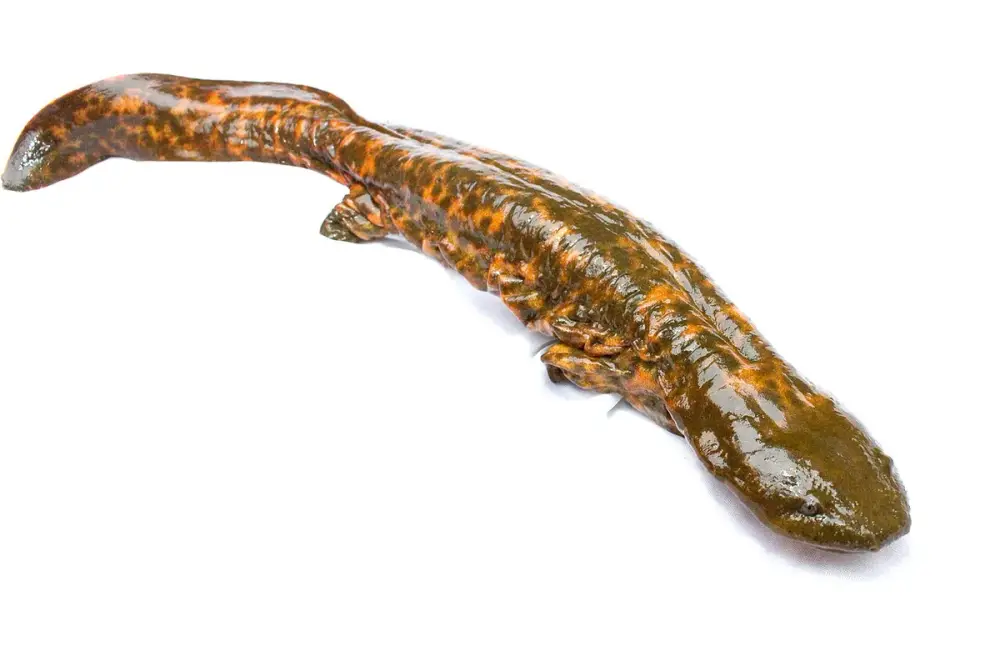
The hellbender is a giant aquatic salamander, the largest in North America, found in the eastern and central United States. Flat-bodied and slimy-skinned, with small eyes on top of the head, thick folds of skin down each side and a keeled tail, it lives in clear, fast-flowing streams, sheltering under large rocks. It absorbs oxygen through capillaries in its skin folds, which is why it needs well-oxygenated water. It hunts mainly at night, taking crayfish and small fish, and uses suction to feed on large prey. Adults reach a total length of 30 to 74 cm and are generally solitary, gathering mainly at mating time.
About the hellbender
The hellbender is a giant aquatic salamander found only in the eastern and central United States, and it is the largest salamander in North America. It is the sole living member of its genus and belongs to the giant salamander family Cryptobranchidae, whose only other living members are the Chinese and Japanese giant salamanders.
It is built to live flat against a stream bed. The body and head are broad and flattened, the small eyes sit on top of the head, and the skin is slimy. Thick, wrinkled folds of skin run along each side of the body from the neck to the base of the tail. The legs are short, with four toes on the front feet and five on the back, and the tail is keeled like a rudder. Color ranges from blotchy brown or reddish brown to gray, yellowish brown or almost black, with a paler belly.
Those side folds are the key to how a hellbender breathes. It does have working lungs, but it rarely uses them. Instead, it absorbs most of its oxygen straight from the water through tiny blood vessels in its skin, and the folds add surface area for that exchange. Young hellbenders have external gills, which they lose at about 18 months old and roughly 13.5 cm (5.3 in) long, though a single gill slit often stays open on each side. The genus name Cryptobranchus means "hidden gill."
Adults measure 24–40 cm (9.4–15.7 in) from snout to vent and 30–74 cm (12–29 in) in total length, and weigh 1.5–2.5 kg (3.3–5.5 lb). That makes Cryptobranchus alleganiensis the fourth-largest aquatic salamander in the world, after the South China, Chinese and Japanese giant salamanders. Males and females grow at the same rate, but females tend to live longer and so get bigger.
Its eyesight is poor, but it has light-sensitive cells all over its body, especially on the tail, which may help it tuck itself fully out of sight under a rock. It also has a good sense of smell, probably its most important hunting sense, and a lateral line like a fish's for picking up vibrations in the water.
Behavior and diet
Diet
Mainly crayfish and small fish, plus insects, worms, snails, tadpoles and smaller salamanders
Hellbenders are solitary. Each one settles under a favorite rock and defends it from other hellbenders all year round, rarely straying far except to breed or hunt. Ranges can overlap, but two hellbenders are seldom in the shared area at the same time. One estimate put the average home range at 198 square meters (about 2,130 sq ft).
They are at least partly nocturnal, with activity peaking about two hours after dark. Despite the paddle-like tail, they rarely swim. Instead, they walk along the bottom, gripping rocks with pads on their toes, and their flat shape lets water slide over them and lets them squeeze into tight crevices.
What hellbenders eat
Hellbenders hunt mainly at night, and crayfish and small fish make up most of the diet. They also eat insects, worms, snails and other mollusks, tadpoles and smaller salamanders, and they will follow a scent trail upstream to find dead fish. Larvae eat mayfly and caddisfly nymphs. Crayfish dominate in summer when they are most active, and fish make up more of the winter diet. Feeding happens between about 7 and 27 °C (45 and 80 °F), and for big prey a hellbender uses suction feeding.
Hellbenders are eaten by fish, snakes and turtles; largemouth bass can take hellbenders one to three years old. Young captive hellbenders change their behavior when they detect chemical cues from predatory fish.
Breeding and egg-guarding
The breeding season starts in late August or September and can run until the end of November. Unlike most salamanders, hellbenders fertilize their eggs outside the body. Each male digs a saucer-shaped nest under a rock or log with the entrance facing away from the current, and males fight, often biting, over good nest rocks.
When a female arrives, the male drives her into the nest. She lays 150–200 eggs over two to three days, and he sprays them with sperm. A male may lure several females, and one nest held 1,946 eggs. He then chases the female off and guards the eggs alone, rocking his body and waving his skin folds to keep oxygen-rich water flowing over them. Incubation lasts 45 to 75 days, and males care for eggs and larvae for at least seven to eight months. Males also eat some of their eggs, and do so more in degraded, poorly forested streams. Hatchlings are 25–33 mm (1–1.3 in) long and live off a yolk sac for their first few months.
Hellbenders reach sexual maturity at about five years old.
Range and habitat
Habitat
Clear, cool, fast-flowing rocky streams and rivers
Hellbenders live in parts of the eastern United States from southern New York to northern Georgia, including Ohio, Pennsylvania, Maryland, West Virginia, Virginia, Kentucky, Illinois, Indiana, Tennessee, North Carolina, Alabama, Mississippi, Arkansas and Missouri, reaching into Oklahoma and Kansas. Only one sighting has ever been documented in South Carolina.
There are two subspecies. The Ozark hellbender (C. a. bishopi) is confined to the Ozarks of northern Arkansas and southern Missouri, mainly the White River and Spring River systems. The eastern hellbender (C. a. alleganiensis) covers the rest of the range. Genetic work suggests the Ozark animals actually form two distinct groups, each diverging separately from the eastern form.
Hellbenders are habitat specialists. They need clear, clean, cool water that flows fast enough to carry plenty of dissolved oxygen over their skin, with large, loose rocks to hide under, and they avoid wide, slow, muddy rivers. Their presence signals good water quality. Forest along stream banks matters a great deal: a Virginia study found that when upstream forest cover fell below about 63 percent, hellbender populations shrank and were made up mostly of older animals.
Hellbender vs mudpuppy
The common mudpuppy (Necturus maculosus) is the only salamander in the hellbender's range that comes close in size, and young hellbenders that still have gills are easy to confuse with it.
| Feature | Hellbender | Common mudpuppy |
|---|---|---|
| External gills as adults | No | Yes |
| Toes on each hind foot | Five | Four |
| Body | Very flat, with thick wrinkled skin folds along the sides | No large side folds |
| Typical adult size | 45–60 cm (18–24 in) for the eastern form, up to 74 cm (29 in) | 28–40 cm (11–16 in) |
Conservation status
The hellbender is listed as Vulnerable on the IUCN Red List, assessed in 2022, and populations have fallen sharply across most of the range. In Missouri numbers dropped an estimated 77 percent from the 1980s, and Ohio populations have fallen about 80 percent. Many remaining populations are mostly old animals with few young.
The causes include siltation, dams that block movement and destroy river habitat, pollution, the loss of streamside forest, disease and over-collecting. Chytrid fungus has been found in every Missouri population of the Ozark subspecies. Warming streams carry less oxygen, so climate change is expected to make things harder.
The Ozark hellbender has been listed as Endangered under the U.S. Endangered Species Act since 2011, with roughly 590 left in the wild. Head-starting programs, which raise wild-collected eggs in captivity and release the young at a safer size, are under way in Indiana, New York and Ohio, and protecting habitat and reintroduction where hellbenders have vanished are seen as key. In 2019 the eastern hellbender became Pennsylvania's official state amphibian.
Where to see hellbender in the U.S.
6 zoos across 5 states
Find the closest one
Rank the 6 zoos holding hellbender by how far they are from you. Your location is used in your browser to sort this list and is never sent to us.
District of Columbia· 1
Kentucky· 1
New York· 2
Ohio· 1
Tennessee· 1
AZAThe Association of Zoos and Aquariums. Accredited members have passed an independent inspection of animal care and welfare, safety, conservation and education, repeated every five years. Many smaller facilities never apply, so “not accredited” isn't a verdict on its own. What accreditation means · How we check this
Built from each zoo's own published animal list.
Hellbender: common questions
Are hellbenders dangerous?
No. Despite the name and appearance, the hellbender is a harmless aquatic salamander.
How big do hellbenders get?
Total length is 30–74 cm (12–29 in), and adults weigh 1.5–2.5 kg (3.3–5.5 lb). It is the largest salamander in North America.
What do hellbenders eat?
Mostly crayfish and small fish, along with insects, worms, snails, tadpoles and smaller salamanders.
How do hellbenders breathe?
Mainly through their skin. Wrinkled folds along the body absorb oxygen from fast-flowing water, and the lungs are used very little.
Why is it called a hellbender?
Nobody knows for sure. The name was already in use by 1802, and one story says settlers thought it was a creature from hell bent on returning there.
Where do hellbenders live?
In clean, fast, rocky streams of the eastern and central United States, from southern New York to northern Georgia and west to the Ozarks of Missouri and Arkansas.
How long do hellbenders live?
Adults can live 25–30 years.
Are hellbenders endangered?
The species is listed as Vulnerable, and the Ozark hellbender is federally Endangered. Populations are declining across most of the range.