- Where to see one
- 11 U.S. zoos in our directory hold eastern hellbender, confirmed against each zoo's own animal list.
- Native range
- Eastern and central United States, from southern New York to northern Georgia, west into Ohio, Pennsylvania, the Ozarks, and parts of Oklahoma and Kansas
- Size
- 24-40 cm (9.4-15.7 in) snout to vent, 30-74 cm (12-29 in) total length; adults weigh 1.5-2.5 kg (3.3-5.5 lb)
- Lifespan
- Up to 25-30 years in the wild; up to 30 years in captivity
About the eastern hellbender
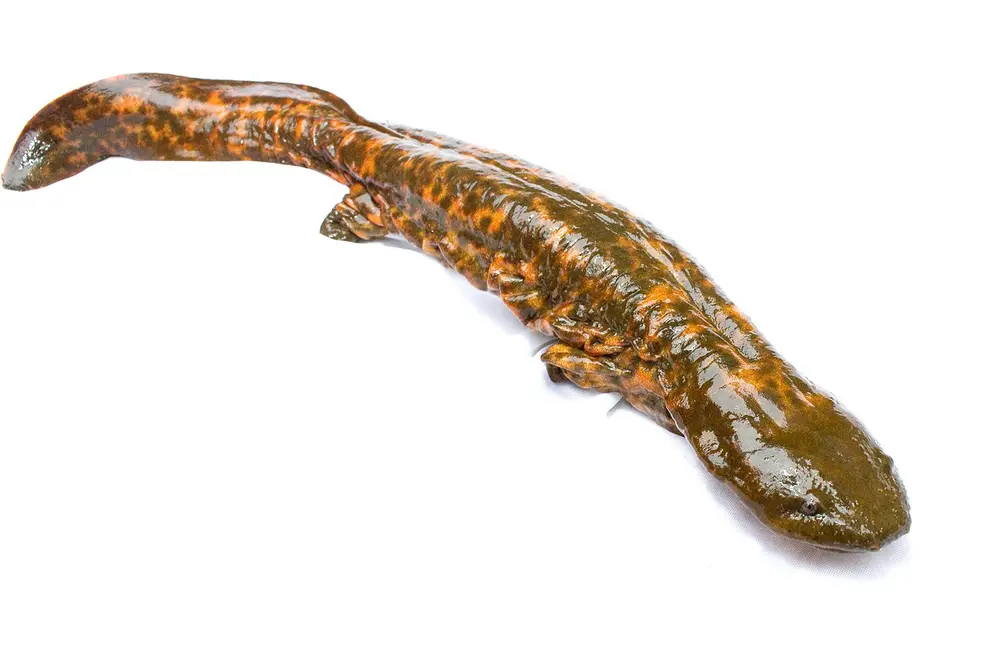
The hellbender is a species of aquatic giant salamander endemic to the eastern and central United States, and it's the largest salamander found in North America. It belongs to the family Cryptobranchidae and is the only living member of the genus Cryptobranchus; its closest relatives, the Japanese and Chinese giant salamanders, belong to the related genus Andrias. The name "hellbender" has an uncertain origin — one account holds that settlers thought it looked like "a creature from hell where it's bent on returning," while another ties the name to the undulating folds of its skin. The name was already in common use by 1802, when a French explorer recorded it from enslaved African American men in what's now North Carolina and Virginia. Other regional names include snot otter, mud-devil, water dog, and Allegheny alligator.
The eastern hellbender has a flat body and head, small dorsal eyes, and slimy skin. Like other salamanders it has short legs, with four toes in front and five behind, and a keeled tail — though the tail is rarely used for swimming, since hellbenders mostly grip rocks with their toe pads and walk along stream bottoms instead. It has working lungs but relies mainly on cutaneous respiration, absorbing oxygen through capillaries in the loose skin folds that run along each side of its body from neck to tail base; juveniles retain true gills for about the first 18 months of life, until they reach roughly 125 mm (4.9 in) in length. Coloration is blotchy brown or red-brown, sometimes gray, yellowish-brown, or nearly black, with a paler underside. Adults reach 24 to 40 cm (9.4 to 15.7 in) from snout to vent and 30 to 74 cm (12 to 29 in) in total length, making the species the fourth-largest aquatic salamander in the world and the largest amphibian in North America; adults weigh 1.5 to 2.5 kg (3.3 to 5.5 lb). Females tend to grow larger than males because they live longer, even though both sexes grow at similar rates. Hellbenders reach sexual maturity around age five.
Behavior and diet
Diet
Mainly crayfish and small fish, plus insects, worms, molluscs, tadpoles, and smaller salamanders
Hellbenders are largely nocturnal, with peak activity reported around two hours after dark and again near dawn, and that nocturnal pattern is strongest in early summer, perhaps coinciding with the highest water depths. Once a hellbender settles into a favorable spot — typically a large, irregularly shaped rock not embedded in the streambed, with swift water flowing past — it tends to stay close to that site except to breed or hunt, and it will defend it from other hellbenders. The species is generally solitary; one longtime collector noted that while home ranges may overlap, he never found two hellbenders under the same rock, and the animals are thought to gather mainly during the breeding season. Adults can live 25 to 30 years in the wild.
They feed primarily at night on crayfish and small fish, along with insects, worms, molluscs, tadpoles, and smaller salamanders; larval hellbenders eat mayfly and caddisfly nymphs. Crayfish predation rises in summer when crayfish are more active, while fish make up more of the winter diet. Feeding activity appears concentrated in a specific temperature window, between 45 and 80°F (7 and 27°C), and hellbenders use suction feeding when taking on large prey. Cannibalism of eggs also occurs within populations, and it appears to increase in areas with more deforestation.
Breeding runs from late August or early September into as late as November, depending on the region. Ahead of the season, males show the only sexual dimorphism the species displays: a bulging ring around the cloacal glands known as cloacal swelling. Each male excavates a saucer-shaped brood site under a rock or log, positioned out of the main current, and will fight other males to defend it. When a female approaches, the male drives her into the burrow and keeps her there until she lays her eggs. Fertilization happens externally — unusual among salamanders — with the male positioned alongside the eggs as the female releases them, spraying them with sperm while swaying his tail. A female lays 150 to 200 eggs over two to three days; each egg measures 18-20 mm (0.71-0.79 in) across, and the eggs are strung together in five to ten connected cords.
Range and habitat
Habitat
Clear, fast-moving, oxygenated streams and rivers with large, loose rocks and low pollution
Eastern hellbenders range across a broad swath of the eastern United States, from southern New York to northern Georgia, including parts of Ohio, Pennsylvania, Maryland, West Virginia, Virginia, Kentucky, Illinois, Indiana, Tennessee, North Carolina, South Carolina, Alabama, and Mississippi, with the related Ozark subspecies confined to northern Arkansas and southern Missouri and populations also extending into Oklahoma and Kansas. Only one sighting has ever been documented in South Carolina. Historically abundant populations in Missouri, Pennsylvania, and Tennessee have declined sharply — Missouri's population alone has dropped an estimated 77% since the 1980s — and the species was already listed as extirpated or endangered in Illinois, Indiana, Iowa, and Maryland by 1981.
Hellbenders are habitat specialists tied to clear, clean, fast-moving streams and rivers with plenty of large, loose rock cover, low water temperatures, and low specific conductivity — conditions that also make the species a strong indicator of good water quality. Forest cover along the banks of these streams is critical to keeping that water clean and cool; one Virginia study found that hellbender populations shrank and skewed toward older individuals once upstream forest cover fell below about 63%, and even modest deforestation measurably worsens stream conditions.
Conservation status
The eastern hellbender is classified as Vulnerable (VU) on the IUCN Red List, largely because of disease and widespread habitat loss and degradation across its range. Nearly 80% of populations are declining or disappearing outright, and in many remaining populations the surviving hellbenders are mostly older animals, with too few young turning up to replace them. The primary driver is the loss of forest along the streams the species depends on, which keeps habitat stable and water quality high; when those riparian buffers are cleared, water quality drops and hellbenders decline. The species is also preyed on by various fish and reptiles, including snakes and turtles — largemouth bass, for instance, can consume hellbenders one to three years old — and eggs are commonly cannibalized by other hellbenders, a behavior that appears more common where deforestation is already a factor.
Where to see eastern hellbender in the U.S.
11 zoos across 11 states
Find the closest one
Rank the 11 zoos holding eastern hellbender by how far they are from you. Your location is used in your browser to sort this list and is never sent to us.
Alabama· 1
Connecticut· 1
Maryland· 1
Minnesota· 1
Missouri· 1
New York· 1
Ohio· 1
Pennsylvania· 1
Tennessee· 1
Virginia· 1
West Virginia· 1
AZAThe Association of Zoos and Aquariums. Accredited members have passed an independent inspection of animal care and welfare, safety, conservation and education, repeated every five years. Many smaller facilities never apply, so “not accredited” isn't a verdict on its own. What accreditation means · How we check this
Built from each zoo's own published animal list.
Eastern Hellbender: common questions
Is the eastern hellbender endangered?
It's classified as Vulnerable on the IUCN Red List. Nearly 80% of its populations are declining or disappearing, mainly due to disease and habitat loss and degradation along the streams it depends on.
How big does an eastern hellbender get?
Adults measure 24 to 40 cm (9.4 to 15.7 in) from snout to vent and up to 74 cm (29 in) in total length, weighing 1.5 to 2.5 kg (3.3 to 5.5 lb) — making it the largest salamander in North America.
What does an eastern hellbender eat?
Mainly crayfish and small fish, along with insects, worms, molluscs, tadpoles, and smaller salamanders, feeding mostly at night.
How long do eastern hellbenders live?
Up to 25 to 30 years in the wild, and up to 30 years in captivity.
Where do eastern hellbenders live in the wild?
In clear, fast-flowing, well-oxygenated streams across the eastern United States, from southern New York to northern Georgia, plus an Ozark population in southern Missouri and northern Arkansas.
Which U.S. zoos have eastern hellbenders?
Seven zoos in the Feather & Fang directory list this species, including the Saint Louis Zoo, the Maryland Zoo in Baltimore, and the Nashville Zoo at Grassmere.