- Where to see one
- 20 U.S. zoos in our directory hold prairie dog, confirmed against each zoo's own animal list.
- Native range
- Grasslands of North America — the Great Plains of the western United States, the Canadian Prairies, and northern Mexico
- Size
- 30 to 40 cm (12 to 16 in) long including the tail, weighing 0.5 to 1.5 kg (1 to 3 lb)
- Lifespan
- 8 to 10 years in the wild, on average
Conservation status
Not Evaluated
This species has not been assessed for the IUCN Red List, so it sits outside the threat scale entirely.
Varies by species; there is no single status for the genus
About the prairie dog
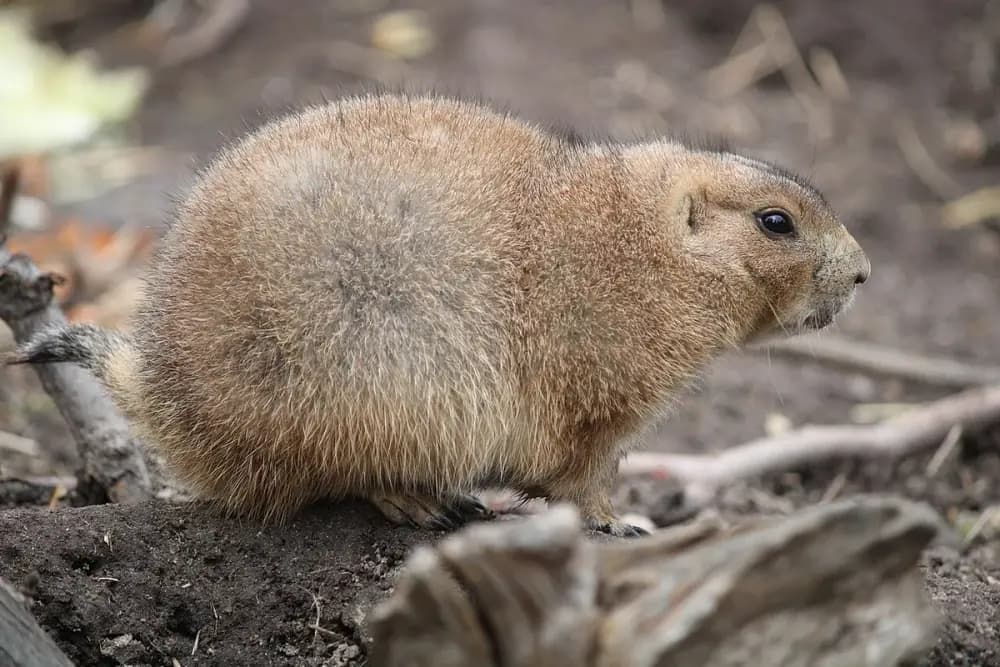
Prairie dogs are herbivorous, burrowing ground squirrels in the genus Cynomys, native to the grasslands of North America. There are five recognized species: black-tailed, white-tailed, Gunnison's, Utah, and Mexican prairie dogs. Despite the name, they aren't canines at all — they belong to the ground squirrel tribe Marmotini, alongside marmots and chipmunks, within the larger squirrel family Sciuridae. The name comes from their grassland habitat and their warning call, a bark similar to a dog's; it dates back at least to 1774, and the 1804 journals of the Lewis and Clark Expedition record the discovery of "a Village of an animal the French Call the Prairie Dog."
Prairie dogs are stout-bodied, averaging 30 to 40 cm (12 to 16 in) long including a short tail, and weighing between 0.5 and 1.5 kg (1 and 3 lb). Sexual dimorphism in body mass varies by species and by season, running from 105 to 136 percent between the sexes; black-tailed prairie dogs show the least difference between males and females, and white-tailed prairie dogs the most. Despite their name, a prairie dog's skull is considerably shorter than a true dog's, running 5.2 to 6.4 cm compared with 11.39 to 17.96 cm for a canine skull. In the wild, prairie dogs live an average of 8 to 10 years.
In the United States, prairie dogs range mainly west of the Mississippi River, with some populations introduced farther east, and they're also found across the Canadian Prairies and in the northern Mexican states of Sonora, Chihuahua, Coahuila, Nuevo León, and Tamaulipas — territory that sits at the southern end of the Great Plains.
Behavior and diet
Diet
Chiefly herbivorous — grasses, small seeds, broadleaf forbs, roots, buds, and fruit, with occasional insects
Prairie dogs feed chiefly on grasses and small seeds, switching to broadleaf forbs in the fall; they also eat roots, seeds, fruit, and buds, and occasionally insects. In winter, pregnant and lactating females supplement their diet with snow for extra water. Diet varies somewhat by species and region: black-tailed prairie dogs in South Dakota eat western bluegrass, blue grama, buffalo grass, six weeks fescue, and tumblegrass, while Gunnison's prairie dogs favor rabbit brush, tumbleweeds, dandelions, saltbush, and cacti along with buffalo grass and blue grama. White-tailed prairie dogs have even been observed killing ground squirrels that compete with them for food.
Prairie dogs are highly social, living in large colonies, or "towns," that can span hundreds of acres and hold 15 to 26 family groups, organized into subgroups called "wards." The family group — called a "coterie" among black-tailed and Mexican prairie dogs and a "clan" among the other three species — is the basic social unit, typically made up of one breeding male, two or three breeding females, and their offspring. Members greet each other through oral contact, sometimes called "kissing," and mutual grooming, behaviors reserved for members of their own group. Females stay in their natal group for life, while males disperse to find a new group to join and defend once they mature. Territorial disputes between males from neighboring family groups can happen as often as 20 times a day and typically involve staring, bluff charges, tail-flaring, teeth-chattering, and sniffing at scent glands before escalating, if necessary, into biting, kicking, and ramming.
Reproduction takes place underground, which lowers the risk of both interruption by rival males and predation. Females signal estrus through behaviors including dust-bathing and late returns to the burrow at night, and males use copulatory plugs afterward to block other males from mating with the same female. Mothers do most of the direct care of the young, nursing them, defending the nursery chamber, and collecting nesting grass, while males defend the territory and maintain the burrow system. Young nurse underground for about six weeks before weaning and emerging, and reach full growth by five months. Perhaps the best-known prairie dog behavior is their alarm-calling system: using sharp color vision to spot predators at a distance, prairie dogs give distinct calls that vary by predator type — different pitches and patterns for hawks and eagles versus coyotes, dogs, or humans — which trigger different escape or watch-and-wait responses across the colony.
Range and habitat
Habitat
Grassland at altitudes of 2,000 to 10,000 ft (600 to 3,000 m), in underground burrow systems
Prairie dogs live across the grasslands of North America, mainly west of the Mississippi River in the United States, throughout the Canadian Prairies, and in the northern Mexican states at the southern end of the Great Plains. They typically live at altitudes from 2,000 to 10,000 ft (600 to 3,000 m), in areas that can swing from 38 °C (100 °F) in summer to −37 °C (−35 °F) in winter.
Their underground burrows, which run 5 to 10 m (16 to 33 ft) long and 2 to 3 m (6.6 to 9.8 ft) deep, buffer them against that range, holding steady at 5–10 °C (41–50 °F) in winter and 15–25 °C (59–77 °F) in summer. Burrows include mounded or flat entrances, dedicated chambers for nursing, sleeping, and winter, and dome- or rim-shaped mounds that double as lookout posts and flood barriers. As ecosystem engineers, prairie dogs are considered a keystone species: their mound-building helps renew topsoil and encourages grass growth, and other animals, including the burrowing owl, mountain plover, and golden-mantled ground squirrel, rely on their burrows for nesting.
Conservation status
There is no single IUCN Red List status for prairie dogs, because the IUCN assesses each of the five species in the genus Cynomys separately. Prairie dog habitat is under pressure from direct removal by farmers and from urban development, both of which have reduced populations, and disease is an additional threat.
Removing prairie dogs tends to cause an undesirable spread of brush, and the resulting costs to livestock range and soil quality often outweigh the benefits. Prairie dogs are protected in many areas to maintain local populations and the broader ecosystems that depend on them.
Where to see prairie dog in the U.S.
20 zoos across 14 states
Find the closest one
Rank the 16 zoos holding prairie dog by how far they are from you. Your location is used in your browser to sort this list and is never sent to us.
4 more zoos hold prairie dog but have no coordinates on file yet, so they aren't ranked here. They're in the full list below.
Arizona· 1
California· 1
Delaware· 1
Kansas· 2
Louisiana· 1
Maine· 1
Massachusetts· 2
Michigan· 1
Minnesota· 2
North Carolina· 1
Oklahoma· 1
South Dakota· 1
Texas· 2
Wisconsin· 3
AZAThe Association of Zoos and Aquariums. Accredited members have passed an independent inspection of animal care and welfare, safety, conservation and education, repeated every five years. Many smaller facilities never apply, so “not accredited” isn't a verdict on its own. What accreditation means · How we check this
Built from each zoo's own published animal list.
Prairie Dog: common questions
Is the prairie dog endangered?
It depends on the species, since the IUCN assesses each one separately. Habitat loss to farming and urban development, along with disease, has reduced populations, and prairie dogs are protected in many areas as a result.
How big does a prairie dog get?
Prairie dogs run 30 to 40 cm (12 to 16 in) long including the tail, and weigh 0.5 to 1.5 kg (1 to 3 lb).
What does a prairie dog eat?
Mostly grasses and small seeds, plus broadleaf forbs, roots, fruit, and buds, with occasional insects.
How long do prairie dogs live?
About 8 to 10 years in the wild.
Where do prairie dogs live in the wild?
Across the grasslands of North America — the western United States, the Canadian Prairies, and northern Mexico — in underground burrow towns.
Which U.S. zoos have prairie dogs?
Seven U.S. zoos list them, including the San Diego Zoo, Detroit Zoo, and Franklin Park Zoo.