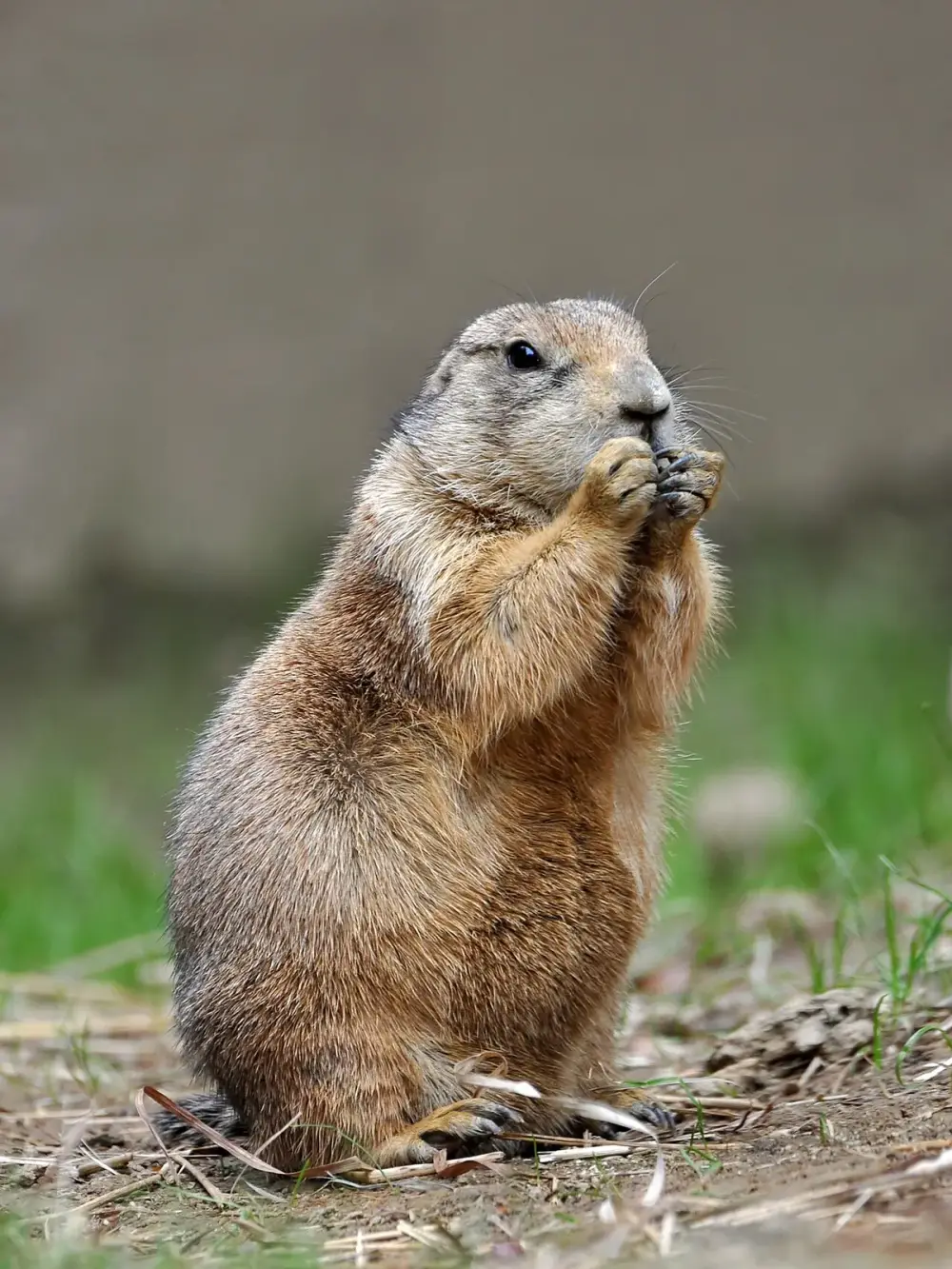
Black-tailed Prairie Dog
Cynomys ludovicianus
Also known as Black-Tailed Praire Dogs
- Where to see one
- 29 U.S. zoos in our directory hold black-tailed prairie dog, confirmed against each zoo's own animal list.
- Native range
- The Great Plains of North America, roughly from the U.S.–Canada border to the U.S.–Mexico border
- Size
- Body 14–17 in (36–43 cm) long with a 3–4 in (7.6–10.2 cm) tail; weighs 1.5–3.0 lb (0.68–1.36 kg), with males typically heavier than females
- Lifespan
- About 5 years for males and 7 for females
Conservation status
Least Concernassessed 2016
IUCN Red List category LC — step 1 of 7.
Least Concern (LC), assessed 2016
About the black-tailed prairie dog
The black-tailed prairie dog is a rodent of the squirrel family, Sciuridae, found across the Great Plains of North America, historically from southern Saskatchewan and Alberta down to Chihuahua, Mexico. It was likely the most abundant prairie dog species in central North America before habitat destruction reduced its numbers, and it was one of two prairie dog species described in the journals of the Lewis and Clark Expedition. One prairie dog town recorded in Texas was estimated to cover 25,000 square miles and hold roughly 400 million individuals — a scale that gives some sense of how dominant the species once was on the plains.
Physically, black-tailed prairie dogs are generally tan with lighter bellies, sometimes showing darker fur in black and brown tones across the back, and their tails end in the black tips that give the species its name. Adults weigh 1.5 to 3.0 lb (0.68 to 1.36 kg), with males typically outweighing females, and body length runs 14 to 17 in (36 to 43 cm) plus a 3- to 4-inch (7.6–10.2 cm) tail. The body is compact, the ears small and set close to the head, and the front feet carry long, black claws built for digging.
As of 2007, the species still occupied most of its historic range, with the exception of Arizona, though the total acreage and population occupied are well below historic levels. Unlike some other prairie dog species, black-tailed prairie dogs don't fully hibernate — they remain visible above ground even in midwinter, though they reduce activity and enter nightly bouts of torpor to conserve energy during the coldest months.
Behavior and diet
Diet
Mostly grasses, plus forbs, prickly pear, roots, and occasionally insects or bison scat
Black-tailed prairie dogs are diurnal, and their above-ground activity drops off when it's raining or snowing, or when temperatures top 100°F (38°C). Rather than hibernating through winter, they continue to leave the burrow to forage but enter torpor at night — a shorter, involuntary version of hibernation marked by dropping metabolism, heart rate, and respiration. On average, they lose about 20% of their body weight over fall and winter as torpor bouts increase through the season; colonies vary in how much time they spend in torpor, likely tied to how much rain fell during the previous growing season, since the animals get most of their water from the plants they eat.
Diet is dominated by grasses — more than 75% of intake, especially in summer — with western wheatgrass, buffalo grass, blue grama, and sedges preferred in spring and summer, and scarlet globemallow and Russian thistle sought after in late summer and fall. In winter, prickly pear, Russian thistle, and underground roots take over. Shrubs such as rabbitbrush, winterfat, saltbush, and sagebrush round out the diet, along with occasional cutworms, grasshoppers, and bison scat. One estimate puts consumption at about 7 lb (3 kg) of vegetation per prairie dog each summer month.
Black-tailed prairie dogs live in colonies that can range from five to thousands of individuals, organized into wards and then into coteries — tight social units of one adult male, three to four adult females, and their young at the start of the breeding season. Communication is unusually sophisticated: researchers led by Constantine Slobodchikoff argue that prairie dog alarm calls encode specific information about a predator's identity, size, and speed of approach, comparable to a form of grammar. The species also performs a "jump-yip" display, stretching upward and throwing its forefeet in the air while calling, which spreads through a colony as other individuals join in — a display thought to let the group gauge how alert its neighbors are.
Hearing plays a big part in avoiding predators, especially while underground: black-tailed prairie dogs can detect frequencies from as low as 4 Hz up to 26 kHz, sensitivity that lets them pick up an approaching threat before it's in sight. Minimum breeding age is usually two years, though yearlings will breed if space and food are abundant — in a Wind Cave National Park study, 40% of yearling females copulated and 9% successfully weaned a litter. Males typically disperse from their birth territory 12 to 14 months after weaning, usually in May and June, moving an average of 1.5 mi (2.4 km) to a new colony, while females generally stay in their natal coterie territory for life.
Range and habitat
Habitat
Shortgrass prairie, mixed-grass prairie, sagebrush steppe, and desert grassland
The black-tailed prairie dog's historic range ran from southern Saskatchewan and Alberta south to Chihuahua, Mexico, and included Montana, North Dakota, South Dakota, Wyoming, Colorado, Nebraska, Kansas, Oklahoma, Texas, Arizona, and New Mexico. As of 2007 it still occurred across most of that range except Arizona, though at much lower density and acreage than historically. It lives in shortgrass prairie, mixed-grass prairie, sagebrush steppe, and desert grassland, with habitat choice shaped by vegetation cover, slope, soil type, and rainfall.
Colonies often form near rivers and creeks, on benches, terraces, and gentle slopes, and the species tolerates a fair amount of land disturbance — it's frequently found on grazed rangeland and near human infrastructure such as reservoirs and cattle areas, though heavily overgrazed land can eventually degrade habitat quality through soil erosion.
Conservation status
The black-tailed prairie dog is listed as Least Concern on the IUCN Red List, based on a 2016 assessment, meaning it is not currently considered at risk of extinction. That status comes despite a range and population far smaller than they were historically.
Agriculture, livestock use, and other development have reduced its habitat to about 2% of its former range, and the animals are frequently exterminated from ranchland as pests. Colonies are now smaller and more fragmented than before European settlement, which leaves them more exposed to sylvatic plague; in 2006, all eight plague outbreaks recorded in black-tailed prairie dog colonies wiped out the colony entirely.
Estimates of occupied habitat in the United States have varied widely, from about 364,000 acres in a 1961 study to roughly 1,842,000 acres in a 2004 survey across 10 states and several tribes. The species' decline matters beyond itself: in Montana west of the Missouri River, about 100 vertebrate species rely on its colonies, and rare and declining species such as the black-footed ferret, swift fox, mountain plover, and burrowing owl are associated with them.
Where to see black-tailed prairie dog in the U.S.
29 zoos across 20 states
Find the closest one
Rank the 28 zoos holding black-tailed prairie dog by how far they are from you. Your location is used in your browser to sort this list and is never sent to us.
1 more zoo holds black-tailed prairie dog but has no coordinates on file yet, so it isn't ranked here. It's in the full list below.
Arizona· 1
California· 2
Colorado· 1
Connecticut· 1
District of Columbia· 1
Georgia· 1
Illinois· 1
Indiana· 2
Kansas· 2
Louisiana· 1
Maryland· 2
Massachusetts· 2
Michigan· 1
Minnesota· 2
Mississippi· 2
Missouri· 1
New Jersey· 1
Pennsylvania· 1
Texas· 2
Wisconsin· 2
AZAThe Association of Zoos and Aquariums. Accredited members have passed an independent inspection of animal care and welfare, safety, conservation and education, repeated every five years. Many smaller facilities never apply, so “not accredited” isn't a verdict on its own. What accreditation means · How we check this
Built from each zoo's own published animal list.
Black-tailed Prairie Dog: common questions
Is the black-tailed prairie dog endangered?
No. It's listed as Least Concern on the IUCN Red List (2016 assessment), though its range and population remain well below historic levels because of habitat loss, extermination as a pest, and plague.
How big does a black-tailed prairie dog get?
Body length runs 14 to 17 in (36–43 cm) with a 3- to 4-inch (7.6–10.2 cm) tail, and adults weigh 1.5 to 3.0 lb (0.68–1.36 kg), with males typically heavier than females.
What does a black-tailed prairie dog eat?
Mostly grasses — over 75% of its diet in summer — plus forbs like scarlet globemallow, prickly pear, roots, and occasionally insects or bison droppings.
Where do black-tailed prairie dogs live in the wild?
Across the Great Plains of North America, from the U.S.–Canada border area south to the U.S.–Mexico border, in shortgrass and mixed-grass prairie, sagebrush steppe, and desert grassland.
Which U.S. zoos have black-tailed prairie dogs?
Eleven U.S. zoos list one, including the Phoenix Zoo, Saint Louis Zoo, and Minnesota Zoo.