- Where to see one
- 6 U.S. zoos in our directory hold sitatunga, confirmed against each zoo's own animal list.
- Native range
- Central Africa, with populations across western, eastern, and southern Africa
- Size
- Males 136–177 cm (54–70 in) long, 81–116 cm (32–46 in) at the shoulder, 76–119 kg (168–262 lb); females 104–146 cm (41–57 in) long and 24–57 kg (53–126 lb)
- Lifespan
- Averages 22–23 years in captivity
- Hooves
- Up to 16 cm (6.3 in) on the hind legs and 18 cm (7.1 in) on the forelegs
- Other name
- Marshbuck
Conservation status
Least Concernassessed 2016
IUCN Red List category LC — step 1 of 7.
The sitatunga, or marshbuck, is a swamp-dwelling, medium-sized antelope of central Africa, centred on the Democratic Republic of the Congo and the Republic of the Congo. It is mostly confined to swampy and marshy habitats, including tall dense vegetation, seasonal swamps, marshy forest clearings, riparian thickets and mangrove swamps. Males are considerably larger than females, weighing 76-119 kg against 24-57 kg, and only males have horns, which are spiral and 45-92 cm long. Its hooves are elongated, widely splayed and banana-shaped, and its pointed toes let it walk slowly and almost noiselessly through water. The shaggy coat is water-repellent.
About the sitatunga
The sitatunga is a medium-sized, swamp-dwelling antelope of central Africa, also called the marshbuck. A spiral-horned antelope in the genus Tragelaphus, it is a close relative of the bongo, bushbuck, and nyala. It lives in papyrus and reed swamps, where long, splayed hooves let it walk on soft, muddy ground.
The scientific name is Tragelaphus spekii, after the English explorer John Hanning Speke, who described it in 1863 after seeing it at a lake in what is now Tanzania. He called it the "water-boc" because it reminded him of a waterbuck. The word "sitatunga" itself comes from an old Bantu language. Genetic work places it in a close group with the bongo, mountain nyala, and bushbuck, and the greater kudu split from that group around 8.6 million years ago. Sitatunga can even hybridize with bushbuck, and sitatunga-bongo hybrids have proved fertile.
Males are much larger than females. A male's head-and-body length is 136 to 177 cm (54 to 70 in), he stands 81 to 116 cm (32 to 46 in) at the shoulder, and he weighs 76 to 119 kg (168 to 262 lb). Females measure 104 to 146 cm (41 to 57 in) and weigh only 24 to 57 kg (53 to 126 lb). The tail is 14 to 37 cm (5.5 to 14.6 in) long, and the saucer-shaped ears are 11 to 17 cm (4.3 to 6.7 in).
Only males grow horns. They are spiral, with one or two twists, and 45 to 92 cm (18 to 36 in) long. Young animals are rufous red and females chestnut, with faint white stripes and spots, white facial marks, and white patches on the throat and chest. Males darken with age to grey or dark brown, grow a rough, scraggy mane and a white stripe along the back, and carry a white chevron between the eyes.
Everything about the body is shaped for swamps. The male's hooves are long and widely splayed, shaped like bananas, and the pasterns are flexible, suiting soft, swampy ground. Its pointed toes let it move slowly and almost silently through water. The rubbery, shaggy coat repels water and is barely affected by slimy, muddy plants, and a wedge-shaped head held low, with horns that sweep back, slips easily through dense reeds. Hearing is sharp, and the ears can pinpoint the direction of a sound, which matters in thick vegetation where sight is limited.
Behavior and diet
Diet
New leaves, fresh grasses, sedges, bulrushes, and browse
Sitatunga are most active in the first hours after dawn, the last hour or two before dusk, and at night, much of it spent feeding. This makes them largely crepuscular and nocturnal. In the heat of the day they rest in flat areas and in reed beds, and they seldom leave the swamp in daylight.
They usually live alone or in pairs, though loose groups form. One herd in Kenya held nine animals: an adult male, four females, and four young. Even in groups they interact little, and animals tend to associate with their own sex. They are not territorial and keep small home ranges near water, moving along clear tracks through the swamp up to 7 m (23 ft) wide.
Sitatunga are good swimmers but stay in heavily vegetated water to avoid crocodiles. When bothered by flies or chased by predators, a sitatunga may sink completely under the water with only its nose and eyes above the surface. Because of this close link to water, it is often called an "aquatic antelope." After feeding in water it often dries off in the sun. Predators include lions, African wild dogs, leopards, and crocodiles.
Communication is subtle. Animals greet by touching noses, sometimes followed by licking and nibbling. A startled sitatunga may freeze with its head high and one leg raised. At night they sometimes give a series of coughs or barks that carry across the swamp and set off others. Males give a low bellow on meeting females in the breeding season, and mothers call their calves with bleats.
The diet is selective. Sitatunga eat new foliage, fresh grasses, sedges, and browse, favoring bulrushes, sedges, and aquatic grasses, mostly along the swamp edge. One study recorded 40 main food species, most of them herbs, and sweet potato was the most favored crop. Like the gerenuk, a sitatunga may rise on its hind legs to reach high branches or pull them down with its horns. Seasonal floods push the animals out of reed beds onto flooded grassland and back again as water levels change.
Breeding happens all year. Females mature at about one year and males at around a year and a half, and males compete for access to groups of females. After a gestation of nearly eight months, a single calf is born, with a possible peak in the dry season. Calves are well hidden and are brought out only when many other sitatunga are around. Mothers nurse and groom their calves for about six months. Young calves often lose their balance and fall into the water while learning the special swamp gait.
Range and habitat
Habitat
Swamps and marshes with tall, dense vegetation such as papyrus and reeds
The sitatunga is centered on central Africa but ranges widely. It is native to 25 countries, including Angola, Botswana, Cameroon, the Democratic Republic of the Congo, Gabon, Kenya, Tanzania, Uganda, and Zambia. It has died out in Niger and may be gone from Togo. It is scattered and local in West Africa but still common in central African forests and some swamps of central, eastern, and southern Africa.
It is an amphibious antelope, at home on both land and water but tied to swamps and marshes. It uses tall, dense vegetation in permanent and seasonal swamps, marshy forest clearings, riverside thickets, and mangrove swamps. In savanna regions it sticks to stands of papyrus and reeds.
Sitatunga vs nyala
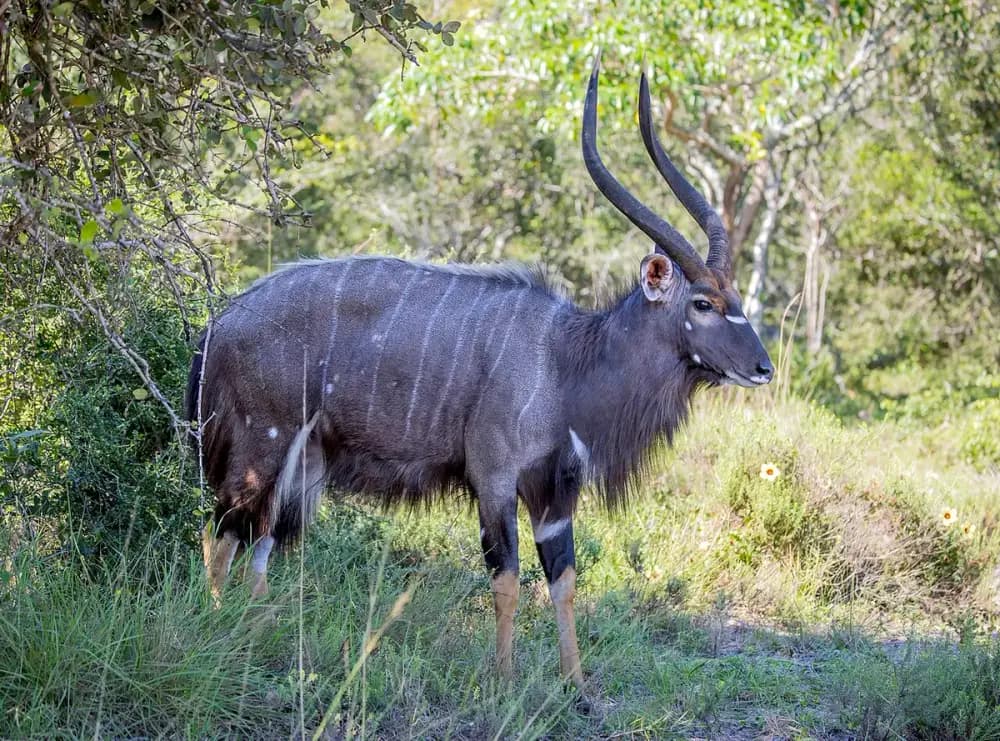
The sitatunga is said to be almost indistinguishable from the nyala except in coat and tracks. Both are spiral-horned antelopes with hornless females and males that look very different from females, but they live in very different places.
| Feature | Sitatunga | Nyala |
|---|---|---|
| Scientific name | Tragelaphus spekii | Tragelaphus angasii |
| Habitat | Swamps, marshes, papyrus and reed beds | Thickets in dense, dry savanna woodland |
| Female coat | Chestnut with faint stripes and spots | Ten or more white vertical stripes |
| Male horns | 45–92 cm (18–36 in), one or two twists | 60–83 cm (24–33 in), yellow-tipped |
| Range | Central Africa and scattered swamps beyond | Southern Africa |
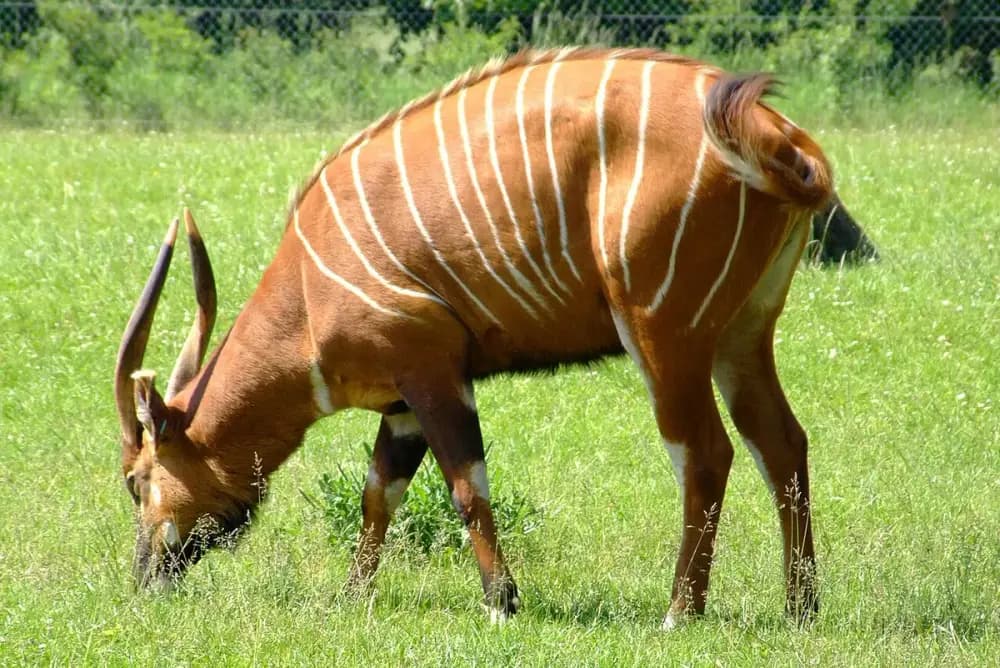
The sitatunga is also related to the bongo, a forest antelope that shares features such as hornless females and white body markings.
Conservation status
The sitatunga is listed as Least Concern on the IUCN Red List, based on a 2016 assessment, and Ghana lists it on CITES Appendix III. Numbers are falling in areas of heavy human settlement but stable elsewhere.
Habitat loss is the most serious threat. Draining of wetlands has isolated populations, long-term changes in water levels alter food plants, and large swamp areas in Zambia are burned every year. In Senegal, heavy hunting for meat and habitat damage have made it very rare, and in Gambia it is confined to a few remote swamps. Botswana still holds a large share of the population.
Counting sitatunga in dense swamps is difficult. A 1999 estimate of 170,000 animals is thought to be too high. Around 40% of that figure lives in protected areas, such as the Okavango Delta in Botswana, though only some of these sites are well managed.
Where to see sitatunga in the U.S.
6 zoos across 6 states
Find the closest one
Rank the 4 zoos holding sitatunga by how far they are from you. Your location is used in your browser to sort this list and is never sent to us.
2 more zoos hold sitatunga but have no coordinates on file yet, so they aren't ranked here. They're in the full list below.
Florida· 1
Indiana· 1
Maryland· 1
Oklahoma· 1
Tennessee· 1
Texas· 1
AZAThe Association of Zoos and Aquariums. Accredited members have passed an independent inspection of animal care and welfare, safety, conservation and education, repeated every five years. Many smaller facilities never apply, so “not accredited” isn't a verdict on its own. What accreditation means · How we check this
Built from each zoo's own published animal list.
Sitatunga: common questions
What is a sitatunga?
A swamp-dwelling, spiral-horned antelope of central Africa, related to the bongo, bushbuck, and nyala. It has long, splayed hooves for walking on soft mud.
How big is a sitatunga?
Males stand 81–116 cm (32–46 in) at the shoulder and weigh 76–119 kg (168–262 lb). Females are much smaller, at 24–57 kg (53–126 lb).
Can sitatunga swim?
Yes. They are good swimmers and can submerge almost completely, leaving only the nose and eyes above water, to hide from predators or flies.
What do sitatunga eat?
New leaves, fresh grasses, sedges, bulrushes, aquatic grasses, and browse, mostly along swamp edges.
Where do sitatunga live?
In swamps and marshes across central Africa and parts of western, eastern, and southern Africa, often in papyrus and reed beds.
Do female sitatunga have horns?
No. Only males grow the spiral horns, which reach 45–92 cm (18–36 in).
How long do sitatunga live?
In captivity they live about 22 to 23 years on average.
Are sitatunga endangered?
No. They are Least Concern, though they are declining where wetlands are lost or heavily settled.