- Where to see one
- 10 U.S. zoos in our directory hold nyala, confirmed against each zoo's own animal list.
- Native range
- Southern Malawi, Mozambique, Zimbabwe, eastern South Africa, and Eswatini
- Size
- Head-and-body length 53–77 in (135–195 cm); males stand up to 43 in (110 cm) and weigh 216–276 lb (98–125 kg), females stand up to 3.0 ft (90 cm) and weigh 121–150 lb (55–68 kg)
- Lifespan
- About 19 years
About the nyala
The nyala, also called the lowland nyala, is a spiral-horned antelope native to Southern Africa and a member of the family Bovidae, in the genus Tragelaphus. It was first described in 1849 by the English naturalist George French Angas, and its common name comes from the Tsonga word for the animal, related to the Zulu inyala. It should not be confused with the endangered mountain nyala of Ethiopia's Bale region, a distant relative despite the shared name. Genetically, the nyala line split off more than 5 million years ago, making it the second tragelaphine lineage to branch off after the lesser kudu; some taxonomists have argued it deserves its own genus, Nyala, though this has not been widely adopted. Its closest relatives include the bongo, bushbuck, common and giant eland, greater and lesser kudu, mountain nyala, and sitatunga — a group that shares hornless females, vertical white side stripes, and spiraling horns and throat "beards" in the males.
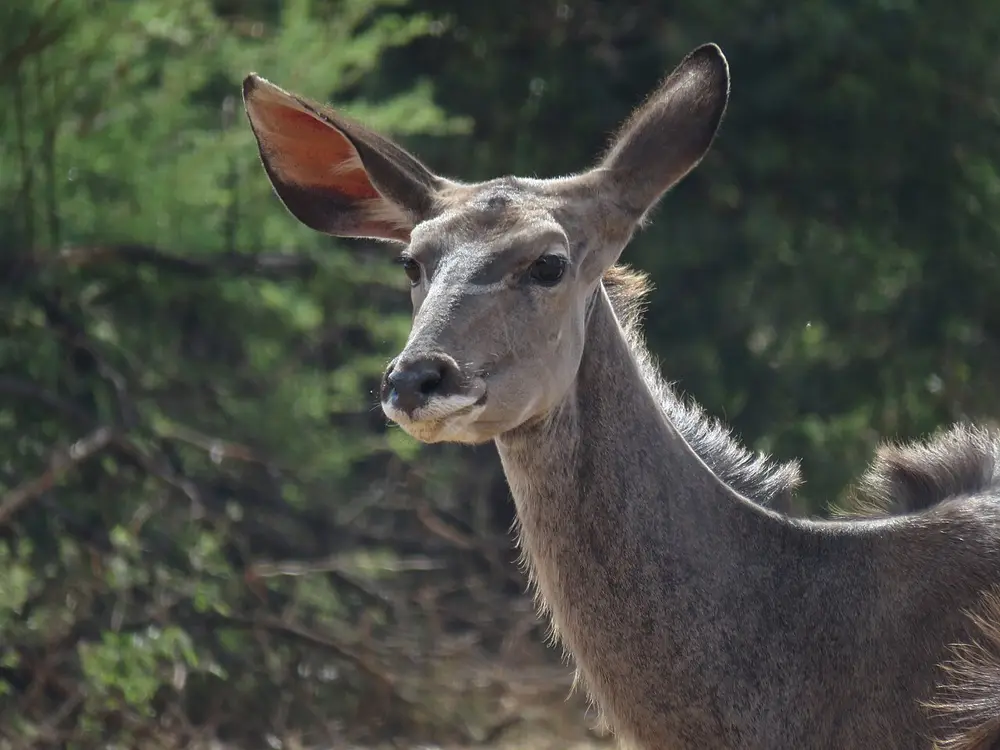
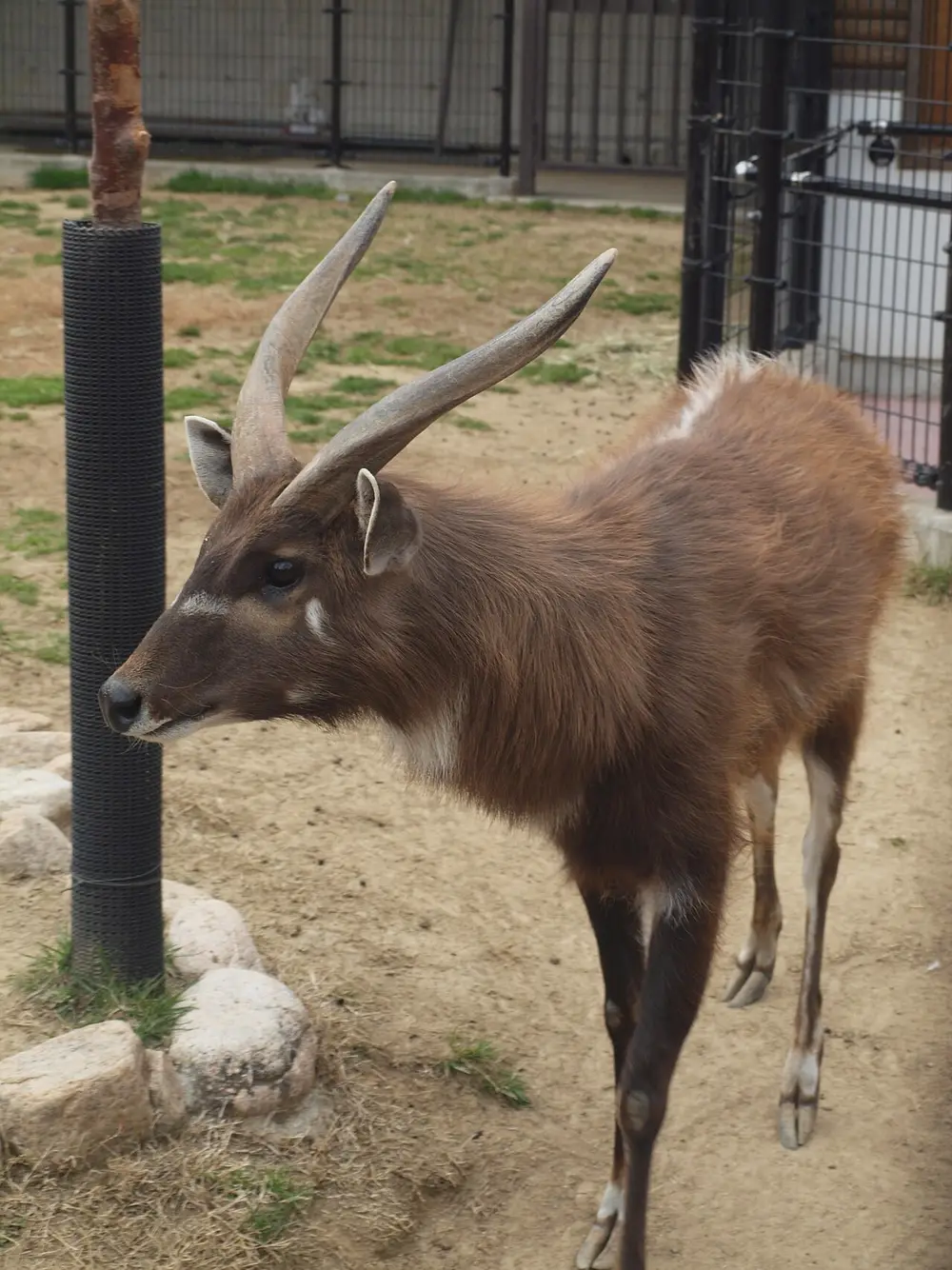
The nyala shows the most pronounced sexual dimorphism of any spiral-horned antelope. It measures 53 to 77 in (135–195 cm) in head-and-body length. Males stand up to 43 in (110 cm) at the shoulder and weigh 216 to 276 lb (98–125 kg), while females stand up to 3.0 ft (90 cm) and weigh only 121 to 150 lb (55–68 kg). Females and young have a rusty or rufous-brown coat marked with ten or more white vertical stripes on the sides, along with white markings on the face, throat, flanks, and thighs; adult males darken to brown or slate-grey, often with a bluish tinge, and their stripes fade or disappear with age. Both sexes carry a white chevron between the eyes and a bushy tail, up to 22 in (55 cm) long, with a white underside, plus a dorsal crest of hair running from the head to the tail tip; males add a fringe of hair along the chest and belly midline. Only males grow horns, which run 24 to 33 in (60–83 cm) long, yellow-tipped, with one or two twists.
Behavior and diet
Diet
Herbivore (foliage, fruits, flowers, twigs, and fresh grass)
The nyala is active mainly in the early morning and late afternoon, browsing during the day when temperatures sit between 68 and 86°F (20–30°C) and shifting to nighttime activity in the rainy season, when it rests in thick bush during the hottest hours. It is a shy, cautious animal that tends to stay hidden rather than come into the open, and prefers water holes over open spaces — most sightings in the wild happen there; in protected areas, though, nyala grow less wary and often come into view of tourists. Nyala live in single-sex or mixed groups of two to ten animals that often break up and re-form, though in one Mozambique study some herds swelled to as many as 30; old males typically live alone, and females tend to keep closer bonds with their mothers than males do with each other. The species is not territorial, and individual home ranges overlap freely. When alarmed, especially females, nyala give a sharp, dog-like bark, and they also respond to the alarm calls of impala, baboon, and kudu — species that, in turn, respond to nyala alarm calls as well. Known predators include lions, leopards, cheetahs, servals, spotted hyenas, African wild dogs, southern African rock pythons, and Nile crocodiles, while juveniles are additionally at risk from chacma baboons and birds of prey such as tawny eagles, crowned eagles, and bateleurs.
As a herbivore, the nyala feeds on foliage, fruits, flowers, and twigs, switching to fresh grass in the rainy season, and it needs regular access to water even though it can tolerate areas where water is only seasonally available. Feeding in the diet studies reviewed here peaks in the early morning and late afternoon, moving to nighttime in the rainy season. Breeding occurs year-round but peaks in spring and autumn. Females reach sexual maturity at 11 to 12 months and males at 18 months, though males remain socially immature until about five years old. A female's estrous cycle runs about 19 days, during which males attempt to mate over a two-day window, but she accepts mating for only about six hours of that cycle; courting males raise their white dorsal crest, lower their horns, and move stiffly toward a female's herd, and rival males fight for dominance. Gestation lasts seven months, and a single calf is born weighing 11 lb (5 kg), typically hidden away from predators in a thicket; it remains concealed for up to 18 days while the mother nurses it at intervals, and stays with her until her next calf is born, at which point rutting males drive it away.
Range and habitat
Habitat
Dense lowland woodland and thickets, including lush riverine country
The nyala's natural range runs across southeastern Africa, from the Lower Shire Valley in Malawi through Mozambique and Zimbabwe to eastern South Africa and Eswatini. It favors dense lowland woodland and thickets, seeking out areas with good grassland and reliable fresh water, including lush riverine country. Genetic studies across South Africa, Mozambique, Malawi, and Zimbabwe have found distinct differences in gene frequencies and mitochondrial DNA haplotypes between populations in different parts of this range, suggesting the species' geographic variation may be tied to its distribution history.
Conservation status
The nyala is listed as Least Concern (LC) by the IUCN, reflecting a relatively stable population. The main threats named are illegal poaching and habitat loss driven by human settlement and livestock grazing, though the species' large-horned males are also highly sought after by sport hunters. Nyala are susceptible to a range of parasites, including multiple nematode, tick, and blood-parasite species documented in game-reserve studies, and to diseases such as myopathy, which caused 21 deaths in one study population between 1973 and 1981, and historically to rinderpest, a viral disease now considered eradicated.
Where to see nyala in the U.S.
10 zoos across 8 states
Find the closest one
Rank the 9 zoos holding nyala by how far they are from you. Your location is used in your browser to sort this list and is never sent to us.
1 more zoo holds nyala but has no coordinates on file yet, so it isn't ranked here. It's in the full list below.
Arizona· 1
Florida· 1
Idaho· 1
Louisiana· 2
Massachusetts· 2
Minnesota· 1
New York· 1
Tennessee· 1
AZAThe Association of Zoos and Aquariums. Accredited members have passed an independent inspection of animal care and welfare, safety, conservation and education, repeated every five years. Many smaller facilities never apply, so “not accredited” isn't a verdict on its own. What accreditation means · How we check this
Built from each zoo's own published animal list.
Nyala: common questions
Is the nyala endangered?
No, it is listed as Least Concern, with a relatively stable population, though it faces pressure from poaching, habitat loss, and sport hunting.
How big does a nyala get?
Males weigh 216 to 276 lb (98–125 kg) and stand up to 43 in (110 cm) at the shoulder; females are considerably smaller, at 121 to 150 lb (55–68 kg) and up to 3.0 ft (90 cm) tall.
What does a nyala eat?
It is a herbivore that browses on foliage, fruits, flowers, and twigs, switching to fresh grass during the rainy season.
How long do nyalas live?
Life expectancy is about 19 years.
Where do nyalas live in the wild?
Their native range covers southern Malawi, Mozambique, Zimbabwe, eastern South Africa, and Eswatini, in dense lowland woodland and thickets.
Which U.S. zoos have nyalas?
7 zoos in our directory list the nyala, including the Phoenix Zoo, the Bronx Zoo, and Safari West.