- Where to see one
- 12 U.S. zoos in our directory hold peregrine falcon, confirmed against each zoo's own animal list.
- Native range
- Nearly worldwide, from Arctic tundra to the tropics, absent mainly from extreme polar regions, very high mountains, most tropical rainforests, and New Zealand
- Size
- Body length 34–58 cm (13–23 in), wingspan 74–120 cm (29–47 in); males 330–1,000 g (12–35 oz), females 700–1,500 g (25–53 oz)
About the peregrine falcon
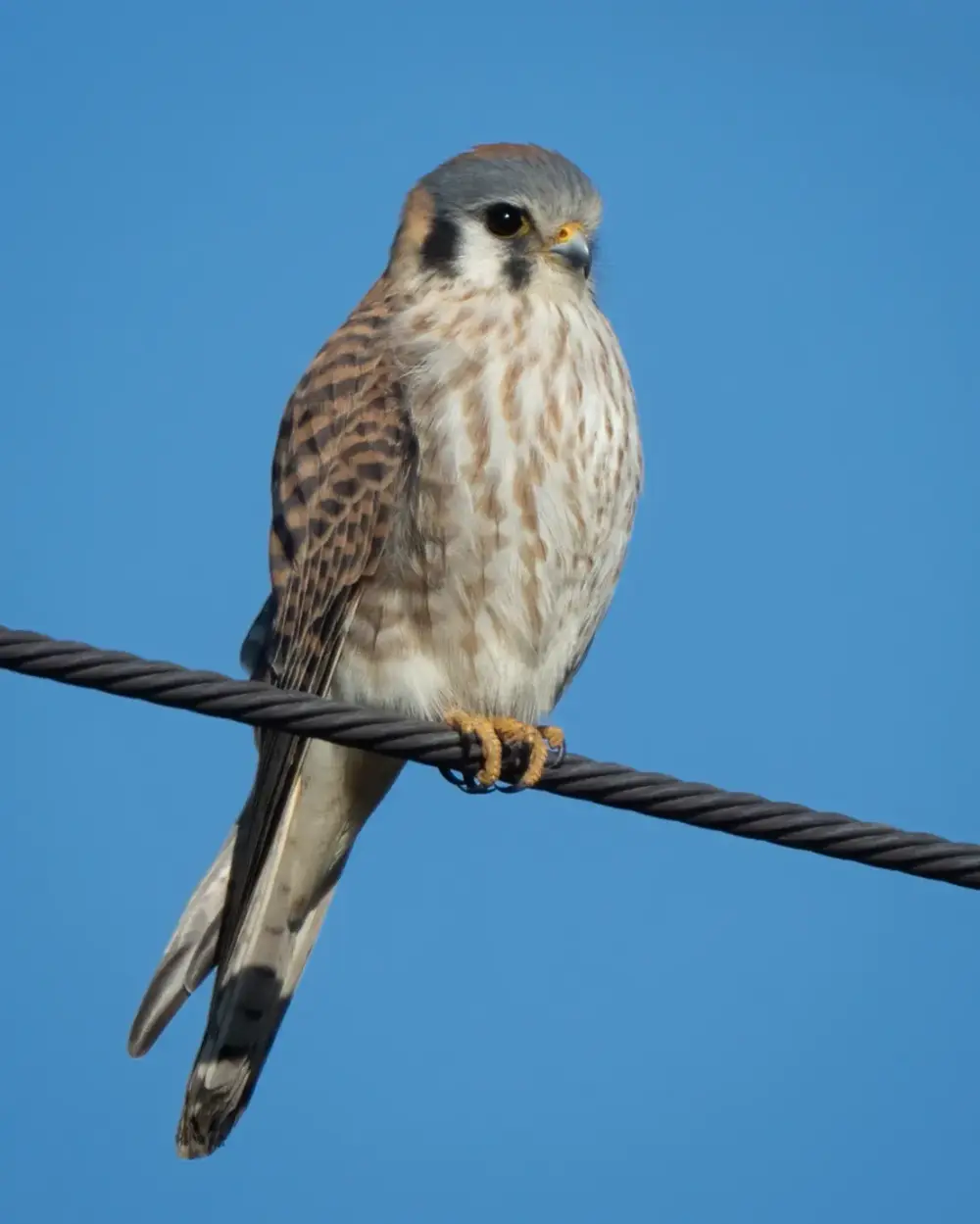
The peregrine falcon is a crow-sized bird of prey best known for its speed, with a blue-grey back, black head, and white underparts barred in dark brown or black. It's sexually dimorphic in the way typical of bird-eating raptors: females run considerably larger than males, sometimes weighing about 50% more than their breeding partners. A body length of 34 to 58 cm (13 to 23 in) and a wingspan of 74 to 120 cm (29 to 47 in) put it solidly in the middle of the falcon family, but its wing chord (26.5 to 39 cm / 10.4 to 15.4 in) and build are shaped for speed rather than bulk. Males weigh 330 to 1,000 g (12 to 35 oz); females weigh 700 to 1,500 g (25 to 53 oz).
Up close, the back and long, pointed wings are bluish-black to slate grey with faint darker barring, the wingtips black, and the tail long, narrow, and rounded with a black tip and white terminal band. A black "moustache," known as the malar stripe, runs down each cheek against pale neck sides and a white throat — a 2021 study found the stripe is larger in sunnier regions, apparently to cut glare and improve the bird's vision. The upper beak carries a small notch near the tip, an adaptation that lets the falcon kill prey by severing the spinal column at the neck. Eighteen to nineteen regional subspecies are recognized, varying somewhat in size and coloring, including the North American "duck hawk" (F. p. anatum) and the very large, dark F. p. pealei of the Pacific Northwest coast.
The peregrine is described as the world's most widespread raptor and among the most widely distributed wild bird species overall — found on every ice-free continent and region except extreme polar zones, very high mountains, most tropical rainforests, and New Zealand. Both its English and scientific names mean "wandering falcon," a nod to the long-distance migrations of its northern populations.
That range has produced a lot of regional variation. Eighteen subspecies are accepted by the IOC World Bird List, nineteen by the Handbook of the Birds of the World, and they differ noticeably in size and color. F. p. anatum, the American peregrine falcon or "duck hawk," is mainly found in the Rocky Mountains and was formerly common across North America. F. p. calidus breeds in the Eurasian Arctic tundra and migrates as far as South Asia and sub-Saharan Africa in winter. F. p. pealei, found along the Pacific Northwest coast from Puget Sound through the Aleutians, is the largest subspecies, with a notably wide bill; females weigh 1,000 to 1,500 g (2.2 to 3.3 lb). F. p. minor, distributed through sub-Saharan Africa, is the smallest, with some males weighing as little as roughly 300 g (11 oz). F. p. madens, confined to the Cape Verde Islands, survives as only six to eight breeding pairs and is itself endangered even though the species overall is not.
Behavior and diet
Diet
Almost exclusively medium-sized birds, occasionally small mammals, small reptiles, or insects
Peregrine falcons hunt almost exclusively medium-sized birds, occasionally taking small mammals, small reptiles, or even insects. Feral and domestic pigeons — themselves descended from the rock dove and spread worldwide by human introduction — make up a major share of the diet, especially in cities, where their abundance has helped peregrines become a highly successful example of urban wildlife. In built-up areas, the falcons take advantage of tall buildings as substitute cliffs for nesting and hunt the pigeons and ducks that concentrate around human development.
Peregrines reach sexual maturity at one year and mate for life. They nest in a scrape — a shallow depression rather than a built nest — typically on a cliff edge, though tall human-made structures increasingly serve the same purpose. Genetically, the species sits in a lineage with the hierofalcons and the prairie falcon, one that likely diverged from other falcons roughly 3 to 8 million years ago, probably somewhere in western Eurasia or Africa given that the group spans both the Old World and North America.
Range and habitat
Habitat
Cliff edges historically; increasingly tall human-made structures, including in cities
The peregrine falcon's breeding range runs from Arctic tundra down to the tropics, and it can be found nearly everywhere on Earth outside extreme polar regions, very high mountains, and most tropical rainforests. The one major ice-free landmass it's entirely absent from is New Zealand — making it, as described, the world's most widespread raptor, and among wild bird species generally, second in geographic spread only to feral and domestic pigeons, which owe their range to human introduction.
Historically, the species nested on cliff edges. It has since adapted widely to human landscapes, nesting on tall buildings and other structures, particularly in cities where feral pigeon populations provide a steady supply of prey. Northern populations, true to both the English and scientific names, are strongly migratory, traveling long distances between breeding grounds and wintering range.
Conservation status
The peregrine falcon is listed as Least Concern on the IUCN Red List today, but that wasn't always the case. The species became endangered across many areas because of widespread pesticide use, especially DDT, which caused population collapses through the mid-20th century — including regional extinction in eastern North America. Since DDT was banned in the early 1970s, populations have recovered substantially, aided by large-scale protection of nesting sites and reintroduction programs; populations in eastern North America today are the descendants of birds reintroduced from elsewhere. The peregrine is also widely used in falconry, valued for its hunting ability, trainability, and availability through captive breeding.
Where to see peregrine falcon in the U.S.
12 zoos across 9 states
Find the closest one
Rank the 11 zoos holding peregrine falcon by how far they are from you. Your location is used in your browser to sort this list and is never sent to us.
1 more zoo holds peregrine falcon but has no coordinates on file yet, so it isn't ranked here. It's in the full list below.
Alabama· 1
California· 1
Idaho· 1
Kentucky· 1
Massachusetts· 2
Minnesota· 1
Oregon· 2
Pennsylvania· 2
Wisconsin· 1
AZAThe Association of Zoos and Aquariums. Accredited members have passed an independent inspection of animal care and welfare, safety, conservation and education, repeated every five years. Many smaller facilities never apply, so “not accredited” isn't a verdict on its own. What accreditation means · How we check this
Built from each zoo's own published animal list.
Peregrine Falcon: common questions
Is the peregrine falcon endangered?
No, not any longer. It's listed as Least Concern today, having recovered from population collapses caused by DDT and other pesticides before the DDT ban in the early 1970s.
How big does a peregrine falcon get?
Body length runs 34 to 58 cm (13 to 23 in) with a wingspan of 74 to 120 cm (29 to 47 in). Females are notably larger than males, weighing 700 to 1,500 g (25 to 53 oz) against a male's 330 to 1,000 g (12 to 35 oz).
What does a peregrine falcon eat?
Almost exclusively medium-sized birds, especially pigeons and ducks, with occasional small mammals, small reptiles, or insects.
Where do peregrine falcons live in the wild?
Nearly everywhere on Earth except extreme polar regions, very high mountains, most tropical rainforests, and New Zealand — making it the world's most widespread raptor.
Why did peregrine falcon populations decline?
Widespread use of pesticides, especially DDT, caused sharp declines through the mid-20th century; the species has recovered since the DDT ban and through reintroduction programs.
Which U.S. zoos have peregrine falcons?
Five zoos in our directory list them: Los Angeles Zoo, Franklin Park Zoo, Stone Zoo, Lehigh Valley Zoo, and ZooAmerica.