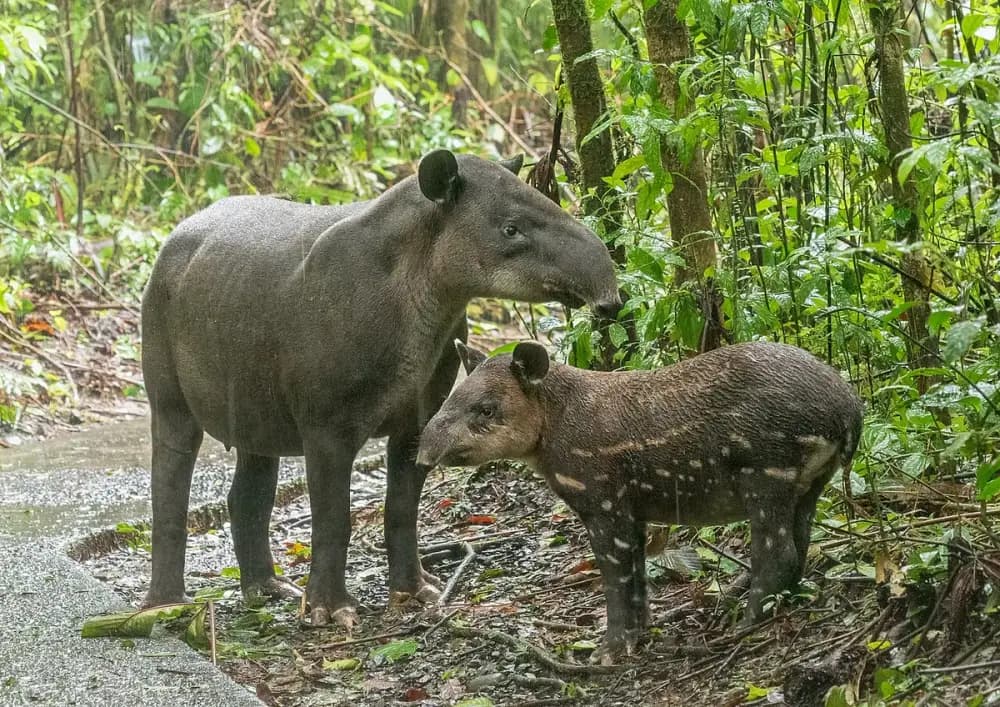
- Where to see one
- 8 U.S. zoos in our directory hold malayan tapir, confirmed against each zoo's own animal list.
- Native range
- Malay Peninsula, Sumatra, Myanmar, Thailand
- Size
- 1.8–2.5 m (5 ft 11 in–8 ft 2 in) long, 90–110 cm (2 ft 11 in–3 ft 7 in) tall at the shoulder, typically 250–320 kg (550–710 lb)
- Lifespan
- Up to 30 years, in the wild or in captivity
About the Malayan tapir
The Malayan tapir is the only living tapir species found outside the Americas, and it is also the largest of the four living tapir species. Also called the Asian tapir, Asiatic tapir, or piebald tapir, it has four toes on each front foot and three on each back foot. Genetic studies show it split off from the tapirs of the Americas roughly 25 million years ago, making it the earliest branch in the tapir family tree.
The animal's markings are its most distinctive feature: black hair covers the head, shoulders, and legs, while a broad band of white covers the midsection and rear, with white edging around the ears as well. Rather than making the tapir conspicuous, this two-tone pattern breaks up its outline in the dappled light of the forest floor, so that a resting tapir can be mistaken for a large rock rather than a living animal. Two melanistic, all-black Malayan tapirs have also been documented in the wild, one in Malaysia's Jerangau Forest Reserve in 2000 and another in Pahang state in 2016.
Like all tapirs, the Malayan tapir has a short, flexible, trunk-like snout formed from an elongated upper lip and nose. The skull behind it is heavily modified to support this proboscis, with a large sagittal crest and a retracted nasal opening. The tapir's eyesight is poor — its corneas often develop a bluish haze thought to come from repeated light exposure — so it relies mainly on smell and hearing to find food and detect danger. In the wild, the species ranges across the lowland forests of Peninsular Malaysia, Sumatra, Myanmar, and Thailand; historical records place it as far north as China in the past, and it survived on Borneo until it vanished from the record there roughly 8,000 years ago.
Behavior and diet
Diet
Herbivore — shoots and leaves of more than 115 plant species
Malayan tapirs are solitary animals that hold large home ranges, marking their territory by spraying urine on plants and wearing distinct paths through the undergrowth as they move. They are most active at night but also feed around dawn and dusk, napping through the middle hours — a pattern that makes them crepuscular rather than strictly nocturnal. They communicate with high-pitched squeaks and whistles, and they favor areas near water, where they bathe, swim, and can also climb surprisingly steep slopes.
The species is exclusively herbivorous, foraging for tender shoots and leaves from more than 115 plant species, of which around 30 are particular favorites. A tapir moves slowly through the forest, pausing often to eat and to check the scent marks left by other tapirs in the area. Despite its bulk, it can run quickly when startled, and if cornered it will defend itself with a powerful bite — a captive female's bite once severed a zookeeper's arm, apparently because he had come between her and her calf.
Females carry a single calf for about 390 to 395 days, an unusually long gestation, and give birth to a calf weighing around 6.8 kg (15 lb) — the largest newborn of any tapir species. Calves are born with a coat of brown hair marked with white stripes and spots that camouflages them in the dappled forest light; this pattern fades into the adult black-and-white coloring between four and seven months of age. Weaning happens between six and eight months, and tapirs reach sexual maturity around age three. Breeding typically occurs in April, May, or June, and females generally produce one calf every two years.
Range and habitat
Habitat
Primary and secondary lowland tropical forest
The Malayan tapir's current range runs from the Malay Peninsula south to Sumatra in Indonesia, and north through Myanmar and Thailand. It lives in primary and secondary lowland tropical forest, staying close to water sources where possible. Historical and fossil evidence indicates a much wider distribution: tapirs once ranged as far north as China, and remains from the Pleistocene have turned up in Java alongside grassland-adapted herbivores, suggesting the species originally evolved in more open country before retreating into closed forest. It also survived on Borneo until around 8,000 years ago, and some 19th-century accounts — likely drawn from local reports — describe it there as a living species; reintroducing tapirs to Borneo has been proposed as a conservation measure.
Conservation status
The Malayan tapir has been listed as Endangered on the IUCN Red List since 2008, with the population estimated at fewer than 2,500 mature individuals. The principal threat is loss and fragmentation of habitat, driven largely by deforestation for oil palm plantations across Thailand and Malaysia. In Peninsular Malaysia, habitat fragmentation displaced 142 tapirs between 2006 and 2010; some were captured and relocated to safer areas, while 15 were killed in vehicle collisions. Because of its size, the species has few natural predators, and even reports of tigers killing tapirs are scarce — the main danger it faces comes from habitat loss rather than predation.
Where to see malayan tapir in the U.S.
8 zoos across 8 states
Find the closest one
Rank the 8 zoos holding malayan tapir by how far they are from you. Your location is used in your browser to sort this list and is never sent to us.
California· 1
Colorado· 1
Florida· 1
Kentucky· 1
Minnesota· 1
South Carolina· 1
Texas· 1
Virginia· 1
AZAThe Association of Zoos and Aquariums. Accredited members have passed an independent inspection of animal care and welfare, safety, conservation and education, repeated every five years. Many smaller facilities never apply, so “not accredited” isn't a verdict on its own. What accreditation means · How we check this
Built from each zoo's own published animal list.
Malayan Tapir: common questions
Is the Malayan tapir endangered?
Yes. It has been listed as Endangered on the IUCN Red List since 2008, with an estimated population of fewer than 2,500 mature individuals in the wild.
How big does a Malayan tapir get?
It grows to between 1.8 and 2.5 m (5 ft 11 in–8 ft 2 in) long and stands 90 to 110 cm (2 ft 11 in–3 ft 7 in) tall, typically weighing 250 to 320 kg (550–710 lb), with some adults reaching 540 kg (1,190 lb).
What does a Malayan tapir eat?
It is a herbivore that forages on the tender shoots and leaves of more than 115 plant species, with around 30 species making up the bulk of its diet.
How long do Malayan tapirs live?
Up to 30 years, both in the wild and in captivity.
Where do Malayan tapirs live in the wild?
In the lowland tropical forests of the Malay Peninsula, Sumatra, Myanmar, and Thailand.
Which U.S. zoos have Malayan tapirs?
Five zoos in our directory list the Malayan tapir, including Denver Zoo, Minnesota Zoo, and Riverbanks Zoo.