- Where to see one
- 7 U.S. zoos in our directory hold red-billed hornbill, confirmed against each zoo's own animal list.
- Native range
- Southern Mauritania east through Somalia and south to northeastern Tanzania
- Size
- About 42 cm (17 in) long (red-billed hornbill group)
- Clutch size
- Three to six white eggs (red-billed hornbill group)
- Bill
- Long, curved and red, with no casque
Conservation status
Least Concernassessed 2016
IUCN Red List category LC — step 1 of 7.
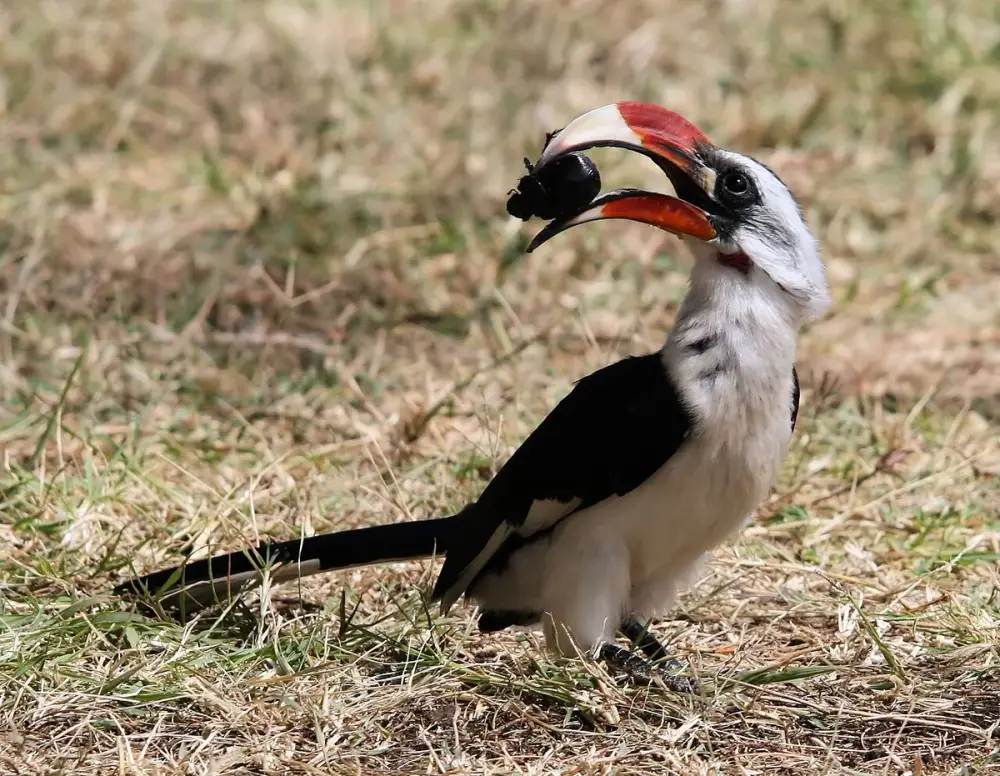
Red-billed hornbills are found in the savannas and woodlands of sub-Saharan Africa; Tockus erythrorhynchus is the northern red-billed hornbill. They have mainly whitish underparts and head, grey upperparts, a long tail and a long, curved red bill that lacks a casque. At about 42 centimetres (17 in) long they are among the smaller hornbills. They are omnivorous, taking insects, fruit, seeds and even small rodents, feed mainly on the ground, and form flocks outside the breeding season. The female nests in a tree hole and walls herself in with a plaster of mud, droppings and fruit pulp.
About the red-billed hornbill
The red-billed hornbill, in the narrow sense now called the northern red-billed hornbill, is an African bird in the hornbill family, Bucerotidae. It is found from southern Mauritania through Somalia to northeastern Tanzania. Like the other red-billed hornbills of sub-Saharan savanna and woodland, it has a long, curved red bill, whitish head and underparts, and a grey back.
Its scientific name is Tockus erythrorhynchus. For a long time, all red-billed hornbills were treated as a single species. Most authorities now split them into five: the northern, western, Tanzanian, southern and Damara red-billed hornbills. Some still treat the other four as subspecies of Tockus erythrorhynchus. The northern bird is also the type species of the genus Tockus, a name taken from a word local people in Senegal used for a hornbill.
Red-billed hornbills are about 42 cm (17 in) long. That sounds large, but the group is considered one of the smaller hornbills. They have mainly whitish underparts and heads, grey upperparts and long tails. Like other Tockus hornbills, the tail feathers are black on the outside and white on the inside. The bill is long, curved and red, and unlike many hornbills it has no casque, the hollow ridge that sits on top of the bill in other species.
Males and females look alike, but the female has a smaller bill. In the related southern red-billed hornbill, males also have somewhat longer bills with a variable amount of black on the lower half.
Some features are shared by every hornbill. They are the only birds in which the first two neck vertebrae are fused, which probably gives a steadier base for carrying the heavy bill. They also have binocular vision in which the bill tip intrudes into the field of view, so a hornbill can see the tip of its own bill while handling food. Long eyelashes shade the eyes from the sun.
Behavior and diet
Diet
Omnivorous; red-billed hornbills eat insects, fruit, seeds and even small rodents
Red-billed hornbills are omnivorous. They eat insects, fruit and seeds, and they will even take small rodents. Most feeding happens on the ground. Outside the breeding season they gather in flocks. Like all hornbills, they cannot swallow food caught at the bill tip because the tongue is too short, so they toss it back into the throat with a jerk of the head.
Hornbills in general are diurnal and travel in pairs or small family groups. Across the family, the more carnivorous species are found in open country, while fruit specialists are generally forest birds. Some African hornbills have a partnership with dwarf mongooses: they forage together and warn each other of birds of prey and other predators.
Red-billed hornbills raise their wings in display, with one exception: the southern red-billed hornbill does not.
Breeding is where red-billed hornbills become remarkable. The nest is a tree hole, prepared by both parents. Once the female is inside, the entrance is walled off with a plaster of mud, droppings and fruit pulp until only a narrow slit remains. That slit is just wide enough for the male to pass food to the female and, later, to the chicks.
The female lays three to six white eggs and stays sealed in with them. In hornbills generally, the sealing takes a few hours to a few days, and the female goes through a complete, simultaneous moult while she incubates. Across the hornbill family, the wall apparently protects the nest site from rival hornbills. In red-billed hornbills it also keeps intruders and predators away from the young.
The female remains inside for a time after the eggs hatch. When she and the chicks no longer fit, she breaks out and rebuilds the wall, leaving the chicks inside for continued protection. Both parents then feed the young through the opening.
Range and habitat
Habitat
Savanna and woodland (red-billed hornbill group)
The red-billed hornbill group is found in the savannas and woodlands of sub-Saharan Africa. The northern red-billed hornbill itself ranges from southern Mauritania east to Somalia and south to northeastern Tanzania. Other members of the group take over in western, central-Tanzanian and southern Africa.
Tockus hornbills as a whole live in tropical and subtropical African grassland, forest and savanna. Of the 24 hornbill species found in Africa, 13 live in open woodland and savanna, and some survive in very dry places.
Red-billed hornbill vs other red-billed hornbills
Because the five red-billed hornbills were once treated as one species, the name "red-billed hornbill" can refer to any of them. Their ranges differ:
| Species | Scientific name | Range |
|---|---|---|
| Northern red-billed hornbill | Tockus erythrorhynchus | Southern Mauritania through Somalia to northeastern Tanzania |
| Western red-billed hornbill | Tockus kempi | Senegal and Gambia to southern Mauritania and western Mali |
| Tanzanian red-billed hornbill | Tockus ruahae | Central Tanzania |
| Southern red-billed hornbill | Tockus rufirostris | Malawi and Zambia to southern Angola and northern South Africa |
| Damara red-billed hornbill | Tockus damarensis | Southwestern Angola, northern Namibia and western Botswana |
The southern species can be told from the others by its yellow eye, pale pink-to-greyish skin around the eye, and heavy blackish streaking from the ear to the side of the neck. The southern and Damara forms meet and hybridize in a contact zone.
Von der Decken's hornbill, Tockus deckeni, is another member of the same genus, found from Ethiopia and Somalia to central Tanzania.
Conservation status
The northern red-billed hornbill is listed as Least Concern on the IUCN Red List (BirdLife International, 2016).
This fits the wider picture for the family. None of Africa's hornbill species are seriously threatened, while many Asian hornbills, especially island species, are at risk from hunting and loss of primary forest. For more on the family, see the hornbill overview.
Where to see red-billed hornbill in the U.S.
7 zoos across 7 states
Find the closest one
Rank the 7 zoos holding red-billed hornbill by how far they are from you. Your location is used in your browser to sort this list and is never sent to us.
California· 1
Georgia· 1
Illinois· 1
Indiana· 1
Missouri· 1
Oregon· 1
Tennessee· 1
AZAThe Association of Zoos and Aquariums. Accredited members have passed an independent inspection of animal care and welfare, safety, conservation and education, repeated every five years. Many smaller facilities never apply, so “not accredited” isn't a verdict on its own. What accreditation means · How we check this
Built from each zoo's own published animal list.
Red-billed Hornbill: common questions
What is a red-billed hornbill?
An African hornbill with a long, curved red bill, whitish head and belly, and grey back. In the narrow sense the name means the northern red-billed hornbill, one of five red-billed species that were once treated as one.
How big is a red-billed hornbill?
About 42 cm (17 in) long, the figure given for the red-billed hornbill group. The group is considered one of the smaller hornbills, and females have smaller bills than males.
What do red-billed hornbills eat?
Red-billed hornbills eat insects, fruit, seeds and even small rodents. They feed mostly on the ground.
Why does the female seal herself in the nest?
The mud-and-droppings wall protects the nest and the chicks. The male feeds her through a narrow slit until she breaks out.
Do red-billed hornbills have a casque?
No. Their long red bill lacks the casque found on many other hornbills.
Where do red-billed hornbills live?
In savanna and woodland across sub-Saharan Africa. The northern species ranges from southern Mauritania to Somalia and northeastern Tanzania.
Are hornbills related to toucans?
No. Toucans fill a similar niche in the Americas, an example of convergent evolution, but hornbills are allied with the hoopoes and wood-hoopoes, while toucans are related to barbets.
Are red-billed hornbills endangered?
No. The northern red-billed hornbill is rated Least Concern, and no African hornbill species is seriously threatened.