- Where to see one
- 11 U.S. zoos in our directory hold von der decken's hornbill, confirmed against each zoo's own animal list.
- Native range
- East Africa, especially east of the East African Rift, from Ethiopia south to Tanzania
- Size
- A small hornbill with a long tail and a long, curved bill
Conservation status
Least Concernassessed 2016
IUCN Red List category LC — step 1 of 7.
About the Von der Decken's hornbill
Von der Decken's hornbill is a hornbill native to East Africa, found mainly east of the East African Rift in a band running from Ethiopia south to Tanzania. It takes its name from the German explorer Baron Karl Klaus von der Decken, who lived from 1833 to 1865. Jackson's hornbill is often treated as a subspecies of this bird rather than a species in its own right.
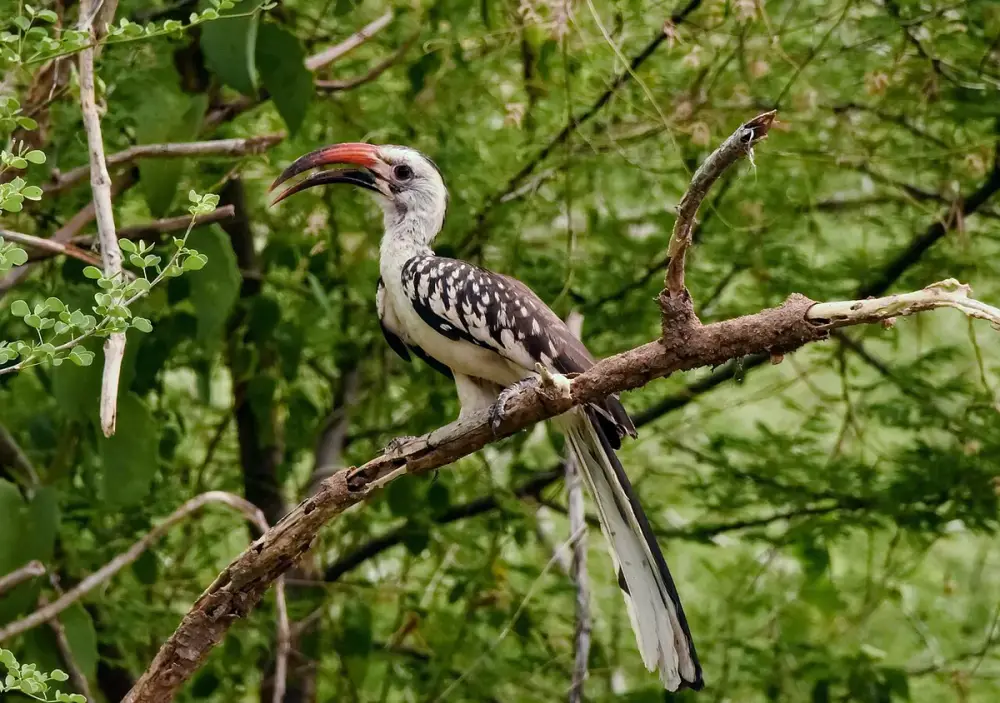
It is a small hornbill with blackish upperparts and mostly whitish underparts and head, a long tail, and a long, curved bill that lacks a casque. It closely resembles the red-billed hornbill, and the two are best told apart by bill color and by the fact that Von der Decken's hornbill lacks spotting on the wing coverts in both sexes.
The species shows clear sexual dimorphism in bill color: females have an all-black bill, while males have a red bill with a cream tip and a black cutting edge, making the sexes easy to tell apart at a glance.
Behavior and diet
Diet
Omnivorous — insects, fruit, and seeds
Von der Decken's hornbill is omnivorous, feeding on insects, fruit, and seeds, and it does most of its foraging on the ground. Outside the breeding season, birds will gather into flocks rather than staying in pairs.
The female lays two or three white eggs inside a tree hole, which is then sealed with a cement of mud, droppings, and fruit pulp, leaving only a narrow slit just wide enough for the male to pass food through to the sealed-in female and chicks. Once the growing chicks and the female become too large for the nest cavity, she breaks out and the pair rebuilds the wall; from that point, both parents feed the chicks. In captivity, breeding can be encouraged with a small barrel or hollow log fitted with an entrance hole about 5 in (13 cm) tall and 3 in (7.6 cm) wide — the birds will seal the hole themselves once the female is ready to nest. Captive diets typically include papaya, cantaloupe, blueberries, bananas, and apples, supplemented daily with live food such as crickets and mealworms; small rodents are also taken but are usually offered only two or three times a week.
Range and habitat
Habitat
Thorn scrub and other arid habitats
Von der Decken's hornbill occupies East Africa, concentrated mainly to the east of the East African Rift, with a range extending from Ethiopia in the north down to Tanzania in the south. It is a bird of thorn scrub and similar dry, arid habitats rather than forest.
Conservation status
Von der Decken's hornbill is rated Least Concern on the IUCN Red List, in a 2016 assessment by BirdLife International, and no specific population threats are noted for it.
Where to see von der decken's hornbill in the U.S.
11 zoos across 11 states
Find the closest one
Rank the 11 zoos holding von der decken's hornbill by how far they are from you. Your location is used in your browser to sort this list and is never sent to us.
California· 1
Colorado· 1
Kentucky· 1
Maryland· 1
Mississippi· 1
New Mexico· 1
New York· 1
Oklahoma· 1
South Dakota· 1
Tennessee· 1
Virginia· 1
AZAThe Association of Zoos and Aquariums. Accredited members have passed an independent inspection of animal care and welfare, safety, conservation and education, repeated every five years. Many smaller facilities never apply, so “not accredited” isn't a verdict on its own. What accreditation means · How we check this
Built from each zoo's own published animal list.
Von der Decken's Hornbill: common questions
Is the Von der Decken's hornbill endangered?
No. It is rated Least Concern on the IUCN Red List (2016).
What does a Von der Decken's hornbill eat?
Insects, fruit, and seeds in the wild; zoos and breeders commonly offer papaya, cantaloupe, blueberries, bananas, apples, crickets, and mealworms.
Where do Von der Decken's hornbills live in the wild?
In thorn scrub and other arid habitat in East Africa, mainly east of the East African Rift, from Ethiopia south to Tanzania.
How does a Von der Decken's hornbill nest?
The female seals herself into a tree-hole nest with a wall of mud, droppings, and fruit pulp, leaving only a narrow gap for the male to pass in food, until she breaks out once the chicks have grown too large for the space.
Which U.S. zoos have Von der Decken's hornbills?
Six U.S. zoos list them, including Cheyenne Mountain Zoo in Colorado, the ABQ BioPark Zoo in New Mexico, and the Virginia Zoological Park.