- Where to see one
- 6 U.S. zoos in our directory hold trumpeter hornbill, confirmed against each zoo's own animal list.
- Native range
- Eastern and southern Africa, from Kenya and Burundi south to eastern South Africa
- Size
- 58–65 cm (23–26 in) long; 0.45–1 kg (1–2.2 lb)
- Lifespan
- Up to 20 years in captivity
- Clutch
- Four to five white eggs
- Group size
- Usually two to five, sometimes up to 50
Conservation status
Least Concernassessed 2018
IUCN Red List category LC — step 1 of 7.
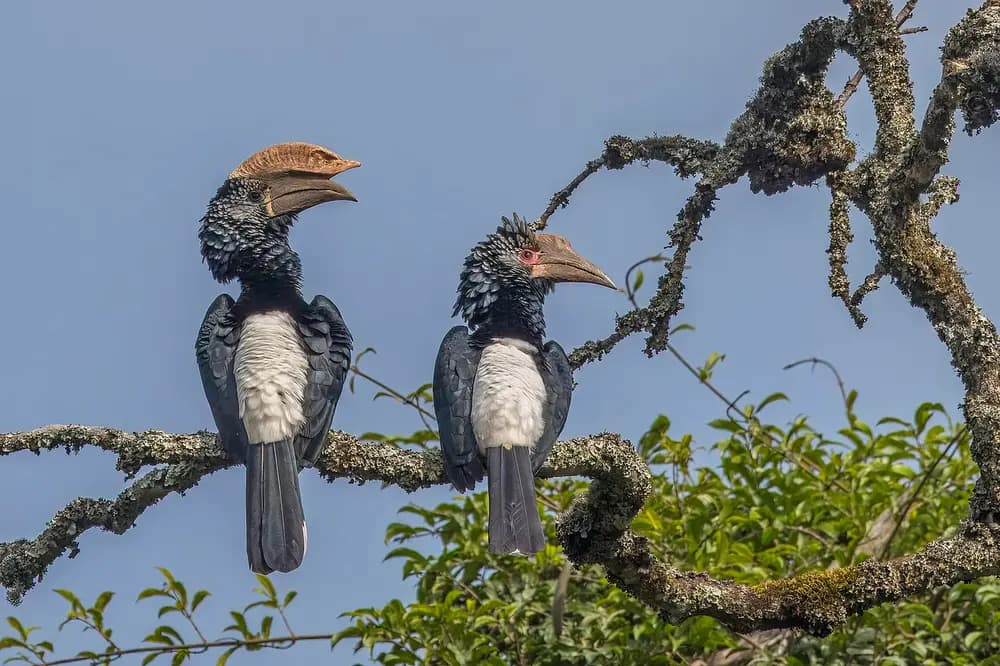
The trumpeter hornbill is a medium-sized hornbill, 58-65 cm long, with a large grey casque on the bill that is smaller in females. It has an all-black back, a white belly, white underwing coverts and red facial skin. It is a locally common resident of tropical evergreen forests in countries including Burundi, Mozambique, Botswana, Congo, Kenya, the Caprivi strip of Namibia and eastern South Africa, where it feeds on fruits and large insects. A gregarious bird, it usually lives in groups of two to five. As in other hornbills, the female incubates four to five white eggs while sealed inside the nest compartment.
About the trumpeter hornbill
The trumpeter hornbill is a medium-sized black-and-white hornbill that lives in the evergreen forests of eastern and southern Africa. It belongs to Bycanistes, a genus of mainly fruit-eating African hornbills, and to the hornbill family Bucerotidae, which also includes the ground hornbills and the Asian rhinoceros hornbill.
Adults measure 58–65 cm (23–26 in) from bill tip to tail and weigh between 0.45 and 1 kg (about 1 to 2.2 lb). The most obvious feature is the big gray casque, a hollow, horn-like structure that runs along the top of the bill. Males and females share the same plumage, but the female's casque is smaller. Across the hornbill family the casque varies a great deal. In some species it is barely noticeable and seems only to strengthen the bill, while in others it is large, braced with bone and open inside, so that it acts as a resonating chamber for calls.
The plumage is black on the back and white on the belly. The underwing coverts are also white, so in flight the wings show white tips. The eyes are brown or red and sit in patches of bare pink to red facial skin. All Bycanistes hornbills wear this black-and-white pattern, and the trumpeter can be confused with its larger relative, the silvery-cheeked hornbill.
Like other hornbills, the trumpeter has a heavy, down-curved bill held up by powerful neck muscles. Hornbills are the only birds whose first two neck vertebrae are fused together, which probably gives the bill a steadier base. The bill is used for fighting, preening, nest building and catching prey. Hornbills also have binocular vision in which the bill tip is visible to the bird itself, helping it handle food with precision, and long eyelashes that shade the eyes.
Bycanistes hornbills were often lumped into the related genus Ceratogymna, but most authorities now keep them separate. Genetic studies suggest Bycanistes is the sister group to the ground hornbills, and that the two split from the rest of the hornbill family early on, as an old African branch of a family that otherwise evolved in Asia. For more on the family as a whole, see the hornbill overview.
Hornbills are often mistaken for toucans, since both have huge bills. The likeness is convergent evolution: toucans fill the same niche in the American tropics but are related to barbets, while hornbills are closer to hoopoes and wood-hoopoes.
Behavior and diet
Diet
Fruit and large insects
The trumpeter hornbill is a sociable bird. It usually lives in groups of two to five, but flocks can reach as many as 50. Like hornbills in general, it is diurnal, active by day. Outside the breeding season hornbills often gather in larger flocks, and some roosting sites draw huge numbers of birds.
What trumpeter hornbills eat
It feeds on fruit and on large insects. Bycanistes hornbills are primarily fruit eaters, and fruit-eating hornbills tend to live in forests, where they are considered important seed dispersers. Hornbills can't swallow food caught at the bill tip using the tongue, which is too short, so they toss each item back into the throat with a flick of the head.
In captivity, a diet heavy in fruit needs care, because trumpeter hornbills are prone to storing too much iron, a condition similar to hemochromatosis in people. Captive birds are active and intelligent and need plenty of room to move.
A nest sealed with mud
Like other hornbills, the female trumpeter hornbill incubates her four to five white eggs while sealed inside the nest. The details of how the seal is made are described for the hornbill family as a whole rather than for this species.
Hornbills nest in natural cavities, usually in trees. In every hornbill except the ground hornbills, the female, sometimes helped by the male, closes the entrance with mud, droppings and fruit pulp until only a narrow slit is left, just wide enough for the male to pass food through. The wall seems to protect the nest from rival hornbills, and sealing takes a few hours or at most a few days. While sealed in, hornbill females go through a complete molt, shedding their feathers all at once. When the chicks and mother outgrow the space, she breaks out, and both parents feed the young. In some species the chicks rebuild the wall themselves after she leaves.
Range and habitat
Habitat
Tropical evergreen forest
The trumpeter hornbill is a locally common resident of tropical evergreen forest in eastern and southern Africa. Its range includes Burundi, Kenya, Tanzania (including the North Pare Mountains), the Congo, Mozambique, Botswana, the Caprivi Strip of Namibia and eastern South Africa. It doesn't migrate, staying in the same area year-round.
Of the 24 hornbill species in Africa, 13 use open woodland and savanna and the remaining 11 live in dense forest. The trumpeter is one of the forest group, unlike the ground hornbills, the sister group of its genus, such as the southern ground hornbill, which walk the open savanna.
Trumpeter hornbill vs silvery-cheeked hornbill
The silvery-cheeked hornbill (Bycanistes brevis) is a close relative that shares East African evergreen forest with the trumpeter. Both are black and white with large casques, so field marks matter.
| Feature | Trumpeter hornbill | Silvery-cheeked hornbill |
|---|---|---|
| Scientific name | Bycanistes bucinator | Bycanistes brevis |
| Length | 58–65 cm (23–26 in) | 75–80 cm (30–31 in) |
| Casque | Large and gray | Very large and cream-colored |
| Head | Pink to red bare skin around the eye | Silver-gray |
| Underparts | White belly and white underwing coverts | Mostly black, with white thighs and vent |
| Back | All black | White rump and lower back |
| Clutch | Four to five eggs | One to three eggs |
Conservation status
The trumpeter hornbill is listed as Least Concern on the IUCN Red List, most recently assessed in 2018. It is widespread across a large range and locally common.
That fits the wider pattern for its family. None of Africa's hornbill species are seriously threatened, while many Asian hornbills, especially island species, are endangered by hunting and by loss of the primary forest they need.
Where to see trumpeter hornbill in the U.S.
6 zoos across 6 states
Find the closest one
Rank the 6 zoos holding trumpeter hornbill by how far they are from you. Your location is used in your browser to sort this list and is never sent to us.
California· 1
Indiana· 1
Michigan· 1
Missouri· 1
New York· 1
North Dakota· 1
AZAThe Association of Zoos and Aquariums. Accredited members have passed an independent inspection of animal care and welfare, safety, conservation and education, repeated every five years. Many smaller facilities never apply, so “not accredited” isn't a verdict on its own. What accreditation means · How we check this
Built from each zoo's own published animal list.
Trumpeter Hornbill: common questions
How big is a trumpeter hornbill?
About 58–65 cm (23–26 in) long, weighing 0.45–1 kg (1–2.2 lb). Males and females look alike, but females have a smaller casque.
What do trumpeter hornbills eat?
Mainly fruit, plus large insects. As fruit eaters, forest hornbills like this one help spread the seeds of the trees they feed in.
Where do trumpeter hornbills live?
In tropical evergreen forest in eastern and southern Africa, including Kenya, Tanzania, Burundi, Mozambique, Botswana, Namibia's Caprivi Strip and eastern South Africa.
What is the casque on a hornbill's bill?
It is a hollow structure along the top of the bill. In the trumpeter hornbill it is large and gray, and it is smaller in females than in males.
How long do trumpeter hornbills live?
Up to about 20 years in captivity.
Are trumpeter hornbills endangered?
No. They are listed as Least Concern and are locally common across a large range.
Do trumpeter hornbills live in groups?
Yes. They usually live in groups of two to five, and flocks of up to 50 birds have been seen.
Why do female hornbills seal themselves into the nest?
The mud wall appears to protect the nest from rival hornbills. The female stays inside to incubate, and the male feeds her through a narrow slit.