- Where to see one
- 12 U.S. zoos in our directory hold toco toucan, confirmed against each zoo's own animal list.
- Native range
- South America, from the Guianas south to northern Argentina and Uruguay
- Size
- Average length 56 cm (22 in); bill 200.5 mm (7.89 in) in males, 178.6 mm (7.03 in) in females on average; body mass around 540 g (19 oz)
About the toco toucan
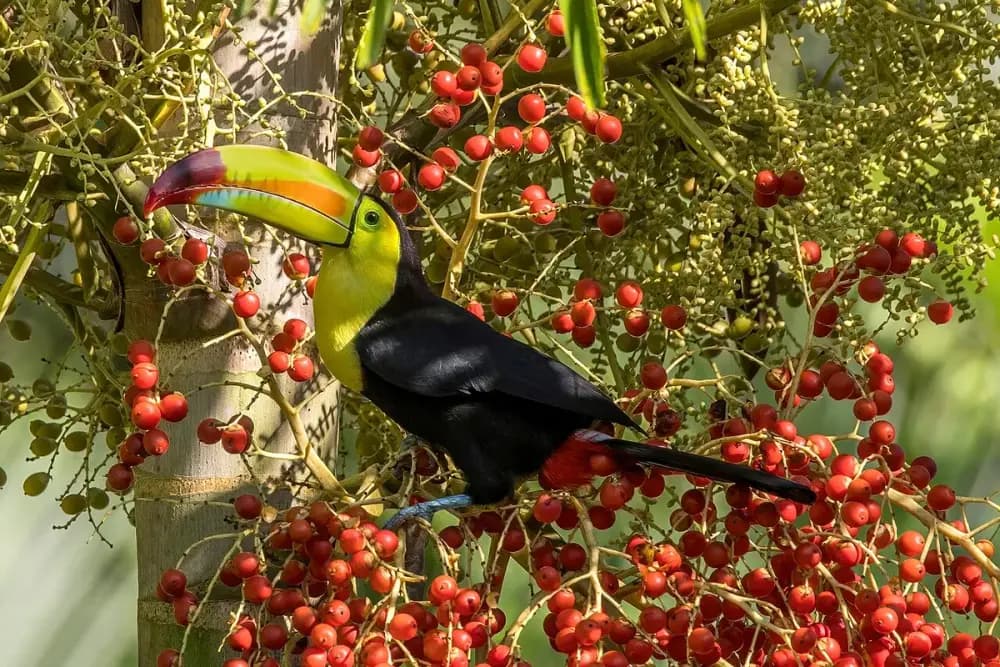
The toco toucan is a bird in the toucan family Ramphastidae, and it is the largest species of toucan alive today. It has a glossy black body, a white throat and chest, white uppertail-coverts, and red undertail-coverts. Its most conspicuous feature by far is its huge beak, yellow-orange with a black base and a large black spot near the tip. The beak looks heavy but is relatively light because the inside is largely hollow, and the tongue inside it is nearly as long as the bill and very flat.
The bill varies from 173 to 215 mm (6.8 to 8.5 in) in males and 158 to 202 mm (6.2 to 8.0 in) in females, with males averaging longer bills than females. Other than this size difference, there is no external difference between the sexes, though juveniles are duller in color and have shorter bills than adults. The eye is brown, though it has also been reported in shades of yellow, green, and blue, and is ringed by a narrow band of blue skin, with the rest of the orbital skin colored sulfur yellow to orange. Toco toucans are known to exhibit partial leucism, an occasional paling of normal plumage color.
The species is endemic to South America, where it ranges from the Guianas south to northern Argentina and Uruguay, with a wide but somewhat disjunct distribution in the north of its range. Unlike most other toucans, which live in continuous, closed-canopy forest, the toco toucan favors a variety of semi-open habitats: gallery forests, savannas, forest edges along water, woodlands, secondary forest, plantations, orchards, and groves. It is especially common in the Brazilian cerrado, a tropical savanna, and in the wetlands of the Pantanal, and it has been recorded at elevations up to 1,750 m (5,740 ft). Two subspecies are recognized, R. t. toco in the north of the range and R. t. albogularis further south, distinguished mainly by slightly smaller size and a whiter throat, though the size difference is not consistent between individuals.
Behavior and diet
Diet
Fleshy fruits, supplemented with insects, eggs, and nestlings of other birds
Toco toucans are typically seen flying between treetops or feeding in the canopy, hopping from branch to branch with an undulating flight that alternates heavy flapping and gliding. They have large home ranges, averaging 86 ha (210 acres), and are more widely dispersed than other toucans because they are able to sustain flight across bodies of water wider than 5 km (3.1 mi). They are less active during the day, resting often in treetops, and they are less gregarious than other toucans, usually feeding alone or in small groups rather than large flocks, though after the breeding season they will sometimes gather into large flocks that range through forests searching for fruit.
The species is a generalist frugivore, feeding mainly on fleshy fruits such as figs, oranges, guavas, and peppers, and supplementing this with insects like caterpillars and termites, along with eggs, nestlings, and small birds. Foraging mostly happens in the canopy, though toucans will also visit the understory and ground for fallen fruit. Diet varies significantly with habitat and season: where fruit is available year-round, the diet stays steady, but where fruit availability is seasonal, toucans concentrate in fruiting areas and move on when supplies decline, sometimes turning to flowers during the dry season. In the wild, toco toucans raid the nests of other birds, including icterid blackbirds, tyrant flycatchers, puffbirds, and parrots, and target the nests of yellow-rumped caciques in particular; they will even take nestlings of birds much larger than themselves, such as the buff-necked ibis, by breaking their necks with sideways strikes of the bill.
Breeding is seasonal, with timing varying by region, and toucans become more secretive and solitary during the nesting season. Nests are made in tree hollows and typically hold two to four eggs, which both parents incubate for 17 to 18 days before hatching. Males will display the red feathers under their tails while fanning out their undertail coverts as part of courtship.
Range and habitat
Habitat
Semi-open habitats including savanna, gallery forest, and wetlands, up to 1,750 m (5,740 ft)
The toco toucan's range runs from the Guianas south through Brazil to northern Argentina and Uruguay, with several separate populations in the north of that range, including in the Guianas, near the Rio Branco, and along the Amazon up to around Manaus. The species was thought to have gone extinct in Tucumán, in northwestern Argentina, by the late 1990s but was rediscovered there in the early 2010s. Its range appears to be expanding: it has only recently been recorded in Uruguay, and its presence in the Amazon rainforest may be increasing due to deforestation. Toco toucans are generally resident year-round, though they will sometimes move in large numbers in search of food.
The species avoids the continuous closed-canopy forest favored by most other toucans, instead using a mix of semi-open habitats: gallery forests, savanna, woodland, chaco, and cultivated land such as plantations and orchards, alongside forest bordering water bodies. It is especially common in the cerrado and the Pantanal wetlands, and has been recorded up to 1,750 m (5,740 ft) in elevation.
Conservation status
The toco toucan is considered Least Concern (LC) by BirdLife International. No major threats to the species are described here. In fact, its range may be expanding: growth into parts of the Amazon rainforest may be linked to deforestation, while its recent expansion south of the 30th parallel may be caused by escaped captive individuals or by changes in ecological conditions.
Where to see toco toucan in the U.S.
12 zoos across 10 states
Find the closest one
Rank the 11 zoos holding toco toucan by how far they are from you. Your location is used in your browser to sort this list and is never sent to us.
1 more zoo holds toco toucan but has no coordinates on file yet, so it isn't ranked here. It's in the full list below.
Arizona· 1
California· 1
Florida· 1
Illinois· 1
Kentucky· 1
Missouri· 1
Oregon· 1
Tennessee· 2
Texas· 2
Virginia· 1
AZAThe Association of Zoos and Aquariums. Accredited members have passed an independent inspection of animal care and welfare, safety, conservation and education, repeated every five years. Many smaller facilities never apply, so “not accredited” isn't a verdict on its own. What accreditation means · How we check this
Built from each zoo's own published animal list.
Toco Toucan: common questions
Is the toco toucan endangered?
No. It is listed as Least Concern by BirdLife International.
How big does a toco toucan get?
It averages 56 cm (22 in) in length and weighs around 540 g (19 oz), with a bill that averages about 200.5 mm (7.89 in) in males and 178.6 mm (7.03 in) in females.
What does a toco toucan eat?
Mainly fleshy fruits such as figs, oranges, guavas, and peppers, supplemented with insects, eggs, and the nestlings of other birds.
Where do toco toucans live in the wild?
In semi-open habitats across South America, from the Guianas south to northern Argentina and Uruguay, including the Brazilian cerrado and the wetlands of the Pantanal.
Which U.S. zoos have toco toucans?
Five zoos in our directory, including the Phoenix Zoo, the Saint Louis Zoo, and the Oregon Zoo.