- Where to see one
- 6 U.S. zoos in our directory hold curl-crested aracari, confirmed against each zoo's own animal list.
- Native range
- Southwestern Amazon Basin in Peru, Brazil and Bolivia
- Size
- 42–46 cm (17–18 in) long; 164–280 g (5.8–9.9 oz)
- Elevation
- Mostly below 500 m (1,600 ft), up to 900 m (3,000 ft) near the Andes
- Group size
- Forages in groups of up to 12
- Breeding season
- Mainly May to August
Conservation status
Least Concernassessed 2016
IUCN Red List category LC — step 1 of 7.
Least Concern (LC), population thought to be decreasing
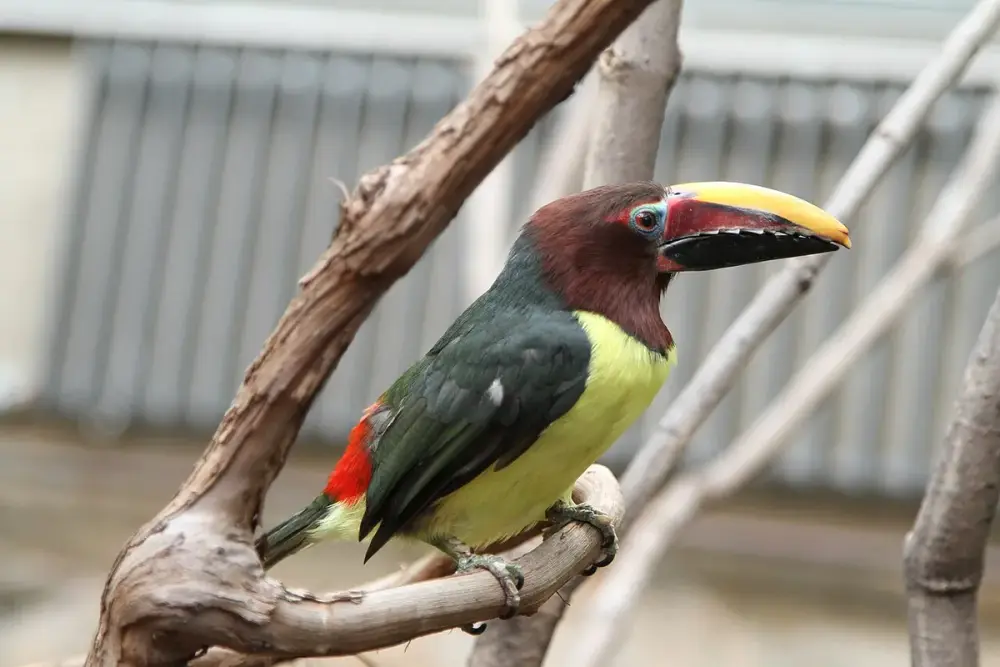
The curl-crested aracari is a toucan found in Bolivia, Brazil and Peru, in the south-western Amazon Basin south of the Amazon River. It lives in wet forest, both well-drained and swampy, mostly below 500 m. It is named for curly, shiny black feathers on the crown and nape that resemble pieces of plastic or enamel. Measuring 42 to 46 cm long, it has dark green upperparts, yellow underparts crossed by a wide red band, and bare blue skin around the eye. It forages mostly in the canopy in groups of up to 12, eating mainly fruit but also the eggs and young of other birds.
About the curl-crested aracari
The curl-crested aracari is a medium-sized toucan of the southwestern Amazon rainforest in Peru, Brazil and Bolivia. It is one of the aracaris, the genus Pteroglossus within the toucan family Ramphastidae, and is named for the glossy, curled black feathers on its crown, which look more like bits of plastic than plumage.
Those curls are the bird's signature. The feathers on the top of the head and the nape are curly, shiny and black, and are often compared to shavings of plastic or enamel. They are unique to this species, and at various times the bird has been placed in a genus of its own, either Beauharnaisius or Ulocomus.
The body is colorful. The upper back and rump are red and the rest of the upperparts are dark green. The underparts are yellow, crossed by a broad red band on the lower breast, and the feathers under the tail may be washed with red. The cheeks and throat are whitish with black speckles, and the eye is ringed with bare blue skin.
The bill is a patchwork of colors. A brown-orange line runs around its base. The lower half is ivory, turning orange at the tip. The upper half has an orange ridge along the top and a maroon stripe along the bottom edge, widest at the base, with green or bluish between them. Faint ivory "teeth" line the cutting edge. Males and females look the same, except that the female's bill is shorter. Young birds are duller versions of the adults.
Adults are 42–46 cm (17–18 in) long and weigh 164–280 g (5.8–9.9 oz). The species was first described in 1831 by Johann Georg Wagler, but the spelling of its scientific name, Pteroglossus beauharnaisii, was not corrected until 2020. It has no recognized subspecies.
Toucan anatomy
As a toucan, the curl-crested aracari has the family's oversized bill. Despite its size, a toucan bill is very light, built from bony struts filled with foam-like keratin, and it also helps the bird shed heat. The bill lets toucans reach fruit without moving and probe into tree holes and hanging nests that other birds can't reach. Toucans have a long, narrow, frayed tongue, strong short legs, and toes arranged in pairs, two forward and two back. The last three tail vertebrae are fused and joined to the spine by a ball-and-socket joint, so a toucan can snap its tail forward until it touches the head, which is the position it sleeps in.
Behavior and diet
Diet
Mostly fruit, plus eggs and nestlings of other birds
Curl-crested aracaris usually forage in groups of up to 12, mostly up in the forest canopy, though they will come down to fruiting bushes near the ground. They are largely year-round residents, making only short or local movements.
What curl-crested aracaris eat
Their diet has not been studied in detail, but it is known to be mostly fruit. They also take the eggs and young of other birds. Curl-crested aracaris are known to tear open the hanging, woven nests of yellow-rumped caciques to get at the eggs and chicks inside. This fits the wider toucan pattern: the family is mainly fruit-eating but opportunistically takes insects, small lizards, smaller birds, and especially eggs and nestlings, which add protein. As the dominant fruit eaters of their forests, toucans are important seed dispersers.
Calls
The calls include a series of deep "rrek" notes, ranging from soft "rrr" sounds to hard, grunting "grenk" notes. Birds give a softer "et-et" while settling into a roost, and another call has been written as a low, raucous "cha-cha-cha cha wruh cha."
Breeding and roosting
The breeding season seems to run mainly from May to August, though it may start earlier and last longer. The nest, eggs and the rest of this species' breeding biology have not been described. In general, aracaris are tree-dwelling birds that nest in tree holes and lay two to four white eggs. Some aracaris are unusual among toucans in roosting together all year, with up to six adults and their fledged young sleeping in one hole, tails folded over their backs. Toucan chicks hatch completely naked, without any down.
Range and habitat
Habitat
Wet forest, both well-drained and swampy, including clearings and edges
The curl-crested aracari lives in the southwestern Amazon Basin, south of the Amazon River. Its range runs from northern Peru south of the Marañón River east into western Brazil as far as the Madeira River, and southeast to the Xingu River. From Peru it also extends south into northern and central Bolivia, and in Brazil it reaches northern Mato Grosso.
It lives in wet forest, both well-drained and swampy, using the forest interior as well as clearings and edges. Most records are below 500 m (1,600 ft), but near the Andes it reaches 900 m (3,000 ft). It occurs in Tambopata National Reserve in Peru.
Toucans in general are limited to forests with large old trees that have holes big enough to nest in, since most toucans don't excavate their own cavities.
Conservation status
The curl-crested aracari is listed as Least Concern on the IUCN Red List, last assessed in 2016. It has a large range and no immediate threats have been identified.
That doesn't mean it is fully understood. Its population size is unknown and thought to be decreasing, it is hunted, and more information on its biology has been called essential in case it ever needs protection.
Within the toucan family, it is one of the aracaris, the medium-sized, brightly colored toucans of the genus Pteroglossus. Relatives include the green aracari and larger toucans such as the toco toucan. See the toucan overview for more on the family.
Where to see curl-crested aracari in the U.S.
6 zoos across 5 states
Find the closest one
Rank the 5 zoos holding curl-crested aracari by how far they are from you. Your location is used in your browser to sort this list and is never sent to us.
1 more zoo holds curl-crested aracari but has no coordinates on file yet, so it isn't ranked here. It's in the full list below.
California· 1
Delaware· 1
Kentucky· 2
Louisiana· 1
Oregon· 1
AZAThe Association of Zoos and Aquariums. Accredited members have passed an independent inspection of animal care and welfare, safety, conservation and education, repeated every five years. Many smaller facilities never apply, so “not accredited” isn't a verdict on its own. What accreditation means · How we check this
Built from each zoo's own published animal list.
Curl-crested Aracari: common questions
Why is it called a curl-crested aracari?
Because of the curly, shiny black feathers on the top of its head and nape. They look more like pieces of plastic or enamel than ordinary feathers.
Is an aracari a toucan?
Yes. Aracaris are medium-sized toucans in the genus Pteroglossus, part of the toucan family Ramphastidae.
How big is a curl-crested aracari?
About 42–46 cm (17–18 in) long, weighing 164–280 g (5.8–9.9 oz). Females have shorter bills than males.
What do curl-crested aracaris eat?
Mostly fruit, plus the eggs and chicks of other birds. They are known to rip open the hanging nests of yellow-rumped caciques.
Where do curl-crested aracaris live?
In wet forest in the southwestern Amazon Basin, in Peru, western Brazil and Bolivia, mostly below 500 m (1,600 ft).
Are curl-crested aracaris endangered?
No. They are listed as Least Concern, though their numbers are thought to be decreasing and they are hunted.
Do curl-crested aracaris migrate?
No. They are mostly year-round residents, making only short-distance or local movements.
What sound does a curl-crested aracari make?
A series of deep "rrek" notes that range from a soft "rrr" to a hard, grunting "grenk." Birds also give a softer "et-et" as they settle into a roost.