- Where to see one
- 6 U.S. zoos in our directory hold silvery-cheeked hornbill, confirmed against each zoo's own animal list.
- Native range
- East Africa, from Ethiopia to South Africa
- Size
- 75–80 cm (30–31 in) long
- Clutch size
- 1 to 3 white eggs, incubated about 40 days
- Social life
- Usually in pairs; sometimes roosts in flocks of hundreds
- Key feature
- Very large cream-colored casque
Conservation status
Least Concernassessed 2018
IUCN Red List category LC — step 1 of 7.
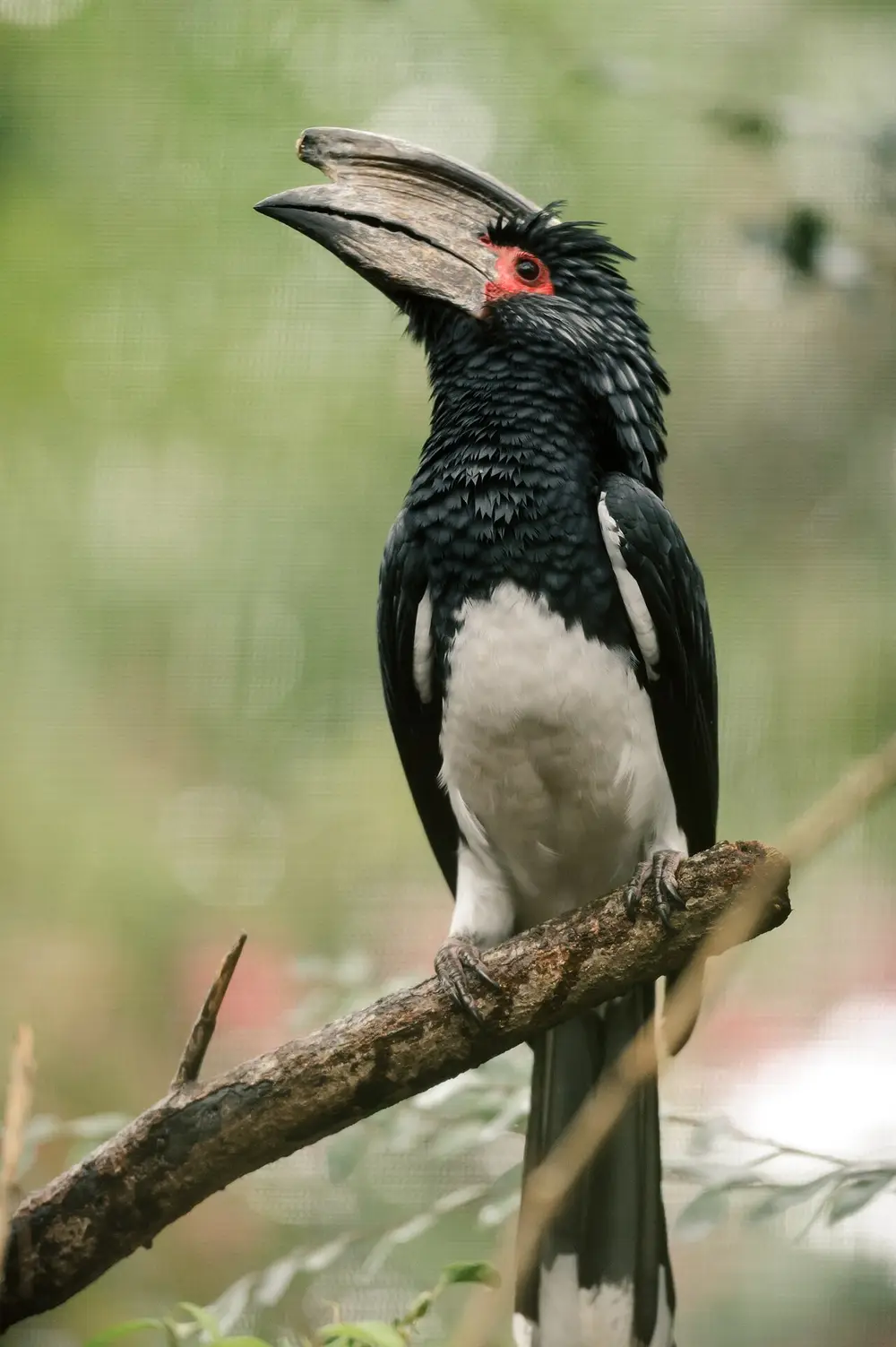
The silvery-cheeked hornbill is a large hornbill of the tall evergreen forests of East Africa, from Ethiopia to South Africa. It measures 75 to 80 centimetres in length and carries a very large cream-coloured casque on its beak. The head is silver-grey and the rest of the plumage is iridescent black, apart from a white rump, lower back, thighs, vent and tips of the outer tail feathers. The female has a smaller casque and reddish skin around the eyes. It is omnivorous, taking fruits, insects, small birds, rodents, small reptiles and centipedes. Usually seen in pairs, it sometimes roosts in flocks of hundreds.
About the silvery-cheeked hornbill
The silvery-cheeked hornbill (Bycanistes brevis) is a large African hornbill that lives in the tall evergreen forests of East Africa, from Ethiopia south to South Africa. It belongs to the genus Bycanistes, a group of six black-and-white, mainly fruit-eating hornbills of sub-Saharan Africa.
The bird measures 75 to 80 cm (30 to 31 in) long. Its most eye-catching feature is a very large, cream-colored casque, the horny structure that sits on top of the upper bill. The head is silver-gray, and the rest of the plumage is glossy, iridescent black, except for white on the rump, lower back, thighs, under the tail and the tips of the outer tail feathers.
Males and females look much alike. The female has a smaller casque and reddish skin around the eyes. A larger casque in males is a trait shared by every species in the genus Bycanistes, all of which have black-and-white plumage. Across the hornbill family, males are always larger than females, though how much larger varies from species to species and from one body part to another.
As in all hornbills, its heavy bill is supported by powerful neck muscles and by fused first and second neck vertebrae, a feature found in no other birds. The casque is a hollow structure running along the upper bill. In some hornbills it is small and seems only to strengthen the bill, while in others it is large, reinforced with bone and works as a resonator for calls. Hornbills also have binocular vision that lets them see their own bill tip, plus long eyelashes that act as sunshades.
Bycanistes hornbills were long placed in the genus Ceratogymna, but most authorities now treat them as separate. Genetic data show that Bycanistes is the sister group of the ground hornbills, such as the southern ground hornbill. The two split from the rest of the hornbill family early on and are thought to represent an early African lineage, while most other hornbills evolved in Asia.
Behavior and diet
Diet
Omnivore: fruit, insects, small birds, rodents, small reptiles and centipedes
The silvery-cheeked hornbill is omnivorous. It eats fruit along with insects, small birds, rodents, small reptiles and centipedes. Bycanistes hornbills as a group are primarily fruit eaters, and in hornbills, species that specialize in fruit tend to live in forests and are considered important seed dispersers. Because fruit is often patchy and requires long-distance travel to find, hornbills that specialize in fruit tend to be less territorial.
Hornbills as a family are diurnal. They cannot swallow food held at the bill tip because their tongues are too short, so they toss each bite back into the throat with a jerk of the head.
Silvery-cheeked hornbills usually live in pairs, but they sometimes roost together in flocks of hundreds. Across the hornbill family, the largest gatherings form at roosting sites, where as many as 2,400 birds have been counted.
Breeding takes place in spring, in September and October in at least part of the range. The female lays one to three white eggs and incubates them for 40 days. In every hornbill except the two ground hornbills, the female nests in a tree or rock cavity and closes the entrance with a wall of mud, droppings and fruit pulp, leaving only a narrow slit through which the male passes food. While sealed in, hornbill females go through a complete molt. When the chicks and mother outgrow the space, the female breaks out and both parents feed the young. Young silvery-cheeked hornbills stay with both parents for about 80 days.
Range and habitat
Habitat
Tall evergreen forest
The silvery-cheeked hornbill lives in the tall evergreen forests of East Africa, from Ethiopia in the north to South Africa in the south. It remains locally fairly common, especially in the northern and central parts of its range. In South Africa its presence is marginal, and in Zimbabwe it is threatened by habitat destruction.
Africa has 24 hornbill species. Thirteen of them live in open woodland and savanna, some even in very dry country, while the rest are birds of dense forest. The silvery-cheeked hornbill falls in the forest group. The trumpeter hornbill, a relative in the same genus, is also a bird of evergreen forest in eastern and southern Africa.
Silvery-cheeked hornbill vs trumpeter hornbill
The trumpeter hornbill (Bycanistes bucinator) is similar to the silvery-cheeked hornbill. Both are black-and-white Bycanistes hornbills of East African forests, but the trumpeter is noticeably smaller.
| Feature | Silvery-cheeked hornbill | Trumpeter hornbill |
|---|---|---|
| Scientific name | Bycanistes brevis | Bycanistes bucinator |
| Length | 75–80 cm (30–31 in) | 58–65 cm (23–26 in) |
| Casque | Very large, cream-colored | Large, gray |
| Head | Silver-gray | Red facial skin; pink skin around the eye |
| Back | Black with a white lower back and rump | All black |
| Group size | Usually pairs; roosts of hundreds | Usually 2 to 5, sometimes up to 50 |
| Clutch | 1 to 3 eggs | 4 to 5 eggs |
Both belong to the hornbill family, Bucerotidae, which has about 62 living species.
Conservation status
The silvery-cheeked hornbill is listed as Least Concern on the IUCN Red List. It remains locally fairly common across much of its range, though habitat destruction threatens it in Zimbabwe and it is only a marginal presence in South Africa.
That fits the broader picture for its family. None of Africa's hornbill species are seriously threatened, while many Asian hornbills are at risk from hunting and loss of the primary forest they depend on. Forest hornbills in general nest in natural tree cavities, and fruit-eating species travel long distances between patchy fruit sources, so forest loss removes both nest sites and food.
Where to see silvery-cheeked hornbill in the U.S.
6 zoos across 4 states
Find the closest one
Rank the 4 zoos holding silvery-cheeked hornbill by how far they are from you. Your location is used in your browser to sort this list and is never sent to us.
2 more zoos hold silvery-cheeked hornbill but have no coordinates on file yet, so they aren't ranked here. They're in the full list below.
Florida· 2
Idaho· 1
Tennessee· 2
Virginia· 1
AZAThe Association of Zoos and Aquariums. Accredited members have passed an independent inspection of animal care and welfare, safety, conservation and education, repeated every five years. Many smaller facilities never apply, so “not accredited” isn't a verdict on its own. What accreditation means · How we check this
Built from each zoo's own published animal list.
Silvery-cheeked Hornbill: common questions
Where do silvery-cheeked hornbills live?
In the tall evergreen forests of East Africa, from Ethiopia to South Africa. They are most common in the northern and central parts of that range.
How big is a silvery-cheeked hornbill?
It is 75–80 cm (30–31 in) long, with a very large cream-colored casque on its bill.
What do silvery-cheeked hornbills eat?
Fruit, insects, small birds, rodents, small reptiles and centipedes. They are omnivores.
How do you tell male and female silvery-cheeked hornbills apart?
By the casque and the face. Females have a smaller casque and reddish skin around the eyes; otherwise the sexes look similar.
Is the silvery-cheeked hornbill endangered?
No. It is listed as Least Concern, though habitat destruction threatens it in Zimbabwe.
How many eggs does a silvery-cheeked hornbill lay?
One to three white eggs, incubated for about 40 days. The young stay with both parents for about 80 days.
What is the difference between a silvery-cheeked hornbill and a trumpeter hornbill?
Size and color. The silvery-cheeked hornbill is larger, at 75–80 cm (30–31 in), with a cream casque and white lower back, while the trumpeter is 58–65 cm (23–26 in) with a gray casque and an all-black back.