- Where to see one
- 12 U.S. zoos in our directory hold green aracari, confirmed against each zoo's own animal list.
- Native range
- Lowland forests of northeastern South America, the Guiana Shield, the northeast Amazon Basin, and the eastern Orinoco River drainage of Venezuela
- Size
- 30–40 cm (12–16 in) long, weighing 110–160 grams (3.9–5.7 oz)
About the green aracari
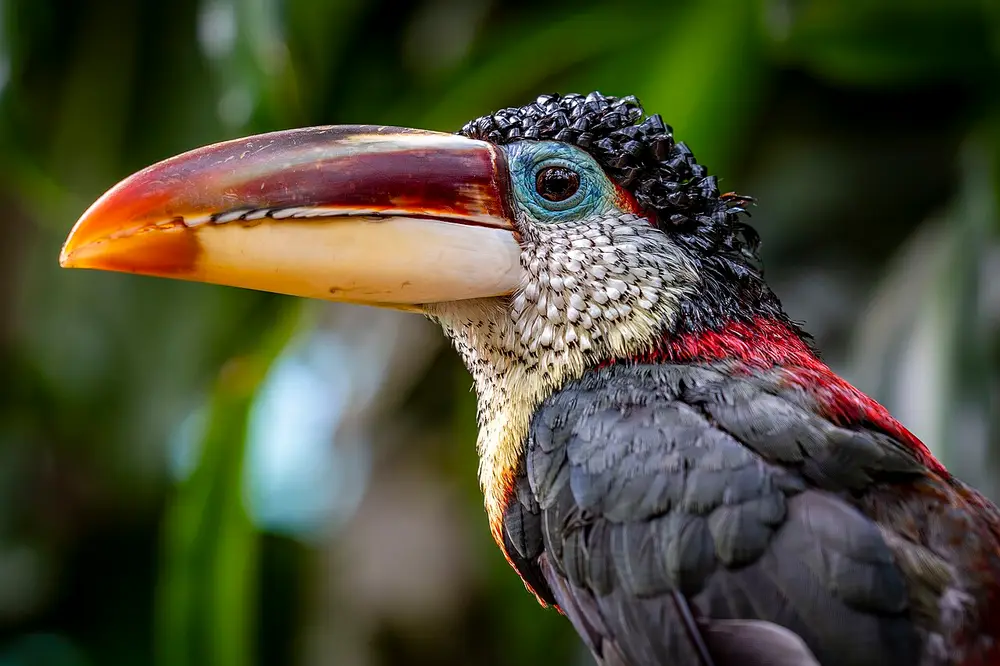
The green aracari is a toucan — a near-passerine bird — found in the lowland forests of northeastern South America, including the Guiana Shield, the northeast Amazon Basin, and the eastern Orinoco River drainage of Venezuela. At 30 to 40 cm long and weighing just 110 to 160 grams, it is the smallest aracari found within its range and among the smallest members of the toucan family as a whole.
The species was originally classified in the genus Ramphastos before being placed in its current genus, and its common name comes from the green feathers that cover its back. The sexes can be told apart by their crowns: males have a black crown, while females have a reddish-brown one.
Behavior and diet
Diet
Mostly fruit, including Cecropia fruit and the palm Oenocarpus bacaba, plus occasional insects
Green aracaris breed from February to June, nesting in tree cavities where the female lays two to four white eggs. Both parents cooperate in rearing the young. The species' diet consists mostly of fruit, including the fruit of Cecropia trees and the palm Oenocarpus bacaba. Its large bill has serrated edges that help it grip and gather fruit, and it also eats insects occasionally, which supplement its diet with additional protein.
Range and habitat
Habitat
Lowland forest
The green aracari is found in the lowland forests of northeastern South America, spanning the Guiana Shield, the northeast Amazon Basin, the Guianas, and the eastern Orinoco River drainage of Venezuela. Changes to this range over time are not detailed here.
Conservation status
The green aracari is rated Least Concern (LC) by the IUCN. Specific threats or conservation programs for the species are not detailed here.
Where to see green aracari in the U.S.
12 zoos across 11 states
Find the closest one
Rank the 12 zoos holding green aracari by how far they are from you. Your location is used in your browser to sort this list and is never sent to us.
California· 1
District of Columbia· 1
Iowa· 1
Kansas· 1
Maryland· 1
Massachusetts· 1
New Jersey· 1
New York· 2
North Dakota· 1
Ohio· 1
Wisconsin· 1
AZAThe Association of Zoos and Aquariums. Accredited members have passed an independent inspection of animal care and welfare, safety, conservation and education, repeated every five years. Many smaller facilities never apply, so “not accredited” isn't a verdict on its own. What accreditation means · How we check this
Built from each zoo's own published animal list.
Green Aracari: common questions
Is the green aracari endangered?
No. It is rated Least Concern (LC) by the IUCN.
How big does a green aracari get?
It grows to 30–40 cm (12–16 in) long and weighs 110–160 grams (3.9–5.7 oz), making it the smallest aracari in its range.
What does a green aracari eat?
Mostly fruit, including Cecropia fruit and the palm Oenocarpus bacaba, along with occasional insects for extra protein.
Where do green aracaris live in the wild?
In the lowland forests of northeastern South America, including the Guiana Shield, the northeast Amazon Basin, and the eastern Orinoco drainage of Venezuela.
Which U.S. zoos have green aracaris?
Seven zoos in our directory keep the species, including the Los Angeles Zoo, the Salisbury Zoo, and the Akron Zoo.