- Where to see one
- 8 U.S. zoos in our directory hold keel-billed toucan, confirmed against each zoo's own animal list.
- Native range
- Southern Mexico through Central America to the far northwest of South America, including Belize
- Size
- Body length (including bill) about 42–55 cm (17–22 in); weight about 380–500 g (13–18 oz)
Conservation status
Near Threatenedassessed 2021
IUCN Red List category NT — step 2 of 7.
Near Threatened (NT), decreasing
About the keel-billed toucan
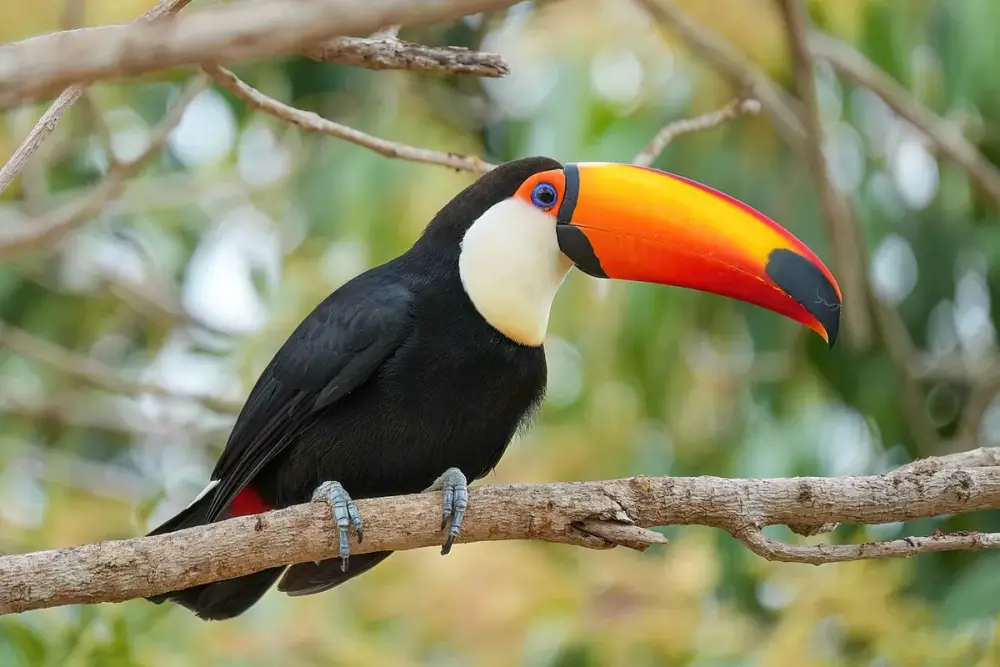
The keel-billed toucan, also called the rainbow-billed toucan or sulphur-breasted toucan, is a forest bird native to southern Mexico, Central America, and the far northwest of South America. It is the national bird of Belize. Most of what identifies the bird at a glance is the bill: a large, brightly colored structure that averages 12 to 15 cm (4.7 to 5.9 in) long, or about a third of the bird's total length. The bill looks heavy but is not. It is a spongy, hollow bone covered in keratin, the same light, hard protein found in hair and claws, and some researchers think its many blood vessels help the bird shed excess body heat. In color the bill is mostly green, with a red tip and orange sides.
The body plumage is mostly black, set off by a yellow neck and chest, red feathers under the tail, and a narrow red band where the yellow chest patch meets the black body. The tail carries red feathers at its tip, and the feet are blue. The bird molts once a year. Like almost all birds in the order Piciformes, the keel-billed toucan has zygodactyl feet, meaning two toes point forward and two point back. Because the species spends much of its time moving through trees, this foot arrangement likely helps it grip branches and jump between them. Males and females look alike apart from a difference in size.
Including its bill, the keel-billed toucan measures roughly 42 to 55 cm (17 to 22 in) long, with a wing length typically between 189.4 and 208.4 mm (7.46 to 8.20 in). It weighs about 380 to 500 g (13 to 18 oz). In the wild, the bird ranges from southern Mexico to Venezuela and Colombia, roosting in the canopies of tropical, subtropical, and lowland rainforests at altitudes up to 1,900 m (6,200 ft). It nests and sleeps in holes in trees, often alongside several other toucans, though it also turns up in nearby plantations, pastures, and second-growth forest outside the deep forest interior.
Behavior and diet
Diet
Fruit, seeds, insects, invertebrates, lizards, snakes, and small birds and their eggs
Keel-billed toucans are social birds that are rarely seen alone. They travel in small flocks of roughly six to twelve individuals, flying in a distinctive pattern of six to ten rapid wing beats followed by a glide, beak dipping forward, over short distances through the lowland forest. At night, groups roost together in tree cavities, sometimes cramming five or six birds into a single hole. To fit, a toucan folds its tail over its body and tucks its long bill along its back, a position that also helps regulate its body temperature while sleeping. The birds favor holes 3 to 27 m off the ground with a small entrance, and the floor of an occupied hole is often littered with the seed stones of fruit the toucans have eaten.
Within a group, there is a family structure, and birds interact through play and ritual: they "duel" with their bills and toss fruit into one another's mouths in a kind of game of catch. They communicate with vocal calls, described as sounds like "grr," "trrii," and "rrrk," a loud male audible from a kilometer away, as well as non-vocal signals such as bill-clacking and wing-beating. Hawk-eagles and collared forest falcons are among the toucan's predators, with the falcon a significant threat in some areas.
The diet is mostly fruit, including species such as Cymbopetalum mayanum and gumbo-limbo, supplemented with insects, eggs, nestlings, and lizards. The long bill, more dexterous than it looks, lets the bird reach fruit that might otherwise be out of range; it dissects the fruit with the bill tip, then tosses its head back to swallow the piece whole. Feeding usually happens from the mid-story up into the canopy, rarely on the ground, though in 2018 researchers in Costa Rica recorded a keel-billed toucan eating carrion, possibly the first toucan species recorded doing so. When courting, mates exchange fruit with each other. The female lays 1 to 4 white eggs in a tree cavity, and both parents share incubation, which lasts about 15 to 20 days, and later share feeding duties. Chicks hatch featherless with their eyes closed for roughly three weeks, and fledge after about eight to nine weeks once their bills have developed. A pair can raise as many as three broods in a year.
Range and habitat
Habitat
Tropical, subtropical, and lowland rainforest canopy, up to 1,900 m (6,200 ft)
The keel-billed toucan's range runs from southern Mexico south through Belize, Guatemala, and the rest of Central America to Venezuela and Colombia in northwestern South America. It is the national bird of Belize. Within this range it lives in the canopy of tropical, subtropical, and lowland rainforest, up to altitudes of 1,900 m (6,200 ft), and it roosts in tree holes, often communally. While its core habitat is forest, the species also appears in plantations, pastures, and second-growth forest bordering intact woodland, showing some tolerance for altered landscapes near its natural habitat.
Conservation status
The keel-billed toucan is listed as Near Threatened on the IUCN Red List, in a 2021 assessment by BirdLife International. The population is in a moderately rapid decline: the 2021 assessment put the loss over the past three generations at 10 to 19 percent and projected a steeper 20 to 29 percent for the future.
Habitat loss is the main pressure, and it has been accelerating in recent years. Hunting and trapping for the wildlife trade add to it; in 2015 a single bird could fetch up to $2,000 on the illegal market.
The bird is sometimes kept in captivity, including as a pet alongside the toco toucan, though it needs a high-fruit diet and is prone to haemochromatosis, an iron storage disease.
Where to see keel-billed toucan in the U.S.
8 zoos across 6 states
Find the closest one
Rank the 7 zoos holding keel-billed toucan by how far they are from you. Your location is used in your browser to sort this list and is never sent to us.
1 more zoo holds keel-billed toucan but has no coordinates on file yet, so it isn't ranked here. It's in the full list below.
Georgia· 1
Massachusetts· 2
New York· 1
Ohio· 1
Rhode Island· 1
Tennessee· 2
AZAThe Association of Zoos and Aquariums. Accredited members have passed an independent inspection of animal care and welfare, safety, conservation and education, repeated every five years. Many smaller facilities never apply, so “not accredited” isn't a verdict on its own. What accreditation means · How we check this
Built from each zoo's own published animal list.
Keel-billed Toucan: common questions
Is the keel-billed toucan endangered?
Not quite. It is listed as Near Threatened by the IUCN (2021), one step below Vulnerable. Habitat loss and trapping for the wildlife trade are driving a moderately rapid population decline.
How big does a keel-billed toucan get?
Including its bill, it measures about 42 to 55 cm (17 to 22 in) long and weighs roughly 380 to 500 g (13 to 18 oz). The bill alone accounts for about a third of its length.
What does a keel-billed toucan eat?
Mostly fruit, along with seeds, insects, invertebrates, lizards, snakes, and occasionally small birds and their eggs.
Where do keel-billed toucans live in the wild?
From southern Mexico through Belize and Central America to Venezuela and Colombia, in tropical, subtropical, and lowland rainforest canopy.
Which U.S. zoos have keel-billed toucans?
Five U.S. zoos list this bird, including Franklin Park Zoo in Massachusetts, Cincinnati Zoo and Botanical Garden in Ohio, and Roger Williams Park Zoo in Rhode Island.