- Where to see one
- 14 U.S. zoos in our directory hold american kestrel, confirmed against each zoo's own animal list.
- Native range
- North and South America, from central and western Alaska to Tierra del Fuego, excluding the Arctic fringes and the densest Amazon rainforest
- Size
- 22–31 cm (8.7–12.2 in) in length, with a wingspan of 51–61 cm (20–24 in); males weigh 80–143 g (2.8–5.0 oz), females 86–165 g (3.0–5.8 oz)
- Lifespan
- Under 5 years for wild birds on average, though the oldest banded wild bird reached 11 years and 7 months; captive kestrels can live 14–17 years
Conservation status
Least Concernassessed 2025
IUCN Red List category LC — step 1 of 7.
Least Concern (LC), assessed 2025; long-term gradual decline in North America
About the American kestrel
The American kestrel is the smallest and most common falcon in the Americas. It was long known by the now-obsolete name "sparrow hawk," a misnomer, since it's a true falcon in the family Falconidae and only very distantly related to the Eurasian sparrowhawk and other birds called sparrowhawks. Its size varies roughly two-to-one across subspecies and sexes, ranging from about the weight of a blue jay up to that of a mourning dove, and it has evolved into 17 recognized subspecies adapted to different habitats across its enormous range, which spans nearly all of North and South America outside the Arctic fringes and the densest parts of the Amazon.
The species was formally described by Carl Linnaeus in 1758, based partly on Mark Catesby's earlier account of a "little hawk" from Carolina. Despite its common name and traditional classification alongside Old World kestrels, DNA analysis shows the American kestrel is actually more closely related to other, non-kestrel falcons — its kestrel-like appearance and hunting style are the result of convergent evolution toward a similar ecological niche, rather than close kinship.
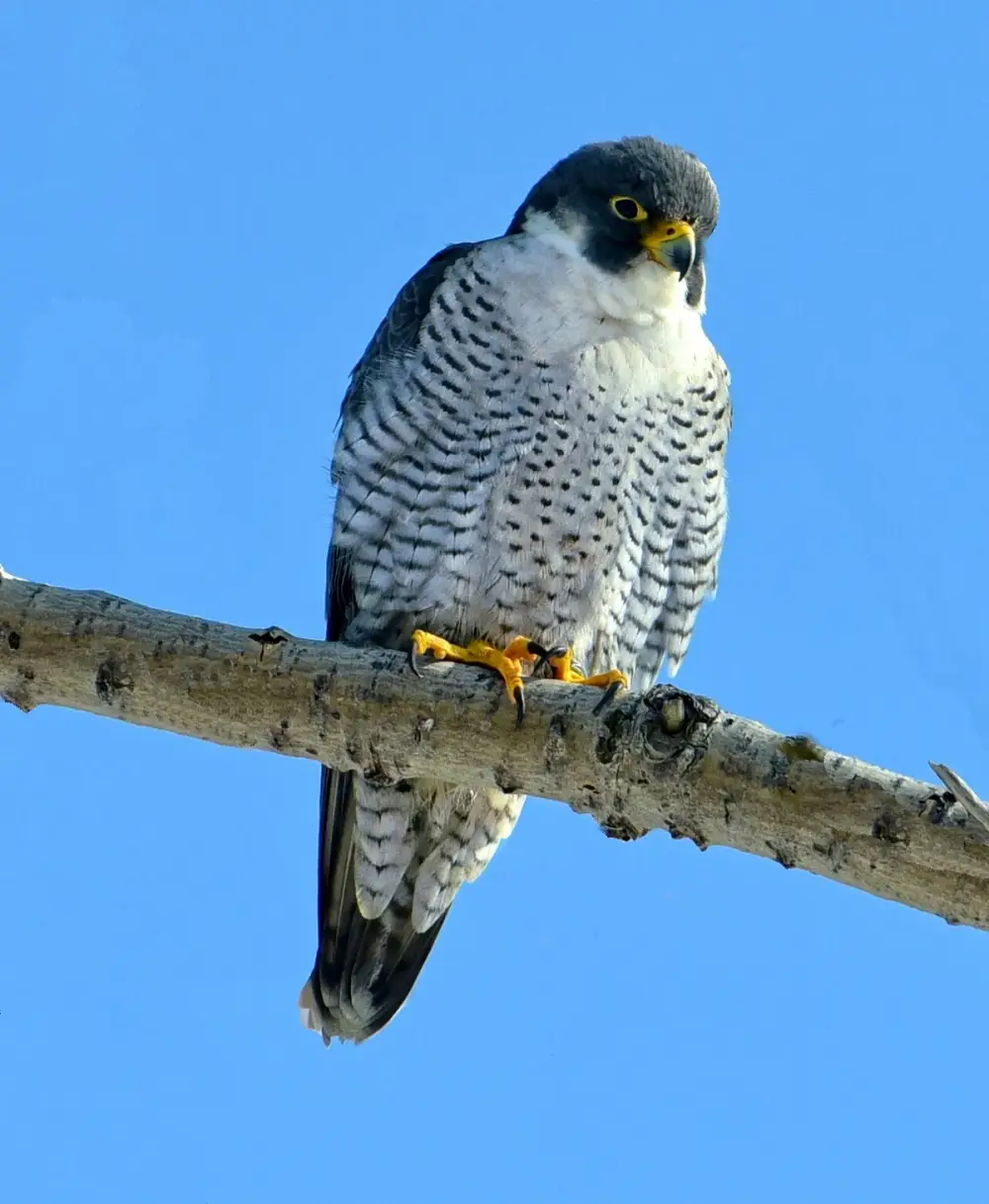
Adults range from 22 to 31 cm (8.7–12.2 in) in length with a wingspan of 51–61 cm (20–24 in). Females are larger than males, typically by about 10% to 15% within a given subspecies, and more northern subspecies run larger overall — enough that a large northern female can be roughly twice the size of a small southern male. Males typically weigh 80–143 g (2.8–5.0 oz) and females 86–165 g (3.0–5.8 oz). The species is more strikingly dimorphic in plumage than in size: males have blue-gray wings with black spots, white undersides with black barring, and a rufous, barred back and tail, while females have rufous, dark-brown-barred wings and backs, creamy to buff undersides with heavy brown streaking, and a rufous tail marked with numerous narrow black bars. Both sexes share a white head with a bluish-gray crown and two vertical black facial markings on each side, along with two dark "false eye" spots on the nape, thought to help deter potential attackers.
Physically, American kestrels are leaner and less muscular than larger falcons — their flight muscles make up only about 12% of body weight, compared to roughly 20% in powerful fliers like the peregrine falcon. This build suits their preferred hunting strategy: energy-conserving ambush hunting rather than sustained high-speed pursuit, which lets them get by on less food per day while still being capable of taking prey as large as themselves.
Behavior and diet
Diet
Grasshoppers and other insects, lizards, mice, and small birds
American kestrels hunt mainly by perching and scanning the ground for prey to ambush, a habit that shows up in their familiar roadside presence on wires, fence posts, and treetops. They also hunt by kiting — hovering in place with rapid wingbeats while scanning below — as well as by low flight over fields or by chasing insects and birds in the air. Before striking, a kestrel typically bobs its head and tail, then flies directly at its prey to seize it with its talons; most prey is taken on the ground, though the birds occasionally catch birds in flight.
Their diet is broad: grasshoppers, crickets, butterflies, moths, dragonflies, beetles, lizards, mice, voles, shrews, frogs, and small birds, with occasional reports of kestrels killing scorpions, snakes, bats, and squirrels. That dietary flexibility is considered a major reason the species can sustain such high population densities across such a wide range. Kestrels adjust their hunting locations based on success rate, moving on if a spot stops producing catches.
American kestrels have three basic calls — the "klee" or "killy," a rapid, excited series heard from both sexes; the "whine," associated mainly with feeding and copulation; and the "chitter," used during courtship feeding, copulation, and feeding of nestlings. They're cavity nesters, generally preferring natural cavities in trees with tight-fitting entrances, though they'll also use cliff ledges, building tops, old woodpecker holes, abandoned nests of other birds, cavities in cacti, and man-made nest boxes. Pair bonds tend to be strong and often permanent, with pairs frequently reusing the same nest site in consecutive years. Females lay three to seven eggs — typically four or five — spaced 24 to 72 hours apart, white to cream in color with brown or gray splotching, and incubation lasts about 30 days, handled mostly by the female though the male incubates 15% to 20% of the time.
Range and habitat
Habitat
Grasslands, meadows, deserts, and other open to semi-open regions, including urban and suburban areas
The American kestrel's breeding range extends from central and western Alaska across northern Canada to Nova Scotia, and south through the rest of North America into central Mexico and the Caribbean; it's also a local breeder in Central America and is widely distributed across South America, all the way to Tierra del Fuego. Most birds that breed in Canada and the northern United States migrate south for the winter, sometimes as far as Central America and the Caribbean, while populations breeding south of about 35° north latitude tend to stay put year-round. It's an occasional vagrant to Western Europe, including the UK, Denmark, Malta, and the Azores.
Habitat includes grasslands, meadows, deserts, and other open to semi-open country, along with both urban and suburban areas — as long as the location offers perches, open hunting ground, and cavities for nesting. The species tolerates an unusually wide range of conditions, from above the Arctic Circle to the tropics of Central America and elevations above 4,500 m (14,800 ft) in the Andes.
Conservation status
The American kestrel is listed as Least Concern on the IUCN Red List, based on a 2025 BirdLife International assessment. It is likely the most abundant falcon in North America, though its total population is hard to pin down because local numbers shift quickly with food and nest-site availability.
That abundance hides a slow slide. Count data from the USGS Breeding Bird Survey show the North American breeding population in a long-term, gradual but sustained decline, with faster drops in regions such as New England and coastal California, and counts from raptor migration corridors point the same way. The southeastern subspecies, Falco sparverius paulus, has declined 82% since 1940 as longleaf pine stands that provided nest cavities were cleared for farmland.
Humans are also a leading direct cause of death: in one study, people accounted for 43.2% of 1,355 reported deaths, including direct killing and roadkill, while predation, including by larger birds of prey, accounted for only 2.8%, a figure likely skewed because reported deaths tend to occur near populated areas. In Florida, kestrels also fall prey to invasive snakes, including Burmese pythons and several types of anaconda and boa.
Where to see american kestrel in the U.S.
14 zoos across 10 states
Find the closest one
Rank the 13 zoos holding american kestrel by how far they are from you. Your location is used in your browser to sort this list and is never sent to us.
1 more zoo holds american kestrel but has no coordinates on file yet, so it isn't ranked here. It's in the full list below.
Alabama· 1
California· 4
Illinois· 1
Indiana· 1
Massachusetts· 1
Minnesota· 1
Nebraska· 1
New Hampshire· 1
Oregon· 2
Virginia· 1
AZAThe Association of Zoos and Aquariums. Accredited members have passed an independent inspection of animal care and welfare, safety, conservation and education, repeated every five years. Many smaller facilities never apply, so “not accredited” isn't a verdict on its own. What accreditation means · How we check this
Built from each zoo's own published animal list.
American Kestrel: common questions
Is the American kestrel endangered?
No. It's listed as Least Concern on the IUCN Red List (2025 assessment), though North American breeding numbers have been declining gradually over the long term.
How big does an American kestrel get?
It measures 22 to 31 cm (8.7–12.2 in) in length with a wingspan of 51–61 cm (20–24 in); males weigh 80–143 g (2.8–5.0 oz) and females weigh 86–165 g (3.0–5.8 oz).
What does an American kestrel eat?
It eats grasshoppers and other insects, lizards, mice, voles, shrews, frogs, and small birds.
How long do American kestrels live?
Wild birds average under 5 years, though the oldest banded wild bird lived 11 years and 7 months; captive kestrels can live 14 to 17 years.
Where do American kestrels live in the wild?
Across North and South America, from central and western Alaska to Tierra del Fuego, avoiding only the Arctic fringes and the densest Amazon rainforest.
Which U.S. zoos have American kestrels?
Six U.S. zoos have them, including the San Diego Zoo, Oregon Zoo, and Virginia Zoological Park.