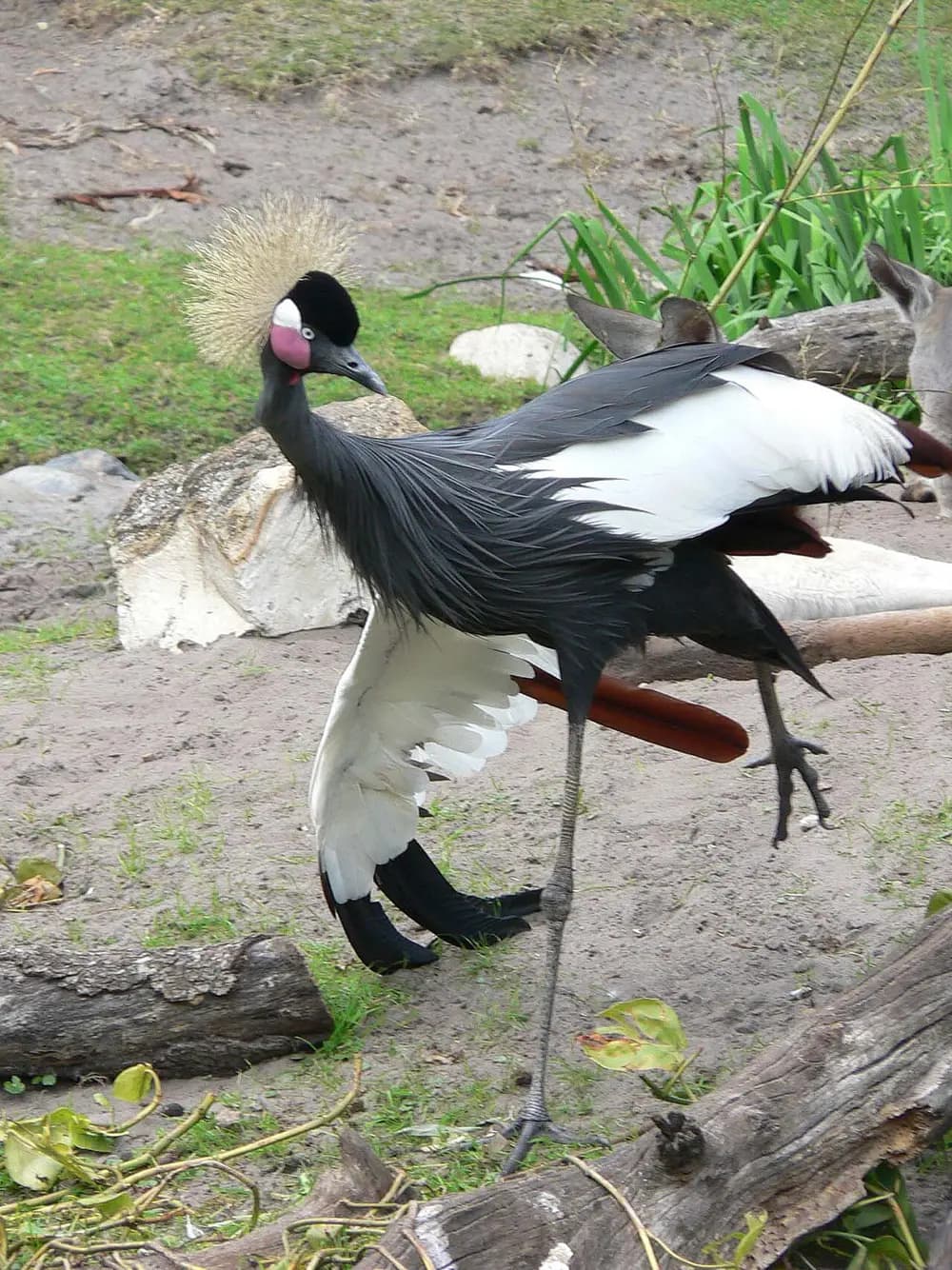
Grey Crowned Crane
Balearica regulorum
Also known as Crowned Crane, East African Crowned Crane, East African Gray Crowned Crane, Gray Crowned Crane
- Where to see one
- 32 U.S. zoos in our directory hold grey crowned crane, confirmed against each zoo's own animal list.
- Native range
- Sub-Saharan Africa, from the eastern Democratic Republic of the Congo and Uganda south to eastern South Africa
- Size
- About 1 m (3 ft 3 in) tall, weighs 3.5 kg (7.7 lb), with a wingspan of 2 m (6 ft 7 in)
About the grey crowned crane
The grey crowned crane, sometimes spelled gray crowned crane, is a large crane native to Sub-Saharan Africa. It stands about 1 m (3 ft 3 in) tall, weighs around 3.5 kg (7.7 lb), and has a wingspan of roughly 2 m (6 ft 7 in). Its body plumage is mainly grey, with wings that are predominantly white, dark grey, and dark red, marked by a golden-yellow patch. The head carries a crown of stiff golden feathers, the sides of the face are white, and a bright red, inflatable throat pouch hangs beneath the bill. The bill itself is short and grey, and the legs are black and long, suited to wading through grass. Its feet are large but slender, built for balance rather than for grasping or defense. Males and females look alike, though males tend to run slightly larger, and young birds are greyer overall with a feathered buff face rather than the adult's bare white cheek patch.
The species goes by several other names as well, including African crowned crane, golden crested crane, golden crowned crane, East African crane, East African crowned crane, Eastern crowned crane, Kavirondo crane, South African crane, and crested crane. Two subspecies are recognized. The East African subspecies, B. r. gibbericeps, is found from the eastern Democratic Republic of the Congo through Uganda — where it is the national bird, appearing on the country's flag and coat of arms — and on to Kenya and eastern South Africa; it carries a larger patch of bare red facial skin than the southern nominate subspecies, B. r. regulorum, which breeds from Angola south to South Africa. The grey crowned crane is closely related to the black crowned crane, and the two were once treated as a single species before genetic evidence, calls, plumage, and bare-part differences led every authority to separate them. Along with the black crowned crane, this species is one of only two cranes that can roost in trees, thanks to a long hind toe that can grip a branch — a trait believed to be ancestral among cranes and since lost in the other crane subfamily. Crowned cranes also lack the coiled trachea found in other crane species and have looser plumage.
Behavior and diet
Diet
Plants, seeds, grain, insects, frogs, worms, snakes, small fish, and the eggs of aquatic animals
Grey crowned cranes are omnivores, eating a wide range of plant and animal matter, including plants, seeds, grain, insects, frogs, worms, snakes, small fish, and the eggs of aquatic animals. They stamp their feet as they walk to flush insects into the open, and they often forage alongside grazing herbivores, snapping up prey items the larger animals disturb. The birds spend their entire day searching for food and retreat to trees at night to sleep and rest.
Courtship in this species centers on an elaborate breeding display involving dancing, bowing, and jumping, performed by both sexes and joined by immature birds; dancing also happens outside the breeding season as a general behavior. The crane's booming call comes from inflating its red gular sac, and it also makes a honking sound distinct from the trumpeting calls of other crane species. Grey crowned cranes are often seen in flocks of 30 to 150 birds.
Breeding timing follows the rains, though the pattern differs by region: in East Africa the species breeds year-round but most often during drier periods, while in Southern Africa breeding is timed to coincide with the rains. Breeding pairs build a large nest platform of grass and other plants in tall wetland vegetation. A clutch of 2 to 5 glossy, dirty-white eggs is incubated by both parents for 28 to 31 days. Chicks are precocial, able to run as soon as they hatch, and fledge in 56 to 100 days. Once grown and independent, chicks of different sexes separate from their parents to start families of their own.
Range and habitat
Habitat
Dry savannah, marshes, cultivated land, and grassy flatlands near rivers and lakes
The grey crowned crane occurs across Sub-Saharan Africa, mainly in dry savannah, though it nests in wetter habitat. It also turns up in marshes, cultivated land, and grassy flatlands near rivers and lakes, from Uganda and Kenya south as far as South Africa. The species does not follow a set migration pattern; birds near the tropics tend to be sedentary year-round, while birds in more arid areas, particularly Namibia, make localized seasonal movements during drier periods.
Conservation status
The grey crowned crane is listed as Endangered, having been uplisted from Vulnerable by the IUCN in 2012. Its global population is estimated at between 58,000 and 77,000 individuals. Although it remains common across parts of its range, the species faces mounting threats from wetland drainage, overgrazing, and pesticide pollution, all of which degrade the habitat it depends on for nesting and foraging. The grey crowned crane is the national bird of Uganda, appearing on the country's flag and coat of arms, and it also appears in the film The Bird with the Crystal Plumage under the invented name Hornitus Nevalis.
Where to see grey crowned crane in the U.S.
32 zoos across 22 states
Find the closest one
Rank the 27 zoos holding grey crowned crane by how far they are from you. Your location is used in your browser to sort this list and is never sent to us.
5 more zoos hold grey crowned crane but have no coordinates on file yet, so they aren't ranked here. They're in the full list below.
Arizona· 1
California· 3
Colorado· 2
Connecticut· 1
Florida· 2
Hawaii· 1
Idaho· 2
Illinois· 1
Iowa· 1
Kansas· 1
Louisiana· 3
Minnesota· 1
Mississippi· 1
Missouri· 1
North Carolina· 2
Ohio· 2
Oklahoma· 1
Tennessee· 2
Texas· 1
Utah· 1
Washington· 1
Wisconsin· 1
AZAThe Association of Zoos and Aquariums. Accredited members have passed an independent inspection of animal care and welfare, safety, conservation and education, repeated every five years. Many smaller facilities never apply, so “not accredited” isn't a verdict on its own. What accreditation means · How we check this
Built from each zoo's own published animal list.
Grey Crowned Crane: common questions
Is the grey crowned crane endangered?
Yes. It was uplisted from Vulnerable to Endangered by the IUCN in 2012, with a global population estimated at 58,000 to 77,000 individuals.
How big does a grey crowned crane get?
It stands about 1 m (3 ft 3 in) tall, weighs around 3.5 kg (7.7 lb), and has a wingspan of about 2 m (6 ft 7 in).
What does a grey crowned crane eat?
It is an omnivore, eating plants, seeds, grain, insects, frogs, worms, snakes, small fish, and the eggs of aquatic animals.
Where do grey crowned cranes live in the wild?
They live across Sub-Saharan Africa in dry savannah, marshes, cultivated land, and grassy flatlands near rivers and lakes.
Which U.S. zoos have grey crowned cranes?
Thirteen zoos in the Feather & Fang directory list a grey crowned crane, including the Denver Zoo, the Houston Zoo, and the International Crane Foundation.