- Where to see one
- 12 U.S. zoos in our directory hold black crowned crane, confirmed against each zoo's own animal list.
- Native range
- The Sahel and Sudan savanna of Africa, from Senegal and Gambia east to Ethiopia, Kenya and Uganda
- Size
- Up to 105 cm (41 in) long; wingspan 180–200 cm (71–79 in); weight 3–4 kg (6.6–8.8 lb)
- Wild population
- An estimated 44,000–77,000 mature birds
- Clutch
- 1–3 eggs, incubated 28–31 days
- National bird
- Nigeria
Conservation status
Vulnerableassessed 2024
IUCN Red List category VU — step 3 of 7.
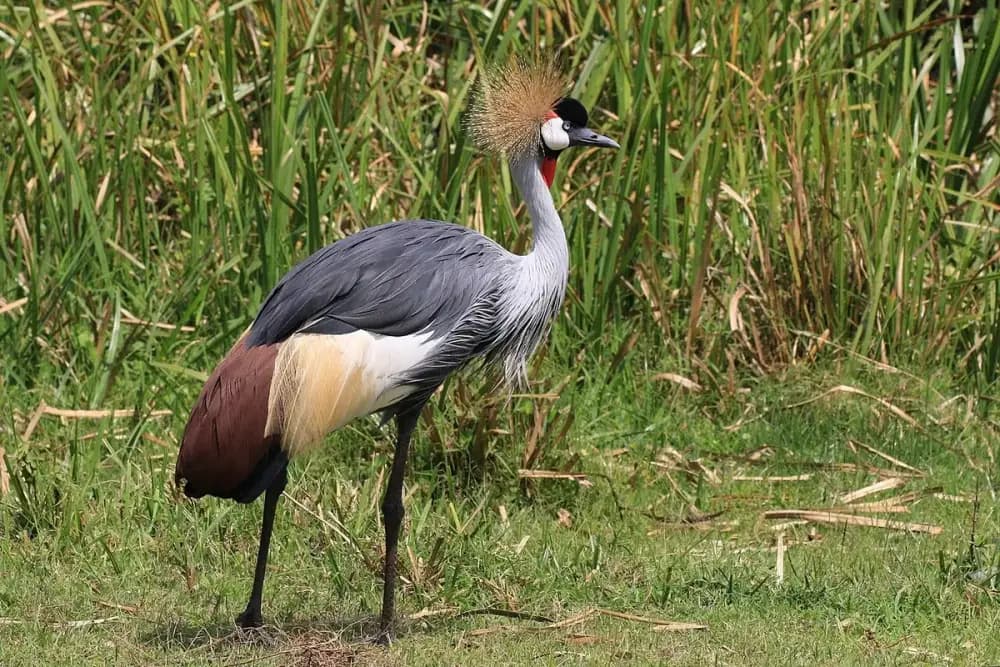
The black crowned crane is a bird of the crane family, topped with a crown of stiff golden bristle-like feathers. Its plumage is dark slate-grey to black, with white on the upper wings, a small red gular sac under the chin and large red cheek patches. It lives across the Sahel and Sudan savanna of Africa, from Senegal to the Ethiopian Highlands, in grasslands, shallow wetlands, marshes and the margins of lakes and rivers, and it also roosts in trees. A generalist feeder, it eats insects, molluscs, fish, amphibians, small reptiles and crops such as rice and millet. Rather than digging, it pecks at food on surfaces or stomps to flush out invertebrates.
About the black crowned crane
The black crowned crane is a large African crane with a crown of stiff, golden, bristle-like feathers. It belongs to the crane family, Gruidae, and its closest relative is its sister species, the grey crowned crane. It lives across the Sahel and Sudan savanna of sub-Saharan Africa, breeding in shallow wetlands during the wet season.
Its scientific name is Balearica pavonina. Carl Linnaeus described it in 1758, first placing it with herons and other cranes in the genus Ardea. It now shares the genus Balearica only with the grey crowned crane. The genus name means "of the Balearic Islands," and pavonina is Latin for "peacock-like," or patterned like a peacock's tail. Two subspecies are recognized: the West African black crowned crane in the west of the range and the Sudan black crowned crane in the east.
This is a big bird. It measures up to 105 cm (41 in) long, weighs 3–4 kg (6.6–8.8 lb) and spreads its wings 180–200 cm (71–79 in). The body plumage is dark slate-grey to black, and the upper part of each wing is white.
The crown is the bird's signature. Each golden, bristle-like feather is a spiral, white on one side and brown on the other, tipped with black. Below it, a large red patch sits on each cheek just behind the eye, and a small pouch of red skin, the gular sac, hangs under the chin. The two subspecies differ in their cheek patches: in the West African bird red covers only the lower half, while in the Sudan bird it reaches the upper half too. The legs and toes are black.
The feet hold a long hind toe that grasps perches, and it matters. Crowned cranes are the only cranes that can roost in trees, because the hind toe is long enough to grip a branch. They also lack the coiled windpipe of other cranes and have looser plumage. Males are larger than females but otherwise look the same. Juveniles are mostly grey, with a brown crown and nape.
Behavior and diet
Diet
Generalist: grasshoppers, locusts and other insects, molluscs, millipedes, crustaceans, fish, amphibians, small reptiles and grain
Black crowned cranes eat a broad menu. They take insects such as grasshoppers, locusts and flies, other invertebrates including molluscs, millipedes and crustaceans, and fish, amphibians and small reptiles. In farm country they also eat crops: rice, corn, teff, millet, chickpeas and lentils. They rarely dig. Instead they peck food off surfaces, and sometimes stamp their feet to flush invertebrates out of the soil.
They stay mostly in wetlands, except during the dry season. Then they may forage in short, dry grass or upland areas near livestock, where insects are plentiful. Dry-season flocks can number several hundred birds. These gatherings let young cranes join other juvenile flocks before they reach breeding age at three to five years old.
Their voice is low-pitched and mellow, a "honk" or a repeated "ka-wonk ka-wonk ka-wonk." The related grey crowned crane booms by inflating its red throat pouch and honks rather than giving the trumpeting calls of other cranes. It also has an elaborate dance of bowing and jumping.
Breeding follows the rains. West African birds breed from May to December and Sudan birds from July to January, with wide margins because success depends on the wet and dry seasons. Pairs are the rule during breeding, though groups of up to 20 are also seen. The nest is a circular platform of grasses and sedges built inside or on the edge of dense wetland vegetation, and the birds will move nest sites as food and cover change through the season.
The female lays one to three eggs, each weighing 122–168 g (4.3–5.9 oz). Both parents incubate for 28–31 days. While the female feeds, the male often stands guard in a nearby tree, ready to raise the alarm. Chicks leave the nest to forage in grassland with their parents the day after hatching and fledge at 60–100 days.
Range and habitat
Habitat
Shallow wetlands, marshes, lake and river margins, grassland and dry savanna near crops
The black crowned crane lives across the Sahel and Sudan savanna belts of Africa. Its range runs from the Senegal Basin and Guinea-Bissau in West Africa to the Ethiopian Highlands and the southwestern Rift Valley in East Africa. The western subspecies lives from Senegal and Gambia to Chad. The eastern subspecies ranges from southwestern Chad to western Ethiopia, northwestern Kenya and northern Uganda, with its largest numbers in Sudan.
It favors open country: grasslands, shallow wetlands, marshes and the edges of lakes and rivers. In the wet season, shallow wetlands are its main places to breed, feed and roost. It also forages in dry savanna grassland and near croplands, and roosts in trees.
Black crowned crane vs grey crowned crane
The two crowned cranes are so similar they were sometimes treated as one species. Genetics, calls, plumage and bare skin now separate them, and every authority treats them as distinct.
| Feature | Black crowned crane | Grey crowned crane |
|---|---|---|
| Body plumage | Dark slate-grey to black | Mainly grey |
| Face | Large red cheek patch | White cheek patch, with some red skin above it |
| Range | Sahel and Sudan savanna, West to East Africa | East and southern Africa, from Uganda and Kenya to South Africa |
| IUCN status | Vulnerable | Endangered |
| National bird of | Nigeria | Uganda |
Other cranes, such as the red-crowned crane, cannot roost in trees the way crowned cranes do.
Conservation status
The IUCN lists the black crowned crane as Vulnerable, in a 2024 assessment by BirdLife International, with an estimated 44,000–77,000 mature birds left in the wild.
Wetland loss is the main threat. Shallow wetlands are where these cranes breed, feed and roost, and many have been damaged by drought or drained for farming, dams and irrigation projects. When wetlands are broken into fragments, the movement of aquatic animals is reduced, which in turn cuts the cranes' food supply.
Hunting, capture and trade make matters worse and have claimed much of the remaining wild population. The species is the national bird of Nigeria and is widely seen as a symbol of peace.
Where to see black crowned crane in the U.S.
12 zoos across 9 states
Find the closest one
Rank the 12 zoos holding black crowned crane by how far they are from you. Your location is used in your browser to sort this list and is never sent to us.
California· 1
Colorado· 1
Florida· 1
Kansas· 3
Kentucky· 1
Louisiana· 1
Maryland· 1
Tennessee· 1
Wisconsin· 2
AZAThe Association of Zoos and Aquariums. Accredited members have passed an independent inspection of animal care and welfare, safety, conservation and education, repeated every five years. Many smaller facilities never apply, so “not accredited” isn't a verdict on its own. What accreditation means · How we check this
Built from each zoo's own published animal list.
Black Crowned Crane: common questions
How big is a black crowned crane?
Up to 105 cm (41 in) long, with a wingspan of 180–200 cm (71–79 in). Adults weigh 3–4 kg (6.6–8.8 lb).
Is the black crowned crane endangered?
It is listed as Vulnerable, one step below Endangered. About 44,000–77,000 mature birds remain, threatened mainly by wetland loss and trade.
What do black crowned cranes eat?
A wide variety of food. They eat insects, molluscs, crustaceans, fish, amphibians and small reptiles, plus grain crops such as rice, millet and corn.
Can black crowned cranes perch in trees?
Yes. A long hind toe lets crowned cranes grip branches, making them the only cranes able to roost in trees.
Where do black crowned cranes live?
In the Sahel and Sudan savanna of Africa, from Senegal and Gambia to Ethiopia, Kenya and Uganda, in wetlands, grasslands and savanna.
What sound does a black crowned crane make?
A low, mellow honk, often written as "ka-wonk ka-wonk ka-wonk."
What is the difference between black and grey crowned cranes?
Plumage and face color. The black crowned crane is dark with a red cheek patch, while the grey crowned crane is paler grey with white cheeks.