- Where to see one
- 22 U.S. zoos in our directory hold green anaconda, confirmed against each zoo's own animal list.
- Native range
- South America east of the Andes, including Colombia, Venezuela, the Guianas, Ecuador, Peru, Bolivia, Brazil, and Trinidad
- Size
- Females typically reach up to 5 m (16 ft 5 in), averaging about 4.6 m (15 ft 1 in); males average around 3 m (9 ft 10 in); typical adult weight is 30 to 80 kg (66 to 176 lbs)
- Lifespan
- About 10 years in the wild, longer in captivity
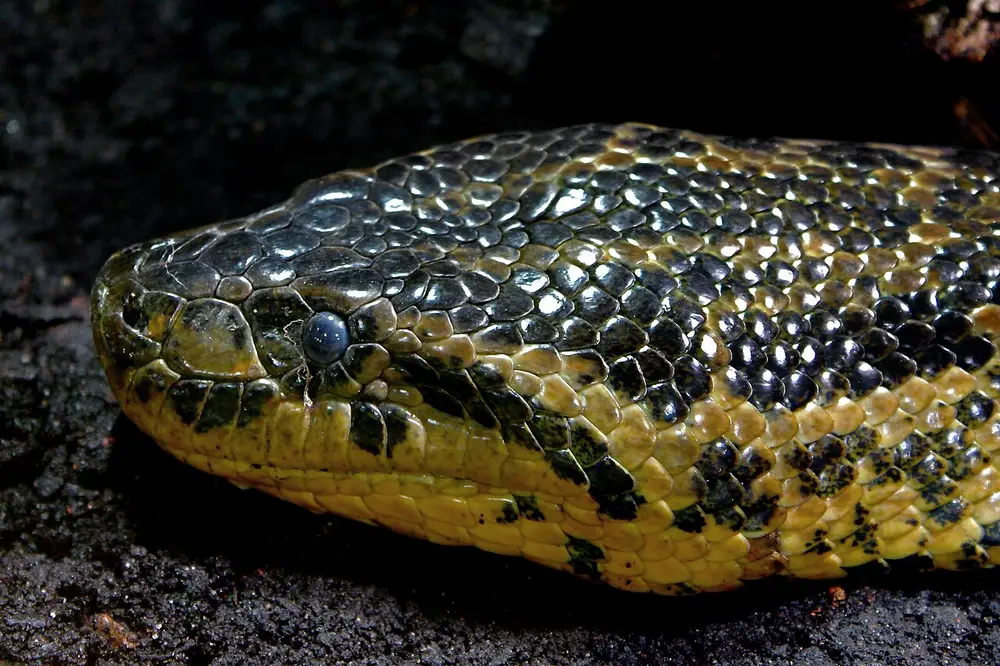
The green anaconda is a non-venomous boa from South America and one of the longest and heaviest snakes known. It lives in tropical rainforest, preferring shallow, slow-moving water such as streams, rivers and flooded grasslands, and spends most of its time in the water. It has an olive green body with black blotches, and its eyes and nostrils sit high on the head so it can watch for prey while submerged. A typical adult weighs 30 to 80 kg. It strikes, coils around its prey and constricts, taking fish, birds, caimans, capybaras and other animals.
About the green anaconda
The green anaconda is a boa species native to South America and one of the longest and heaviest snakes alive today. It is the largest snake native to the Americas, and while it is somewhat shorter than the reticulated python, it is far bulkier — a 5.2-meter green anaconda has a body mass comparable to a 7.4-meter reticulated python. Like all boas, it is a non-venomous constrictor: it strikes at passing prey, coils around it, and kills by constriction and suffocation rather than venom.
Females are considerably larger than males, more typically reaching up to 5 m in length with a mean of about 4.6 m, while males average only around 3 m. Weights in a typical adult range from 30 to 80 kg. The longest and heaviest verified specimen examined by herpetologist Jesús Antonio Rivas, who has studied more than 1,000 anacondas, measured 5.21 m and weighed 97.5 kg. Reports of anacondas exceeding 9 or even 12 meters circulate widely, but no such specimen has ever been backed by a museum voucher, and the Guinness Book of World Records notes the species has likely suffered more extreme size exaggeration than any other living animal.
The green anaconda's coloring is an olive-green background overlaid with black blotches running the length of the body, with a narrow head marked by distinctive orange-yellow stripes on either side. Its eyes and nostrils sit high on the head, letting it watch for prey and breathe while nearly its entire body stays submerged. The jaw bones are joined by flexible ligaments rather than fused bone, letting the mouth open wide enough to swallow prey larger than the snake's own head, while a windpipe in the mouth allows it to keep breathing during the process. Digesting a large meal can take many days, during which the anaconda becomes notably sluggish.
Behavior and diet
Diet
Fish, amphibians, birds, mammals, and other reptiles, including capybaras and caimans
Green anacondas are mostly nocturnal and spend the bulk of their time in the water, where they are stealthy and fast swimmers, though they are cumbersome moving on land. They float with just their eyes and nostrils exposed, waiting for prey to approach or stop to drink before striking, coiling around it, and constricting it to death.
As apex predators, green anacondas take almost any animal they can overpower: fish, amphibians, birds, mammals, and other reptiles. In both grassland and river-basin habitats they regularly take prey weighing 14 to 50 percent of their own body mass, including broad-snouted, spectacled, yacare, black, and smooth-fronted caimans, capybaras, red-rumped agoutis, collared peccaries, South American tapirs, boa constrictors, green iguanas, and several species of turtle. Particularly large individuals have been known to take tapirs, deer, peccaries, jaguars, and caimans, though such large meals are rare. Juveniles start out on much smaller fare, typically small birds and young caimans weighing just 40 to 70 grams. Because anacondas have a low metabolism, large individuals can go weeks or months without eating after a big meal.
Cannibalism has been documented in the species, usually a larger female consuming a smaller male; researchers link this to the anaconda's extreme size difference between sexes and to a female's heightened need for food after breeding to sustain her long gestation. Females also show increased feeding after giving birth to recover from the reproductive investment. Despite widespread local legend, there is little evidence of green anacondas preying on humans.
Range and habitat
Habitat
Swamps, marshes, lagoons, and slow-moving streams and rivers in tropical rainforest and seasonally flooded savanna
The green anaconda is found in South America east of the Andes, across Colombia, Venezuela, the Guianas, Ecuador, Peru, Bolivia, Brazil, Trinidad, and as far south as northern Paraguay. It favors swamps, marshes, lagoons, and slow-moving streams and rivers, particularly in the tropical rainforests and seasonally flooded savannas of the Amazon and Orinoco basins, spending most of its time in the water and only occasionally moving onto land into thick vegetation.
The species has also turned up outside its native range: as of August 2023, eleven green anacondas had been verifiably observed in the wild in Florida, spanning a range from Gainesville to Homestead. Florida is the only state in the continental U.S. with suitable habitat for the species, and it was added to Florida's list of prohibited nonnative species in April 2021. As of 2023 there was no known established breeding population, but Florida wildlife officials rate the ecological risk of introduction as very high, since the species could compete with or prey on native wildlife such as white-tailed deer, alligators, and wading birds.
Conservation status
The green anaconda is listed as Least Concern (LC) by the IUCN.
Where to see green anaconda in the U.S.
22 zoos across 16 states
Find the closest one
Rank the 20 zoos holding green anaconda by how far they are from you. Your location is used in your browser to sort this list and is never sent to us.
2 more zoos hold green anaconda but have no coordinates on file yet, so they aren't ranked here. They're in the full list below.
California· 1
Florida· 1
Illinois· 1
Kentucky· 1
Massachusetts· 2
Minnesota· 1
New Mexico· 1
New York· 2
North Carolina· 1
Ohio· 1
Oklahoma· 1
Rhode Island· 1
Tennessee· 1
Texas· 4
Virginia· 1
Wisconsin· 2
AZAThe Association of Zoos and Aquariums. Accredited members have passed an independent inspection of animal care and welfare, safety, conservation and education, repeated every five years. Many smaller facilities never apply, so “not accredited” isn't a verdict on its own. What accreditation means · How we check this
Built from each zoo's own published animal list.
Green Anaconda: common questions
Is the green anaconda endangered?
No. It is listed as Least Concern (LC) on the IUCN Red List.
How big does a green anaconda get?
Females typically reach up to 5 m (16 ft 5 in), averaging about 4.6 m, and can weigh 30 to 80 kg in a typical adult. Males are smaller, averaging around 3 m.
What does a green anaconda eat?
It preys on fish, amphibians, birds, mammals, and reptiles, including capybaras, caimans, and other large animals weighing up to half its own body mass.
How long do green anacondas live?
They generally live about 10 years in the wild, with some captive individuals living longer.
Where do green anacondas live in the wild?
They inhabit swamps, marshes, and slow-moving rivers in the Amazon and Orinoco basins of South America, including Colombia, Venezuela, Brazil, Peru, and Trinidad.
Which U.S. zoos have green anacondas?
Eleven zoos in our directory keep the species, including the Houston Zoo, the Buffalo Zoo, and the Nashville Zoo at Grassmere.