- Where to see one
- 6 U.S. zoos in our directory hold yellow anaconda, confirmed against each zoo's own animal list.
- Native range
- Southern South America, in the Paraguay River basin from the Pantanal to northeastern Argentina and northern Uruguay
- Size
- Averages 3.7 m (12 ft 1 in) long; females up to 4.6 m (15 ft 1 in); usually 25–35 kg (55–77 lb)
- Lifespan
- Typically 15–20 years in the wild; up to 23 years recorded in captivity
- Venom
- None; kills by constriction
- Litter size
- 4 to 82 live young, about 40 on average
Conservation status
Not Evaluated
This species has not been assessed for the IUCN Red List, so it sits outside the threat scale entirely.
Not assessed by the IUCN (NE)
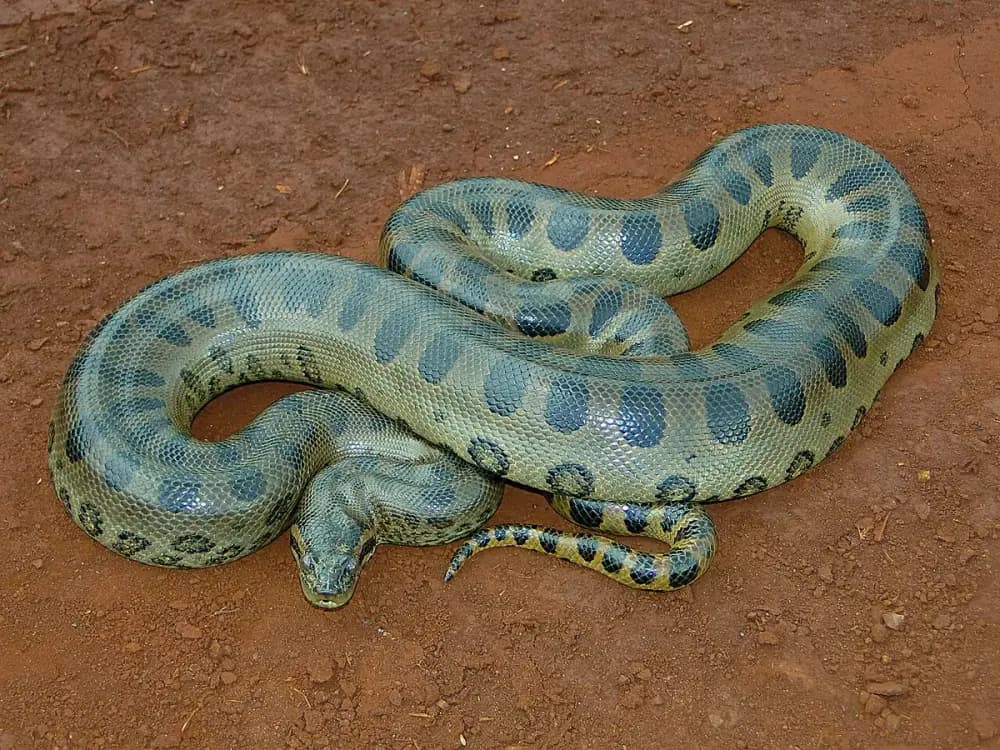
The yellow anaconda, also called the Paraguayan anaconda, is a non-venomous boa from southern South America and one of the largest snakes in the world, though smaller than the green anaconda. Its range covers the drainage of the Paraguay River, from the Pantanal of Bolivia, Paraguay and western Brazil to northeastern Argentina and northern Uruguay, and it favours swamps, marshes and slow-moving rivers. A solitary hunter that uses both ambush and wide foraging, it eats mostly aquatic or semi-aquatic prey, including apple snails, birds, fish, reptiles and mammals, and kills by constriction. Females give birth to live young.
About the yellow anaconda
The yellow anaconda is a large, non-venomous constricting snake in the boa family, native to the wetlands of southern South America around the Paraguay River. It is a close relative of the green anaconda and one of the largest snakes in the world, though it is clearly smaller than its green cousin. It is also called the Paraguayan anaconda.
Its scientific name is Eunectes notaeus. The species name comes from a Greek word meaning "dorsal." When Edward Drinker Cope described it, he separated it from the green anaconda by noting that its back scales are larger and set in fewer rows. No subspecies are recognized, although a 2023 proposal would merge two other anaconda names into this species and extend its range north.
Adults average 3.7 m (12 ft 1 in) in total length, with a typical range of about 2.4 to 4.6 m (7 ft 10 in to 15 ft 1 in). Females are the larger sex and have been reported up to 4.6 m (15 ft 1 in), while males reach about 3.7 m. Most adults weigh 25 to 35 kg (55 to 77 lb), but individuals heavier than 55 kg (121 lb) have been recorded. They appear to keep growing throughout life.
The color is a yellow, golden-tan, or greenish-yellow base covered with black or dark brown saddles, blotches, spots, and streaks that wrap around the body. The pattern works as camouflage in murky water and thick vegetation, and it hides young snakes from predators. Like all anacondas, it has heat-sensing pits along the mouth that detect warm-blooded prey, and more than 100 backward-curving teeth help it grip and swallow.
Behavior and diet
Diet
Wading birds and other birds, eggs, mammals, turtles, lizards, caimans, fish, and carrion
The yellow anaconda is a strictly solitary snake, meeting others only to mate. It spends most of its time in water, often floating at the surface with just its nose showing. It comes onto land to mate, to move between bodies of water, or to catch land prey. In droughts it seeks out swamps and marshes that still hold enough water to hunt, and it may shelter in caves or in water-holding holes along riverbanks. It has been recorded active both by day and at night.
It is a generalist predator that hunts by ambush and by actively searching. Almost all of its prey lives in or near water: apple snails, wading birds and other birds, bird eggs, small mammals, turtles, lizards, caimans, fish, and carrion. Large individuals take bigger animals, including brocket deer, peccaries, and capybaras. Compared with other boas, it often eats prey that is heavy relative to its own body weight. Cannibalism has also been seen.
Most feeding happens from June to November, when floodwaters drop and wetlands shrink. In flooded areas of Brazil's Pantanal, wading birds are the most common prey at that time of year. The snake strikes, wraps its coils around the animal, and tightens with each breath the prey lets out until it suffocates, sometimes dragging it underwater. Prey is swallowed head first. Because digestion is slow, a yellow anaconda may go days or even months between meals.
Like most snakes, it hears poorly but senses vibrations through its jaw, and it relies heavily on its forked tongue to taste the air. It is considered a timid snake that tries to escape threats, but it will defend itself when cornered.
Breeding takes place each year in April and May, usually in water. Males follow airborne scent from a female, and several males may coil around one female in a breeding ball that can last up to a month. The males compete, and the largest usually wins. Females carry the eggs inside their bodies for about 6 months and give birth to live young, anywhere from 4 to 82, each about 60 cm (24 in) long. The mother leaves at once, and the young are independent from birth. They mature at 3 to 4 years.
Young snakes face many predators, including crab-eating foxes, tegu lizards such as the Argentine black and white tegu, caimans, larger anacondas, wild cats, herons, and raptors such as the crested caracara. Adults have few natural enemies apart from people.
Range and habitat
Habitat
Swamps, marshes, and the brushy banks of slow rivers and streams
The yellow anaconda lives in the drainage of the Paraguay River and its tributaries. Its range runs from the Pantanal of Bolivia, Paraguay, and western Brazil south to northeastern Argentina and northern Uruguay. The best habitat lies mostly in northern Argentina and southern Paraguay.
It favors mostly aquatic habitat: swamps, marshes, and the brush-covered banks of slow-moving rivers and streams. During the rainy months it moves into flooded, treeless areas to hunt fish and caimans, and it sometimes enters forest after larger game. A small population, thought to come from escaped pets, appears to have become established in Florida, though it is unknown whether it breeds there.
Yellow anaconda vs green anaconda
The two anacondas are close relatives and are often confused, but they differ in size, color, and range.
| Feature | Yellow anaconda | Green anaconda |
|---|---|---|
| Scientific name | Eunectes notaeus | Eunectes murinus |
| Typical length | About 3.7 m (12 ft); up to 4.6 m (15 ft) | Mature females average about 4.6 m (15 ft 1 in); reported up to 6.32 m (20 ft 9 in) |
| Typical weight | 25–35 kg (55–77 lb) | 30–80 kg (66–176 lb) |
| Color | Yellow, golden-tan, or greenish-yellow with dark blotches | Olive green with black blotches |
| Range | Paraguay River basin, southern South America | Amazon and Orinoco basins, east of the Andes |
The green anaconda is the heaviest snake in the world, while the yellow anaconda is smaller and more southern.
Conservation status
The yellow anaconda has not been assessed by the IUCN, so it has no category on the IUCN Red List. It is listed on CITES Appendix II, which regulates international trade.
Hunting for skins once took a heavy toll. Between the 1940s and the 1980s, 10,000 to 60,000 yellow anaconda skins from Argentina were exported to Europe and the United States, with no limits or monitoring. Argentina banned hunting and trade in 1986, and since 2001 the species has been managed under regional and national conservation and sustainable-use plans. Poaching there has nearly stopped, though some tightly regulated local hunting continues, and hunting is illegal in most of South America. Habitat loss, killing out of fear, and collection for the pet trade remain pressures. In the United States, importing the species and moving it across state lines was banned in 2012 to keep it from becoming invasive in places such as the Florida Everglades.
Where to see yellow anaconda in the U.S.
6 zoos across 6 states
Find the closest one
Rank the 5 zoos holding yellow anaconda by how far they are from you. Your location is used in your browser to sort this list and is never sent to us.
1 more zoo holds yellow anaconda but has no coordinates on file yet, so it isn't ranked here. It's in the full list below.
Alabama· 1
California· 1
Maryland· 1
Mississippi· 1
North Carolina· 1
Washington· 1
AZAThe Association of Zoos and Aquariums. Accredited members have passed an independent inspection of animal care and welfare, safety, conservation and education, repeated every five years. Many smaller facilities never apply, so “not accredited” isn't a verdict on its own. What accreditation means · How we check this
Built from each zoo's own published animal list.
Yellow Anaconda: common questions
How big do yellow anacondas get?
Adults average about 3.7 m (12 ft) long and usually weigh 25–35 kg (55–77 lb). Females can reach 4.6 m (15 ft), and some individuals weigh more than 55 kg (121 lb).
Are yellow anacondas venomous?
No. Like all boas, they are non-venomous and kill prey by constriction.
Are yellow anacondas dangerous to humans?
Rarely. Attacks on people are exceptionally rare, and wild snakes usually try to escape, but captive animals can be unpredictable and defensive.
What do yellow anacondas eat?
Mostly water-linked prey: wading birds, eggs, mammals, turtles, lizards, caimans, fish, apple snails, and carrion. Large adults can take brocket deer, peccaries, and capybaras.
Where do yellow anacondas live?
In the wetlands of the Paraguay River basin, from the Pantanal of Bolivia, Paraguay, and Brazil to northeastern Argentina and northern Uruguay.
How long do yellow anacondas live?
Typically 15 to 20 years in the wild. Well-kept captive snakes can live longer, with a recorded maximum of 23 years.
Do yellow anacondas lay eggs?
No. Females keep the eggs inside their bodies for about 6 months and give birth to 4 to 82 live young, each about 60 cm (24 in) long.
Can you keep a yellow anaconda as a pet?
It is difficult and, in the U.S., restricted. Captive yellow anacondas are often aggressive and hard to tame, and since 2012 importing them and moving them across state lines has been banned.