- Where to see one
- 11 U.S. zoos in our directory hold wood turtle, confirmed against each zoo's own animal list.
- Native range
- Northeastern North America, from Nova Scotia west to Minnesota and south to Virginia
- Size
- Carapace length 14 to 20 cm (5.5 to 7.9 in), up to 23.4 cm (9.2 in) in the largest males; weighs about 1 kg (2.2 lb) at full growth
- Lifespan
- Up to 40 years in the wild, and up to 58 years in captivity
Conservation status
Endangeredassessed 2011
IUCN Red List category EN — step 4 of 7.
Endangered (EN), assessed in 2011; numbers declining
About the wood turtle
The wood turtle is a turtle of the family Emydidae, native to northeastern North America. Its only close relative in the genus Glyptemys is the bog turtle; the wood turtle was formerly classified in the genus Clemmys alongside the spotted turtle, whose genetic makeup differs only marginally from the bog turtle's. The species carries several older common names, including sculptured tortoise, red-legged tortoise, and redleg, and its scientific name, insculpta, refers to the rough, sculpted texture of its shell.
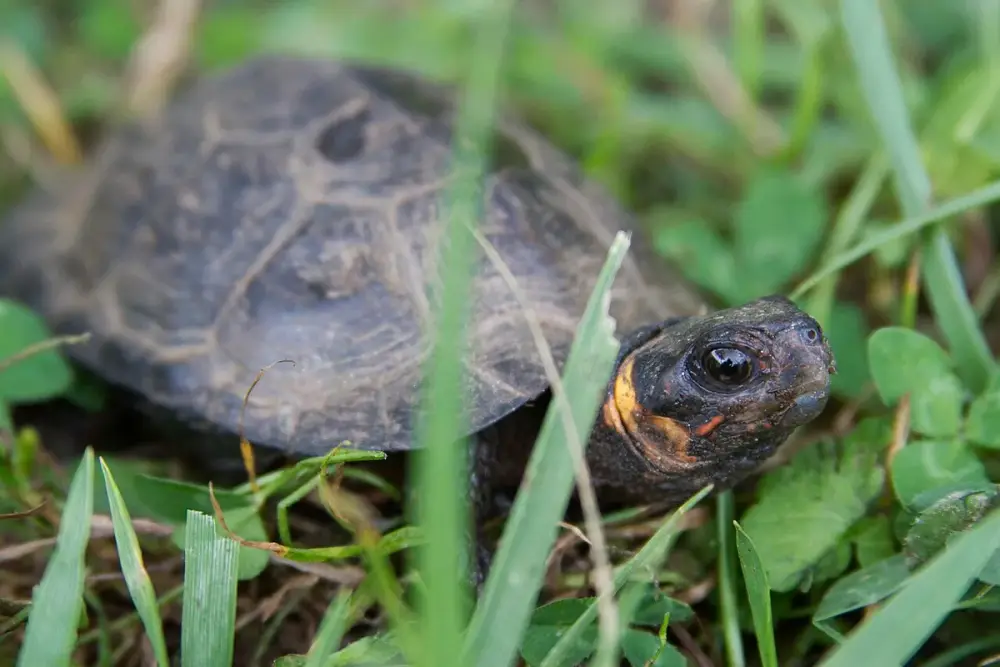
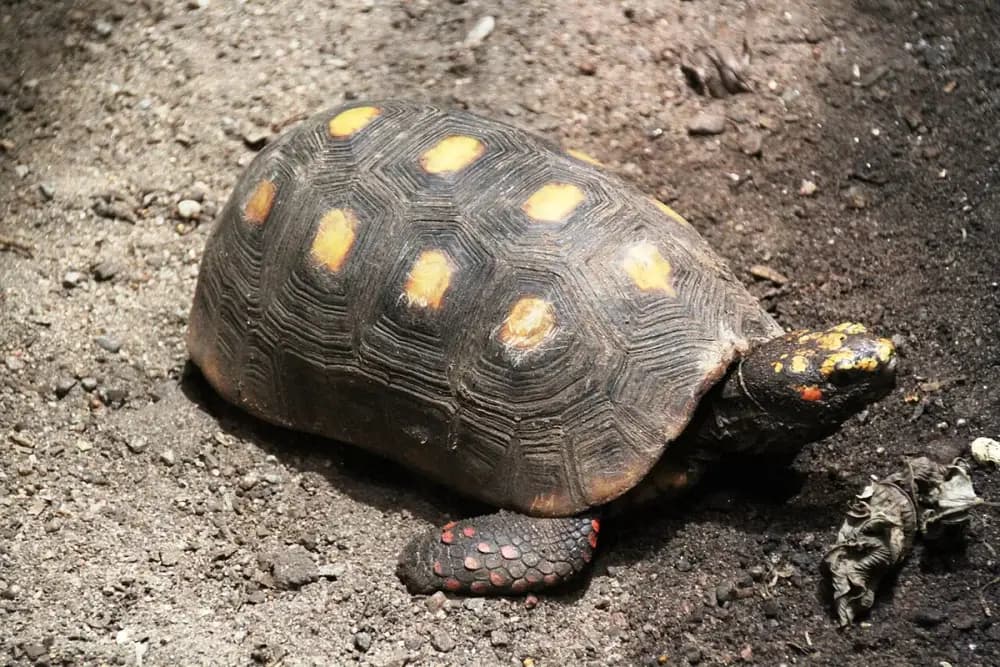
That texture is the wood turtle's most obvious feature: a carapace, tan to grayish brown or brown, built around a central keel of pyramid-shaped ridges and grooves that becomes more worn and abraded as the turtle ages. The carapace runs 14 to 20 cm (5.5 to 7.9 in) in most adults, with the largest males reaching 23.4 cm (9.2 in) — larger than the largest recorded females, at 20.4 cm (8.0 in). A full-grown wood turtle weighs about 1 kg (2.2 lb). The plastron, or lower shell, is yellowish with dark patches and ends in a V-shaped notch at the rear. The head is often dark gray to black on top, while the neck, chin, and legs run orange to red, more vividly so in males than in females. Males also carry larger claws, a bigger head, a concave plastron, a more domed carapace, and a longer tail than females; hatchlings, by contrast, have dull gray-to-brown plastrons, carapaces as wide as they are long, and none of the pyramidal texture that develops with age.
The species' range stretches from Nova Scotia in the east and north to Minnesota in the west, and south to Virginia, though it was once pushed further south by advancing glaciers — skeletal remains have turned up as far south as Georgia. Roughly 30% of the total population lives in Canada.
Behavior and diet
Diet
Omnivorous — plant matter, insects, worms, fungi, and carrion, taken on land and in water
Wood turtles are diurnal and most active in spring, typically moving between about 7 a.m. and 7 p.m., with early morning and late afternoon the preferred times to forage. They bask on logs, sandy shores, and banks to regulate their body temperature, reaching a peak of about 37 °C (99 °F) after a long bask, and will estivate under vegetation or debris during especially hot stretches. Through summer the wood turtle behaves more like a land animal, resting at night in creeks or nearby underbrush with its body temperature dropping to 15–20 °C (59–68 °F). Come November, it shifts back to the water, spending November through February or March hibernating — sometimes alone, sometimes in groups — buried in mud at the bottom of a river, where it is vulnerable to flash floods. It doesn't emerge again until March or April.
Males establish dominance hierarchies through direct aggression rather than sheer size: larger, older males rank higher, and confrontations can include biting, shoving, and ramming, with a dominant male sometimes trying to displace a rival already mating with a female. The wood turtle is omnivorous, eating beetles, millipedes, slugs, mosses, grasses, various insects, carrion, and specific fungi such as Amanita muscaria. It also practices a technique called worm charming — stomping the ground with alternating front feet to mimic the vibrations of a burrowing mole, which brings earthworms to the surface where they're easily caught. On land it pokes its head into decaying logs and dense vegetation to hunt; in the water it searches algae beds and stream-bank cavities the same way.
The wood turtle takes a long time to mature, becoming sexually capable only between 14 and 18 years of age, and mating activity peaks in spring and again in fall. It also has a documented homing ability: in one case, a male displaced 2.4 km (1.5 mi) from its home site found its way back within five weeks, a skill that does not appear to vary by sex, age, or the direction of displacement. On an average day it covers about 108 meters (354 ft) — a notably long distance for a turtle.
Range and habitat
Habitat
Slow-moving streams with sandy bottoms, forests, fields, bogs, wet meadows, and beaver ponds
Wood turtles range through most New England states, Nova Scotia, west to Michigan, northern Indiana, and Minnesota, and south to Virginia, in a distribution that is disjunct overall, with populations often small and isolated. They favor slow-moving streams with sandy bottoms and heavily vegetated banks; the soft, muddy stream bottoms are used for overwintering, while the open-canopy areas bordering the water serve as nesting ground. From spring through summer the turtles range more widely into forests, fields, bogs, wet meadows, and beaver ponds, returning to the waterways for the rest of the year.
Population density varies sharply by latitude. In the northern part of the range, in Quebec and other parts of Canada, densities run thin — an average of about 0.44 individuals per hectare (2.5 acres) — while over a comparable area farther south, densities have been recorded from 6 to 90 turtles. Turtles in the western part of the range also tend to be more aquatic, while those in the east are markedly more terrestrial in summer, though even there they rarely stray far from water.
Conservation status
The wood turtle is listed as Endangered on the IUCN Red List, in an assessment published in 2011. Despite a seemingly large and diverse distribution, its numbers are in decline, and Canada's COSEWIC considers it threatened nationally.
Human interference with its habitat is the main driver. Habitat destruction and fragmentation make it harder for turtles to find mates and build quality nests, and additional losses come from road traffic, farming accidents, and illegal collection for the international pet trade. Many areas have passed laws to protect the species, though enforcement and public education remain minimal. Under-road tunnels are one emerging fix for road deaths, which mainly affect nesting females.
Raccoons, which are overabundant in many areas, pose a direct threat to the species at every life stage, and eggs and hatchlings are further targeted by otters, foxes, cats, snapping turtles, common ravens, and coyotes, some of which can destroy an entire nest. The species is also known to suffer from leech infestations.
Where to see wood turtle in the U.S.
11 zoos across 7 states
Find the closest one
Rank the 10 zoos holding wood turtle by how far they are from you. Your location is used in your browser to sort this list and is never sent to us.
1 more zoo holds wood turtle but has no coordinates on file yet, so it isn't ranked here. It's in the full list below.
Florida· 1
Illinois· 1
Maryland· 1
New Jersey· 1
New York· 2
Pennsylvania· 2
Virginia· 3
AZAThe Association of Zoos and Aquariums. Accredited members have passed an independent inspection of animal care and welfare, safety, conservation and education, repeated every five years. Many smaller facilities never apply, so “not accredited” isn't a verdict on its own. What accreditation means · How we check this
Built from each zoo's own published animal list.
Wood Turtle: common questions
Is the wood turtle endangered?
Yes. It is listed as Endangered on the IUCN Red List (2011), with habitat loss, road deaths, and illegal collection driving its decline.
How big does a wood turtle get?
Most adults reach a carapace length of 14 to 20 cm (5.5 to 7.9 in), with the largest males growing to 23.4 cm (9.2 in) and weighing about 1 kg (2.2 lb).
How long do wood turtles live?
Up to about 40 years in the wild, and as long as 58 years in captivity.
What do wood turtles eat?
They're omnivorous, eating beetles, millipedes, slugs, mosses, grasses, insects, certain fungi, and carrion, both on land and in water.
Where do wood turtles live in the wild?
In northeastern North America, from Nova Scotia west to Minnesota and south to Virginia, favoring streams with sandy bottoms and vegetated banks.
Which U.S. zoos have wood turtles?
Seven U.S. zoos, including the Lincoln Park Zoo, the Maryland Zoo in Baltimore, and the Virginia Zoological Park.