- Where to see one
- 12 U.S. zoos in our directory hold rhinoceros iguana, confirmed against each zoo's own animal list.
- Native range
- Hispaniola (Haiti and the Dominican Republic) and nearby small islands
- Size
- Length 60–136 cm (24–54 in); most adults weigh 4.56–9 kg (10.1–19.8 lb)
- Lifespan
- About 20 years reported in captivity
- Clutch
- 2–34 eggs, averaging 17; incubation about 85 days
- Wild population
- An estimated 10,000–17,000 in 1996
Conservation status
Endangeredassessed 2019
IUCN Red List category EN — step 4 of 7.
The rhinoceros iguana is a large lizard native to the Caribbean island of Hispaniola, shared by Haiti and the Dominican Republic, and its surrounding islands. Its name comes from the bony, horn-like growths on the snout. Individuals measure 60 to 136 centimetres in length, and skin colour ranges from steely grey to dark green and brown. They favour dry scrub woodland and barren, rocky ground with boulders for basking and crevices for retreat. The diet is mainly leaves, flowers, seeds and fruit, though individuals have been seen eating small lizards, snakes, land crabs, insects and carrion. Seeds that pass through Cyclura iguanas germinate more quickly.
About the rhinoceros iguana
The rhinoceros iguana is a large, heavy-bodied lizard endemic to the Caribbean island of Hispaniola and its surrounding islets. It is one of the West Indian rock iguanas of the genus Cyclura, named for the bony, horn-like growths on its snout. It lives in dry, rocky scrubland and is listed as Endangered.
Its scientific name, Cyclura cornuta, comes from the Latin for "horned." Pierre Joseph Bonnaterre first described the species in 1789. Besides the living Hispaniolan form, a second subspecies once lived on Navassa Island but is now extinct. The Mona ground iguana of Puerto Rico was once treated as a third subspecies, and some taxonomists still treat it that way. Other rock iguanas include the Grand Cayman blue iguana and the Jamaican iguana.
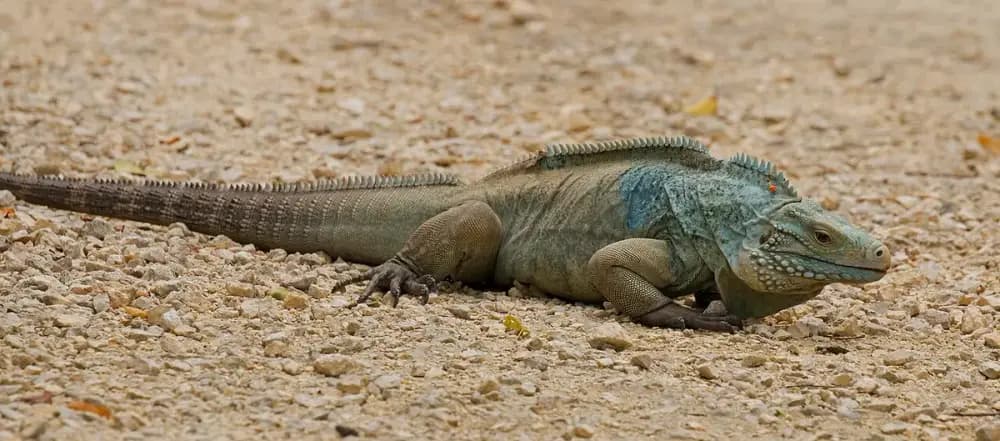
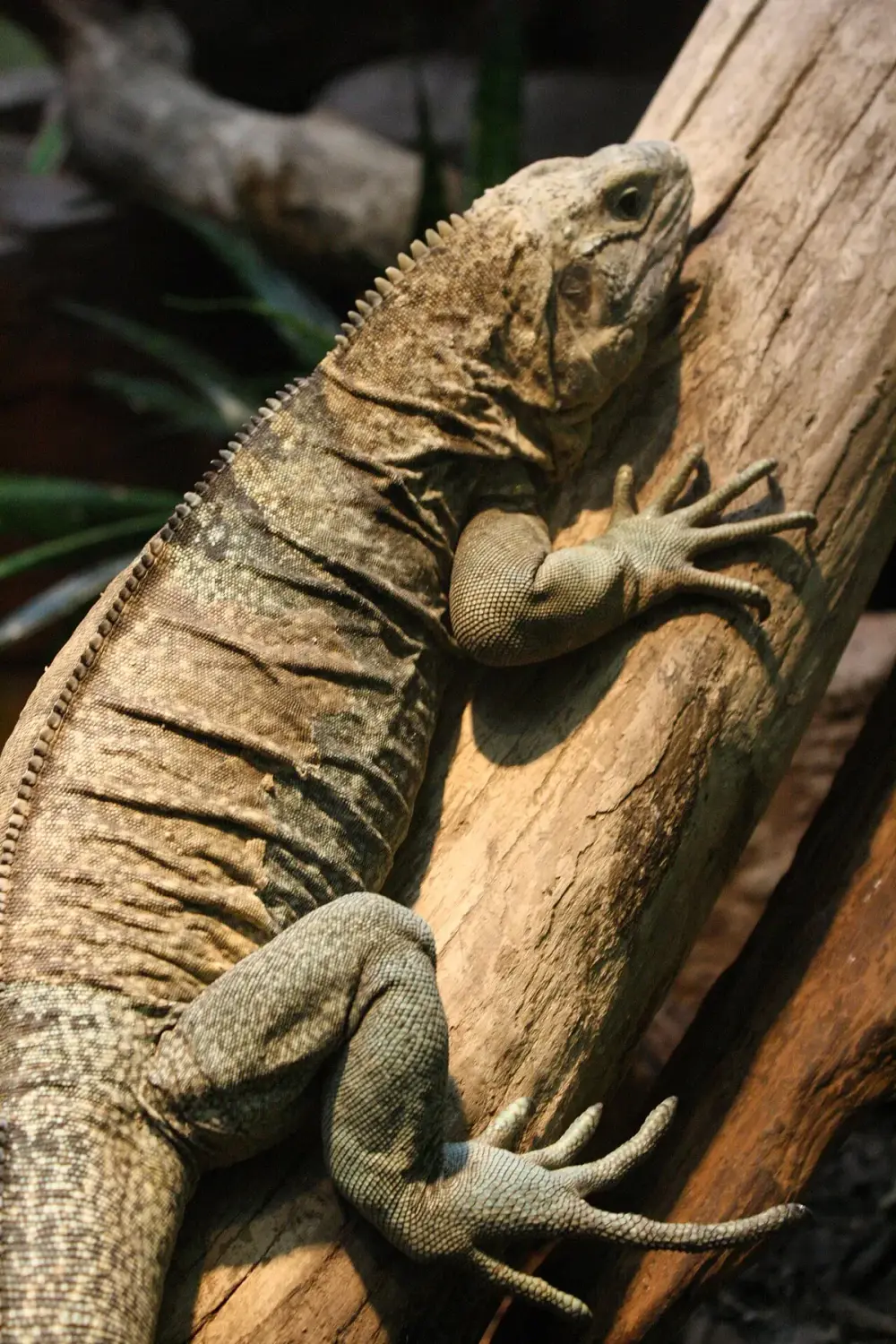
This is a big lizard. Adults range from 60 to 136 cm (24 to 54 in) long, and most weigh 4.56–9 kg (10.1–19.8 lb). Like other Cyclura, it has a heavy head, strong legs and a tail flattened from side to side. A crest of pointed, horn-like scales runs from the nape of the neck to the tail tip. Skin color is a drab grey to brown, sometimes dark green or olive, which helps it blend into its surroundings.
The "horns" that give the species its name are bony bumps on the snout. Males grow larger horns, along with a fatty pad on the back of the head that looks like a helmet, a large dewlap and big femoral pores on the thighs that release pheromones. Unusually, females have horns and well-developed dewlaps too, and the size difference between the sexes is smaller than in most iguanas. Researchers suggest this is because females compete fiercely for scarce nesting sites, using their horns to fight one another much as males fight over mates.
Behavior and diet
Diet
Mainly leaves, flowers, seeds, berries and fruit; occasionally insects, land crabs, small lizards and carrion
Rhinoceros iguanas are cold-blooded and depend on the sun to warm up, shifting position through the day to hold a good body temperature. They need warm conditions, typically areas where the average yearly temperature is at least 27°C (81°F). They are strongly territorial, and the most aggressive males hold the largest territories.
Head-bobbing is their main language. Males nod at each other to assert dominance or claim an area, to warn rivals off and to court females. Females bob their heads mostly to fend off persistent males. Wild and captive iguanas sometimes direct the same signal at people, either as a warning or as a kind of greeting.
Most rhinoceros iguanas, especially those bred in captivity, are docile and tolerant of people. Moods vary, though. When threatened they prefer to flee into rock crevices, but a cornered iguana will bite and lash out repeatedly with its thick tail, and the long claws can cause deep scratches even during friendly handling.
The diet is mostly plants: leaves, flowers, seeds, berries and fruit. They are also opportunistic meat-eaters and have been seen eating small lizards, snakes, land crabs, insects and carrion, especially dead birds and fish. Young iguanas eat insects and small animals more often. An iguana that finds a fruiting bush will defend it from others.
These iguanas matter to their ecosystem. As the largest native plant-eaters on their islands, they spread seeds, especially when females travel to nesting sites. A study by Allison Alberts found that seeds passing through a Cyclura iguana's gut sprout faster than other seeds, helping them get going before short rainy seasons end.
Mating takes place at the start of, or just before, the first rainy season, in May and June, and lasts two to three weeks. About 40 days later the female lays 2 to 34 eggs, 17 on average, in a burrow up to 1.5 m (5 ft) long. She guards the nest for several days, and the eggs incubate for about 85 days. Hatchlings are independent from the start. Females mature at two to three years old and males at four to five.
Range and habitat
Habitat
Dry forest and scrub on rocky limestone, coastal terraces and arid lowlands
The rhinoceros iguana lives only on Hispaniola, the island shared by Haiti and the Dominican Republic, and on its offshore islands and cays. Populations are stable only on Isla Beata and at the tip of the Barahona Peninsula in the Dominican Republic's Jaragua National Park. There are moderately dense populations in southeastern Haiti and its offshore islands, around the brackish lake Étang Saumâtre, and around the very salty Lake Enriquillo and its island, Isla Cabritos.
The species favors dry places with little rain and few trees or shrubs. It is most common in the scrub woodlands of the Hispaniolan dry forest, on rough, eroded limestone with sparse plants, as well as coastal terraces and lowlands. True to the "rock iguana" name, it likes barren ground with big smooth boulders and rocky outcrops for basking, and plenty of crevices to hide in. Historically it lived near the coast, but people and introduced predators have pushed it inland. The Navassa Island population has been wiped out.
Conservation status
The IUCN lists the rhinoceros iguana as Endangered, in a 2019 assessment. In 1996 about 10,000–17,000 were thought to remain in the wild. International trade is restricted under Appendix I of CITES.
The threats are many and almost all caused by people. They include illegal logging, competition from cattle, pigs and goats, limestone mining, collection for the pet trade, hunting for bushmeat, pollution and wildfires. Haiti's populations are in especially bad shape because of deforestation, land clearing and poaching for food.
Introduced predators are a major problem. The only confirmed native predator is the Hispaniola racer, a large snake that chases young iguanas and waits outside their burrows. Most predation now comes from feral dogs, feral cats, small Indian mongooses and feral pigs, which eat eggs, young and adults. The iguana's head-bobbing threat displays do little to deter them.
There has been some success with captive breeding. A captive-breeding program in the Dominican Republic hatched about 100 young a year from 1974 to 1994 and released head-started juveniles into protected areas in the southwest of the country, though the program ended in 1995. The rhinoceros iguana is the Cyclura species most often kept in captivity, which has reduced demand for wild-caught animals.
Where to see rhinoceros iguana in the U.S.
12 zoos across 8 states
Find the closest one
Rank the 10 zoos holding rhinoceros iguana by how far they are from you. Your location is used in your browser to sort this list and is never sent to us.
2 more zoos hold rhinoceros iguana but have no coordinates on file yet, so they aren't ranked here. They're in the full list below.
Alabama· 1
California· 1
Florida· 2
Illinois· 1
Missouri· 1
New York· 2
Pennsylvania· 1
Tennessee· 3
AZAThe Association of Zoos and Aquariums. Accredited members have passed an independent inspection of animal care and welfare, safety, conservation and education, repeated every five years. Many smaller facilities never apply, so “not accredited” isn't a verdict on its own. What accreditation means · How we check this
Built from each zoo's own published animal list.
Rhinoceros Iguana: common questions
How big do rhinoceros iguanas get?
From 60 to 136 cm (24 to 54 in) long. Most adults weigh 4.56–9 kg (10.1–19.8 lb), and males are larger than females.
Why is it called a rhinoceros iguana?
Because of the bony, horn-like bumps on its snout, which resemble a rhinoceros horn. Males have the biggest horns, but females have them too.
Are rhinoceros iguanas dangerous?
Not usually. Most are docile, but a cornered iguana will bite, scratch and strike with its thick tail.
What do rhinoceros iguanas eat?
Mostly plants, including leaves, flowers, seeds, berries and fruit. They occasionally eat insects, land crabs, small lizards and carrion.
How long do rhinoceros iguanas live?
About 20 years has been reported in captivity. Little is known about wild lifespans, which some researchers think could be much longer.
Where do rhinoceros iguanas live?
Only on Hispaniola, in Haiti and the Dominican Republic, and on nearby islands such as Isla Beata, in dry, rocky scrubland.
Can you keep a rhinoceros iguana as a pet?
Captive-bred animals are kept as pets, and legal trade exists. Buyers are advised to insist on full documentation, because wild collection threatens the species and wild animals often carry parasites and disease.
Are rhinoceros iguanas endangered?
Yes. The IUCN lists them as Endangered because of habitat loss, hunting and introduced predators.