Grand Cayman Blue Iguana
Cyclura lewisi
Also known as Grand Cayman Iguana, Grand Cayman Rock Iguana
- Where to see one
- 10 U.S. zoos in our directory hold grand cayman blue iguana, confirmed against each zoo's own animal list.
- Native range
- Endemic to the island of Grand Cayman
- Size
- Up to 5 ft (1.5 m) nose to tail, weighing as much as 30 lb (14 kg)
- Lifespan
- Possibly up to 69 years
About the grand cayman blue iguana
The Grand Cayman blue iguana, also called the Grand Cayman ground iguana or Cayman Island rock iguana, is a lizard in the family Iguanidae found nowhere in the world except the island of Grand Cayman. It was once classified as a subspecies of the Cuban iguana, Cyclura nubila, until a 2004 study by Frederic J. Burton separated it into its own species based on genetic differences, skin color, geographic isolation, and mitochondrial DNA analysis. Its closest relatives remain the Cuban iguana and the Northern Bahamian rock iguana, and it can still interbreed with a related subspecies found on Little Cayman and Cayman Brac to produce fertile offspring.
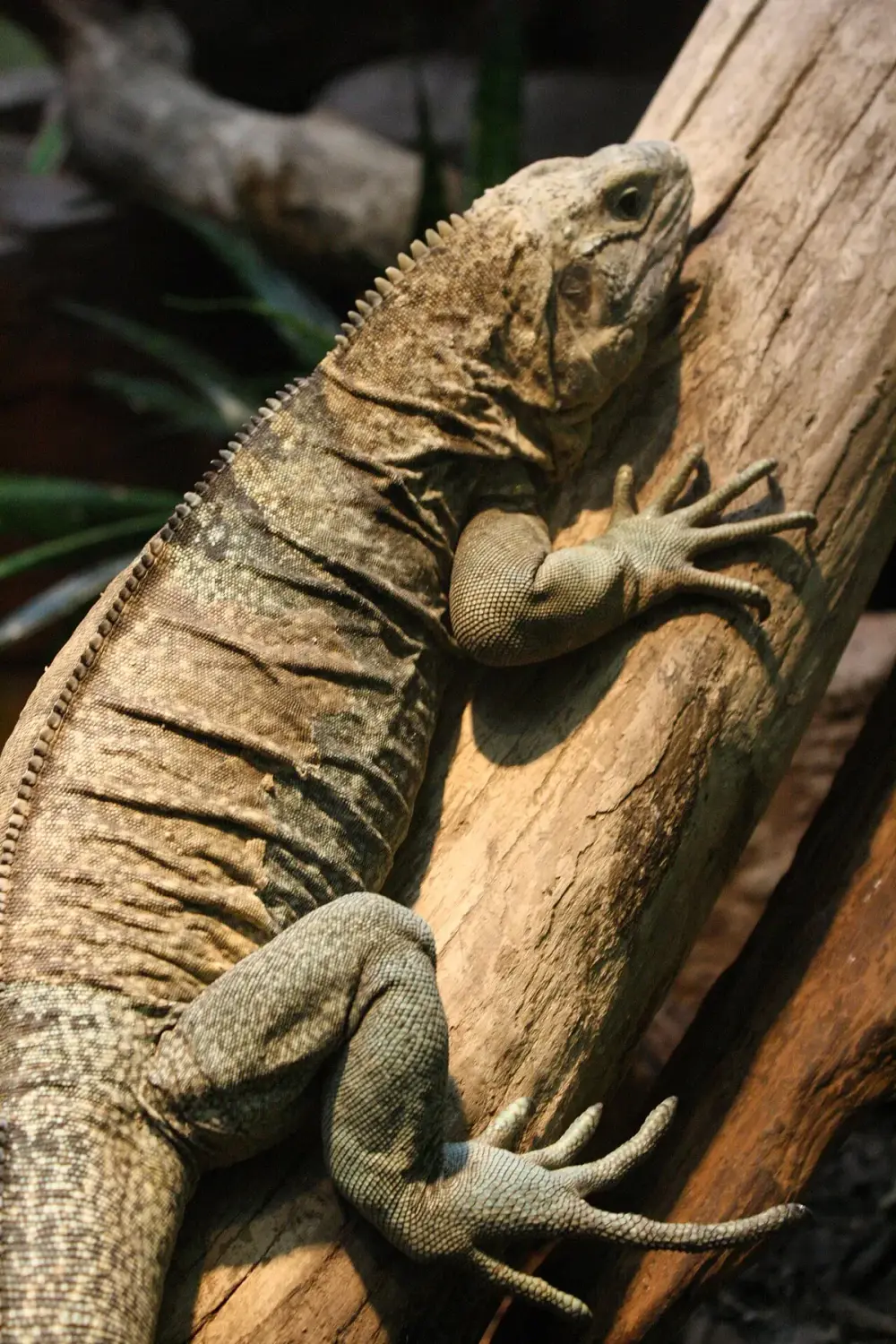
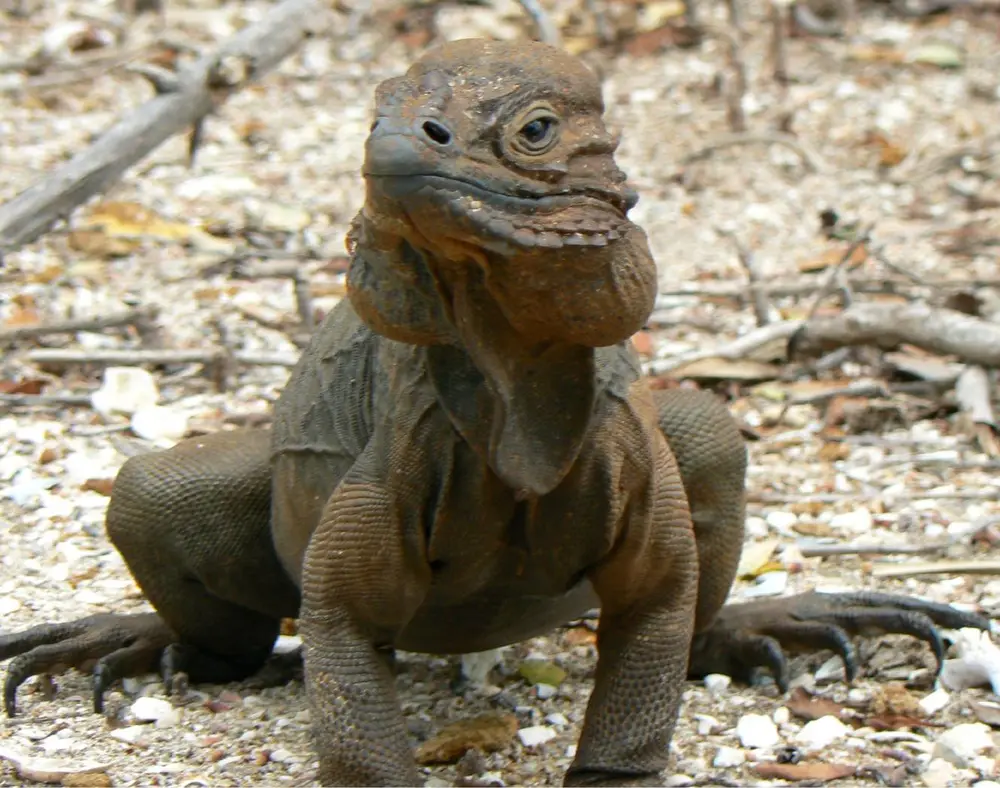
It is an example of island gigantism: the largest native land animal on Grand Cayman, and among the largest lizard species in the Western Hemisphere. Adults reach a total nose-to-tail length of 5 ft (1.5 m) and can weigh as much as 30 lb (14 kg), with a body length of 20 to 30 in (510 to 760 mm) and a tail of roughly equal length. Mature males range from dark grey to turquoise blue, while females run more olive green to pale blue, with the blue coloring becoming more pronounced during the breeding season and most vivid in males. The species changes color to a more intense blue in the presence of other iguanas as a way to signal and establish territory. Young iguanas look quite different: uniformly dark brown or green with faint banding as hatchlings, developing an intricate pattern of eight dark dorsal chevrons that fade within the first year before the animal transitions through mottled gray and cream and finally to adult blue. The eyes have a golden iris and red sclera, and the feet are distinctively black against the lighter body.
Males are larger than females — by about a third of body size — and have more prominent dorsal crests along with larger femoral pores on the thighs, used to release pheromones. Toes are articulated for efficient digging and climbing, and although the species is primarily terrestrial as an adult, individuals have been observed climbing trees 15 feet (4.6 m) or higher, with younger iguanas more inclined to climb than adults.
Behavior and diet
Diet
Leaves, stems, flowers, nuts, and fruits from more than 45 plant species, occasionally insects, crabs, slugs, and fungi
The blue iguana is primarily herbivorous, eating leaves, stems, flowers, nuts, and fruit from more than 45 plant species. Its diet is rarely supplemented with insects, crabs, slugs, and fungi, and individuals have also been observed ingesting small rocks, soil, feces, and bits of their own shed skin. Iguanas spend little time in a retreat during the day before settling in at the end of it, and as adults they occupy rock holes and tree cavities.
Mating takes place from May through June. Courtship begins with numerous head-bobs from the male, who then circles behind the female and grasps the nape of her neck to maneuver into position for copulation, which typically lasts 30 to 90 seconds; a pair rarely mates more than once or twice in a day. Females lay a clutch of 1 to 21 eggs in June or July, digging nests in sun-exposed pockets of earth — sometimes starting several exploratory burrows before completing one. These nest burrows range from 16 in (0.41 m) to more than 60 in (1.5 m) long, with an enlarged chamber at the end where the female can turn around. Nest temperatures monitored by researchers held steady at 32°C (90°F) throughout an incubation period of 65 to 90 days, and the eggs themselves are among the largest laid by any lizard. Iguanas become aggressively territorial from about three months of age and typically reach sexual maturity after four years in captivity.
Hatchlings are preyed on by the native snake Cubophis caymanus, but adults have no natural predators. Longevity in the wild is unknown but presumed to run many decades; a captive individual named "Godzilla," captured on Grand Cayman in 1950 and later housed at the Gladys Porter Zoo in Brownsville, Texas, is thought to have reached about 69 years of age before his death in 2004, making him possibly the longest-living lizard with a reliable record.
Range and habitat
Habitat
Rocky, sunlit, open areas in dry forest, and interfaces between farm clearings, roads, gardens, and closed-canopy dry forest or shrubland
The blue iguana is endemic to Grand Cayman and, as of 2012, was found across the island except for the urban areas of Bodden Town, Gun Bay, Seven Mile Beach, and West Bay. Comparisons with related Cyclura species suggest a coastal population once existed but was displaced by human settlement and road construction, leaving today's iguanas mostly inland in natural xerophytic shrubland and along the edges of farm clearings, roads, gardens, and closed-canopy dry forest. Agricultural clearings and fruit farms appear to have drawn iguanas inland by offering sun for thermoregulation, herbaceous browse, fallen fruit, and soil suitable for nesting — but that same proximity brought them into more frequent contact with humans and feral animals. Females often migrate to coastal areas specifically to nest. Radio-tracking of iguanas released into the Queen Elizabeth II Botanic Park in 2004 found that females occupy territories averaging 0.6 acres (2,400 m²) and males 1.4 acres (5,700 m²), with overlapping ranges supporting a population density of four to five animals per hectare.
Conservation status
The blue iguana is listed as Endangered on the IUCN Red List, an improvement from its earlier classification as Critically Endangered. Surveys in 2003 found a total wild population of just 5 to 15 individuals, and by 2006 the species ranked among the most endangered lizards on Earth. Habitat destruction — driven by land clearance for agriculture, road construction, and real estate development — is the leading threat, compounded by predation of hatchlings by rats, predation of hatchlings and sub-adults by feral cats, and killing of adults by pet dogs; vehicle strikes are also an increasing source of mortality.
Since 2004, a captive-breeding and release program run by a partnership headed by the Durrell Wildlife Conservation Trust has released hundreds of animals into preserves on Grand Cayman, including the Queen Elizabeth II Botanic Park and the Salina Reserve. An April 2007 release brought the wild population to 299 animals, and by late 2012 the blue iguana recovery program estimated the wild population had grown to roughly 750 individuals — the milestone that prompted the IUCN to downlist the species from Critically Endangered to Endangered. International trade in the species is restricted under Appendix I of the Convention on International Trade in Endangered Species.
Where to see grand cayman blue iguana in the U.S.
10 zoos across 8 states
Find the closest one
Rank the 9 zoos holding grand cayman blue iguana by how far they are from you. Your location is used in your browser to sort this list and is never sent to us.
1 more zoo holds grand cayman blue iguana but has no coordinates on file yet, so it isn't ranked here. It's in the full list below.
California· 1
District of Columbia· 1
Florida· 2
Kansas· 1
New Mexico· 1
Oklahoma· 1
Texas· 2
Wisconsin· 1
AZAThe Association of Zoos and Aquariums. Accredited members have passed an independent inspection of animal care and welfare, safety, conservation and education, repeated every five years. Many smaller facilities never apply, so “not accredited” isn't a verdict on its own. What accreditation means · How we check this
Built from each zoo's own published animal list.
Grand Cayman Blue Iguana: common questions
Is the Grand Cayman blue iguana endangered?
Yes, it is listed as Endangered on the IUCN Red List, though that marks an improvement from its former Critically Endangered status after a recovery program helped raise the wild population to roughly 750 individuals by 2012.
How big does a Grand Cayman blue iguana get?
It can reach 5 ft (1.5 m) in total length and weigh as much as 30 lb (14 kg), making it the largest native land animal on Grand Cayman.
What does a Grand Cayman blue iguana eat?
Mostly leaves, stems, flowers, nuts, and fruit from more than 45 plant species, with occasional insects, crabs, slugs, and fungi.
How long do Grand Cayman blue iguanas live?
Wild longevity is unknown but presumed to span decades; a captive individual is thought to have lived to about 69 years.
Where do Grand Cayman blue iguanas live in the wild?
Only on the island of Grand Cayman, mostly in inland dry shrubland and along the edges of farmland, roads, and forest.
Which U.S. zoos have Grand Cayman blue iguanas?
Five zoos in our directory list them, including the Houston Zoo, ABQ BioPark Zoo, and the Tulsa Zoo and Living Museum.