- Where to see one
- 6 U.S. zoos in our directory hold jamaican iguana, confirmed against each zoo's own animal list.
- Native range
- Jamaica (endemic), now confined to the Hellshire Hills
- Size
- Males up to 428 mm (16.9 in) in length and over 2 kg (4.4 lb); females up to 378 mm (14.9 in)
Conservation status
IUCN Red List category CR — step 5 of 7.
About the Jamaican iguana
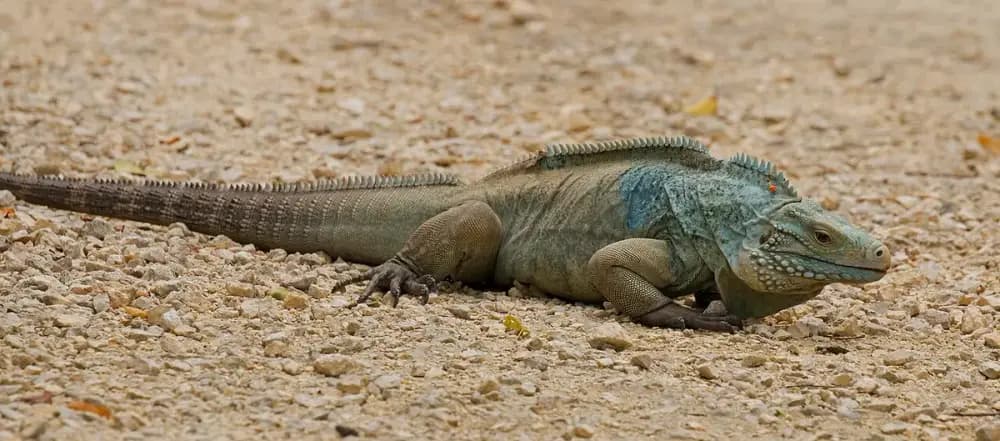
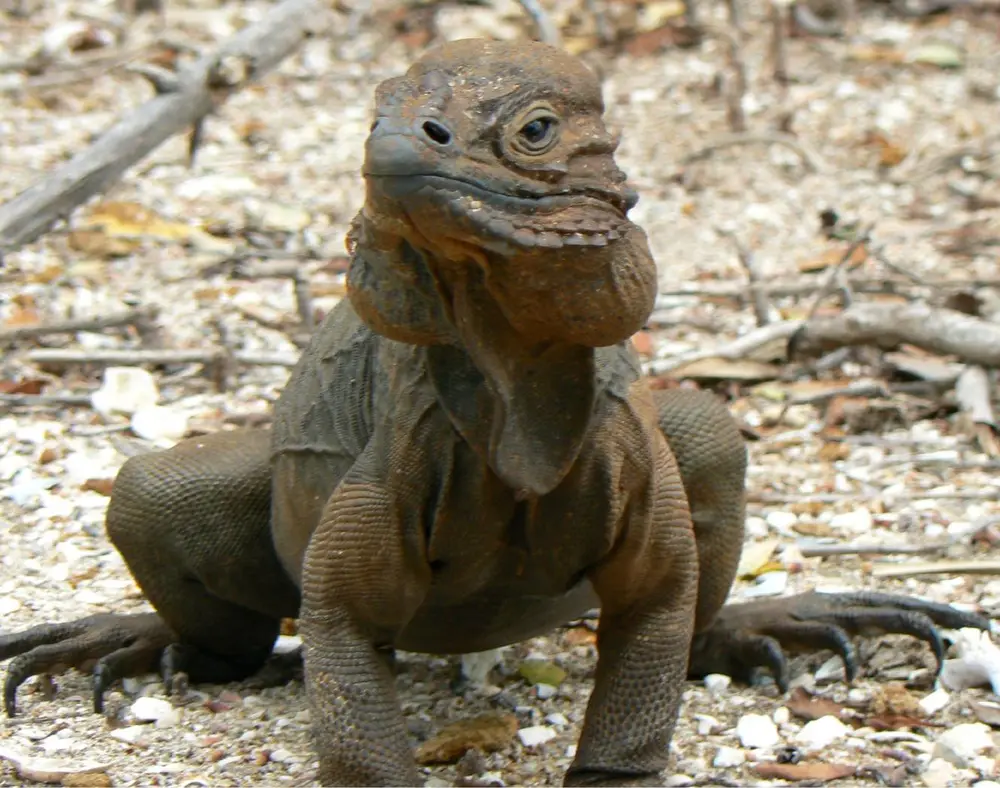
The Jamaican iguana, also known as Colley's iguana, is a large lizard in the family Iguanidae found only on Jamaica. It was described in 1845 by John Edward Gray, who named it for someone he identified only as "Colley," without further explanation. The species is primarily green to a salty blue, with darker olive-green shading on the shoulders and three broad, dark chevrons running from the base of the neck down the back to the tail, overlaid with olive-brown zigzag spots. Its dorsal crest scales run a brighter bluish-green than the rest of the body, and its overall surface carries yellowish blotches broken into small clusters of spots. Wild individuals — nesting females especially — often take on a deep reddish-brown cast after digging in the coarse soils of their habitat.
It is the second-largest land animal native to Jamaica, outweighed only by the Jamaican boa. Males can exceed 2 kg and reach 428 mm in length; females are somewhat smaller, growing to about 378 mm. The species shows some sexual dimorphism beyond size alone: males carry large femoral pores on the underside of their thighs, used to release pheromones, and sport a taller dorsal crest than females, whose corresponding pores are smaller.
According to Sir Hans Sloane, a physician and botanist who visited Jamaica in 1688, iguanas were common across the island at that time. That changed dramatically in the second half of the 19th century, following the introduction of the small Asian mongoose as a rat- and snake-control measure. The iguana's decline was so severe that it was believed extinct by 1948, and although a dead specimen turned up in 1970, the species wasn't confirmed alive again until August 1990 — a discovery owed, unexpectedly, to a hunting dog.
Behavior and diet
Diet
Primarily herbivorous — leaves, flowers, and fruit from over 100 plant species, occasionally supplemented with insects and snails
The Jamaican iguana is primarily herbivorous, feeding on the leaves, flowers, and fruit of more than 100 different plant species. Insects and invertebrates such as snails appear only rarely in its diet, and even those may be consumed incidentally while the animal is eating the leaves the invertebrates happen to be living on.
The species' modern story is inseparable from its rediscovery. In August 1990, a dog belonging to hog hunter Edwin Duffus chased a live adult male iguana into a hollow log in the Hellshire Hills. The dog injured the animal before Duffus reached it, but the injured iguana was taken to Hope Zoo, and a remnant wild population was located soon afterward. A follow-up study found only about 50 survivors — at the time described as the rarest lizard in the world. Today the species persists in two dense but scattered populations within the dry, rocky limestone forest of the Hellshire Hills in St. Catherine parish, the only part of Jamaica where it is now found; it was last seen on Goat Island, off Jamaica's coast, in 1940.
Range and habitat
Habitat
Dry, rocky limestone forest
Once distributed throughout Jamaica, including the offshore islets of Great Goat Island and Little Goat Island, the Jamaican iguana is now restricted entirely to the forests of the Hellshire Hills. This dry, rocky limestone habitat in St. Catherine parish is the last refuge for a species that, within living memory, was believed to have vanished from the island altogether. A 2021 assessment estimated 500 to 600 mature individuals remain, concentrated in two dense populations, with researchers describing the species' recovery potential as high.
Conservation status
The Jamaican iguana is classified as Critically Endangered by the IUCN, following decades in which it was believed extinct between 1948 and 1990. The single greatest cause of its historical decline was the introduction of the small Asian mongoose, which came to rely heavily on hatchling iguanas as a food source. That threat prompted the creation of a "Headstart" rearing facility at Hope Zoo, where eggs and hatchlings collected from the wild are raised in safety until they are large enough to withstand mongoose predation before being released — a program that also conducts health screening to establish baseline data on parasites and disease in the population. More recently, the charcoal industry has emerged as the leading threat to the species, since charcoal burners cut hardwood trees from the Hellshire Hills, the iguana's only remaining refuge, and have at times threatened the research teams working to protect it.
Recovery efforts have drawn international support: a consortium of twelve zoos, including several in the United States, funded and built the Headstart Facility at Hope Zoo. In August 2006, the Indianapolis Zoo achieved the first successful captive breeding and hatching of the species outside Jamaica, with 22 hatchlings, doubling the size of the U.S. captive population at the time. A 2021 assessment put the current population at 500 to 600 mature individuals, with researchers assessing the species' recovery potential as high.
Where to see jamaican iguana in the U.S.
6 zoos across 5 states
Find the closest one
Rank the 6 zoos holding jamaican iguana by how far they are from you. Your location is used in your browser to sort this list and is never sent to us.
Illinois· 1
Kansas· 1
Massachusetts· 2
Missouri· 1
Virginia· 1
AZAThe Association of Zoos and Aquariums. Accredited members have passed an independent inspection of animal care and welfare, safety, conservation and education, repeated every five years. Many smaller facilities never apply, so “not accredited” isn't a verdict on its own. What accreditation means · How we check this
Built from each zoo's own published animal list.
Jamaican Iguana: common questions
Is the Jamaican iguana endangered?
Yes — it is classified as Critically Endangered, the IUCN's highest risk category short of extinction in the wild, and was believed extinct between 1948 and 1990.
How big does a Jamaican iguana get?
Males can exceed 2 kg and grow to 428 mm (16.9 in) in length; females are somewhat smaller, reaching about 378 mm (14.9 in).
What does a Jamaican iguana eat?
Mostly leaves, flowers, and fruit from over 100 plant species, with insects and snails eaten only occasionally.
Where do Jamaican iguanas live in the wild?
Only in the dry, rocky limestone forest of the Hellshire Hills in Jamaica's St. Catherine parish — the species' sole remaining habitat.
Which U.S. zoos have Jamaican iguanas?
Five zoos in the Feather & Fang directory, including the Lincoln Park Zoo, Saint Louis Zoo, and Virginia Zoological Park.