- Where to see one
- 6 U.S. zoos in our directory hold puna teal, confirmed against each zoo's own animal list.
- Native range
- High Andes of central Peru, western Bolivia, northern Chile and far northwestern Argentina
- Size
- About 48 cm (19 in) long; males weigh about 546–560 g (19–20 oz)
- Clutch size
- 5 to 8 creamy pink eggs, incubated about 25 days
- Population
- Estimated 100,000 to 1,000,000 birds
- Key feature
- Light blue bill with a black nail and ridge
Conservation status
Least Concernassessed 2016
IUCN Red List category LC — step 1 of 7.
The Puna teal is a dabbling duck resident in the Andes of Peru, western Bolivia, northern Chile and extreme northwestern Argentina, where it lives on the larger lakes and pools of the altiplano. It is non-migratory and about 48 cm long, similar in size to a wood duck. Adult males have a blackish-brown cap, a creamy white lower face and neck, and a distinctive light blue bill. It feeds mostly on plants and seeds and often on invertebrates, tipping forward to reach food on the bottom of the water. Nests are on the ground in rough vegetation, with clutches of 5 to 8 eggs, and both parents rear the ducklings.
About the puna teal
The puna teal (Spatula puna) is a South American dabbling duck in the family Anatidae that lives year-round on high lakes and wetlands of the Andes in Peru, Bolivia, Chile and Argentina. It was once treated as a subspecies of the silver teal, its close relative, and it is larger than that bird.
The Swiss naturalist Johann Jakob von Tschudi first described the bird in 1844 as Anas puna. A 2009 genetic study showed that the old genus Anas was not a natural group, and the puna teal moved to the revived genus Spatula, Latin for "spoon," as a species in its own right. Its species name, puna, comes from the Puna de Atacama, a high Andean plateau.
The puna teal is larger than the silver teal, at about 48 cm (19 in) long, close to the size of a wood duck. Males weigh between 546 and 560 g (about 19–20 oz). The bill is 47–53 mm (1.9–2.1 in) long, against 37–41 mm (1.5–1.6 in) in the silver teal.
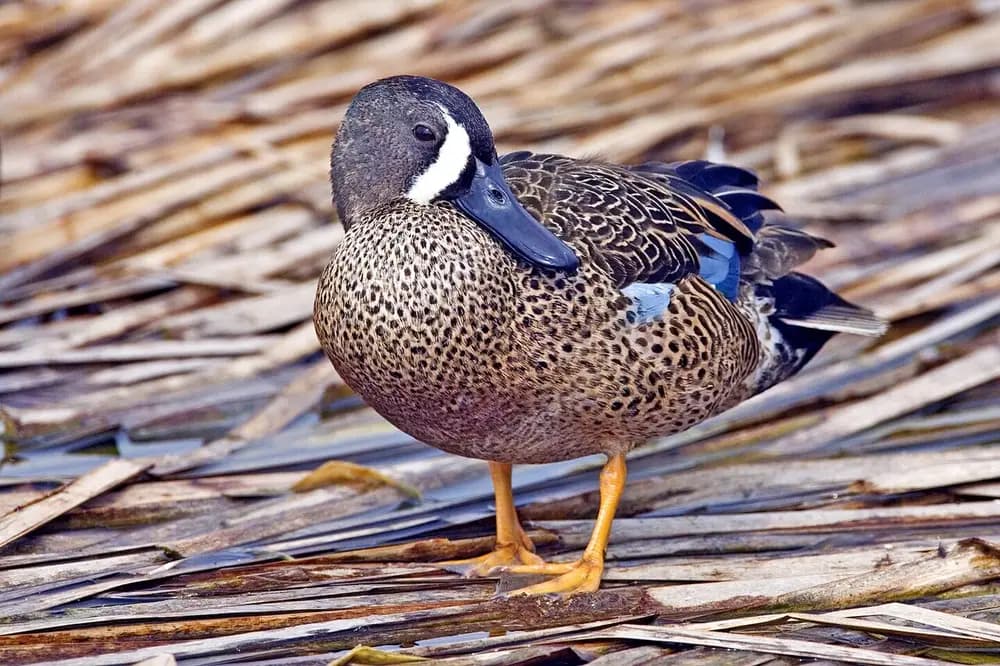
The head and bill make it easy to identify. Adult males have a blackish-brown cap reaching below the eyes, a creamy white lower face and neck, and a coffee-colored back, chest and flanks with small dark spots that become bars on the back and sides. The bill is light blue with a black nail and a black ridge along the top. The wings show dull blue coverts and an iridescent green speculum edged with black and white bars. Legs and feet are gray and eyes are brown. Females are duller, with fainter barring, and juveniles are duller still. Chicks are brown above and grayish white below, with paired white spots and a thin black stripe running from the eye to the nape. A single leucistic bird, with a white head and neck on an otherwise normal body, has been recorded at Huaypo Lake in Peru.
Living high in the mountains has shaped the bird's body. Studies at Lake Titicaca found that the puna teal has larger lungs relative to its body mass than lowland ducks, with more airway and gas-exchange tissue and a richer blood supply. These features likely help it take up oxygen in thin mountain air.
Behavior and diet
Diet
Mostly plants and seeds, plus invertebrates
The puna teal eats mostly plants and seeds, along with many invertebrates. Like other dabbling ducks, it feeds by tipping forward until it is upside down, reaching food on the bottom of shallow ponds and lakes. Its bill is lined along the edges with comb-like plates called lamellae, which strain food out of the water.
Birds first breed at about one year old. Pairs are mostly monogamous, and the bond between male and female may be long-term, though some males mate with other females on the side. Puna teal live in single pairs or small groups, sometimes mixed with silver teal.
Nests sit on the ground in rough vegetation such as long grass, not always close to water. Eggs are laid between April and June and are creamy pink. A clutch holds 5 to 8 eggs, and the female incubates them alone for about 25 days. Chicks weigh around 25 g (0.9 oz) at hatching. Much like swans and geese, both parents raise the young: the male stays with the brood and guards the female while the ducklings grow.
Puna teal do not truly migrate. Outside the breeding season they move downhill from the high Andes to lower ground when food becomes scarce, and they can then turn up in lowlands and sometimes along the Peruvian coast.
Their calls differ from the silver teal's. Its "decrescendo" call is shorter, with only 4 or 5 weaker notes. Other sounds include a low chattering "hueer, pt pt pt," a mechanical rising trill and a low "whr" alarm.
Range and habitat
Habitat
Altiplano lakes, pools, swamps and bogs up to 4,600 m (15,100 ft)
The puna teal is native to the Puna zone of the Andes. Its range runs from central Peru, around the Junín region, south through western Bolivia and northern Chile as far as Antofagasta, and into Jujuy Province in far northwestern Argentina.
It is a high-altitude bird, found at elevations up to 4,600 m (15,100 ft) on the altiplano. It lives on larger lakes and pools and on other freshwater wetlands, favoring slightly alkaline lakes, swamps and bogs with plenty of floating plants, especially the aquatic plant genus Chara. Lake Titicaca, on the border of Peru and Bolivia, is one of the places it occurs.
Puna teal vs silver teal
The two species were long lumped together, and they still sometimes flock together. These are the differences that set them apart:
| Feature | Puna teal | Silver teal |
|---|---|---|
| Scientific name | Spatula puna | Spatula versicolor |
| Size | Larger, about 48 cm (19 in) | Smaller |
| Bill length | 47–53 mm (1.9–2.1 in) | 37–41 mm (1.5–1.6 in) |
| Chick bill | Larger, grayish blue | Smaller |
| Decrescendo call | Shorter, 4–5 weaker notes | Longer |
Other ducks called teal include the blue-winged teal, the ringed teal and the marbled teal.
Conservation status
The puna teal is listed as Least Concern on the IUCN Red List. As of 2023, its population was estimated at 100,000 to 1,000,000 birds, or roughly 66,700 to 667,000 mature adults. Most of its habitat is undisturbed, and the population overall is considered stable.
There are local problems. Numbers at Lake Junín in Peru had dropped sharply by 2014 compared with earlier counts. The likely cause was the loss of Chara, a favorite food, which is disappearing because of nutrient pollution, silt and heavy metal contamination. Some populations are also hunted.
Where to see puna teal in the U.S.
6 zoos across 6 states
Find the closest one
Rank the 5 zoos holding puna teal by how far they are from you. Your location is used in your browser to sort this list and is never sent to us.
1 more zoo holds puna teal but has no coordinates on file yet, so it isn't ranked here. It's in the full list below.
California· 1
Connecticut· 1
Delaware· 1
Kansas· 1
Louisiana· 1
Wisconsin· 1
AZAThe Association of Zoos and Aquariums. Accredited members have passed an independent inspection of animal care and welfare, safety, conservation and education, repeated every five years. Many smaller facilities never apply, so “not accredited” isn't a verdict on its own. What accreditation means · How we check this
Built from each zoo's own published animal list.
Puna Teal: common questions
Where do puna teal live?
In the high Andes of central Peru, western Bolivia, northern Chile and far northwestern Argentina. They live on lakes, pools, swamps and bogs at elevations up to 4,600 m (15,100 ft).
How big is a puna teal?
About 48 cm (19 in) long, close to the size of a wood duck. Males weigh around 546–560 g (19–20 oz).
What do puna teal eat?
Mostly plants and seeds, plus invertebrates. They tip upside down to feed from the bottom and strain food with comb-like plates on their bills.
Is the puna teal the same as the silver teal?
No. It was once treated as a subspecies of the silver teal but is now a separate species. It is larger, with a longer bill and a shorter call.
Do puna teal migrate?
Not in the usual sense. They stay in the Andes but move to lower elevations outside the breeding season when food runs short.
Is the puna teal endangered?
No. It is listed as Least Concern, with a stable population estimated at 100,000 to 1,000,000 birds, though numbers have fallen at Lake Junín in Peru.
How many eggs does a puna teal lay?
Five to eight creamy pink eggs. The female incubates them for about 25 days, and both parents raise the ducklings.