- Where to see one
- 8 U.S. zoos in our directory hold indian star tortoise, confirmed against each zoo's own animal list.
- Native range
- Western and southeastern India, southeastern Pakistan and Sri Lanka
- Size
- Males 15–20 cm (6–8 in) shell length, females 25–30 cm (10–12 in); record female 38 cm (15 in)
- Lifespan
- Up to 25 years recorded in captivity; lifespan in the wild has not been studied
- Clutch
- 1–10 eggs, up to nine clutches a year
- Incubation
- Usually about 90–170 days (known range 47–180)
Conservation status
Vulnerableassessed 2020
IUCN Red List category VU — step 3 of 7.
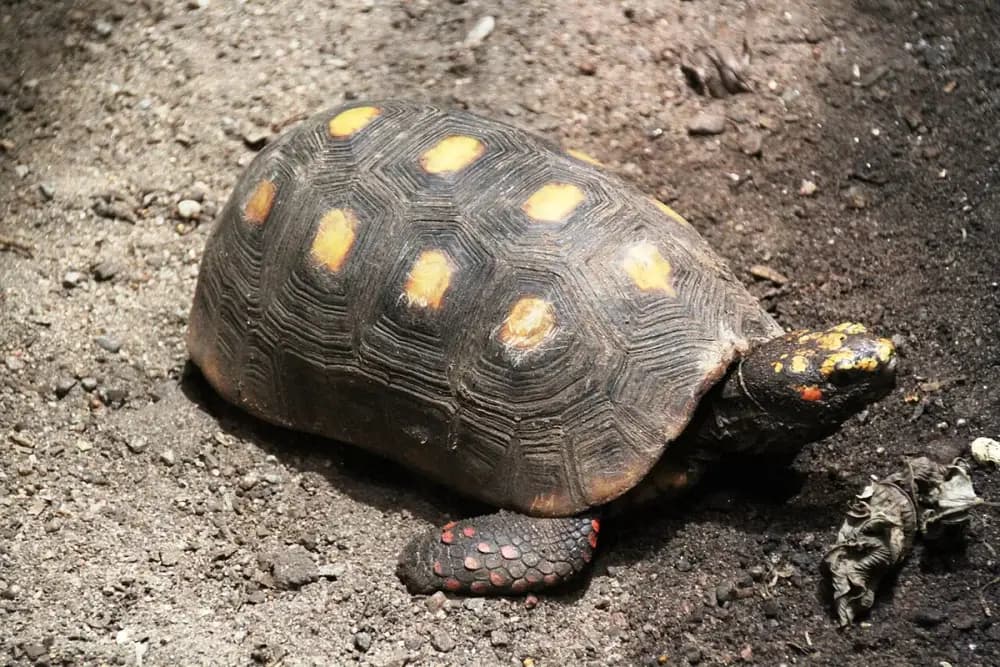
The Indian star tortoise is native to India, Pakistan and Sri Lanka, where it lives in dry areas, scrub forest, dry grasslands and even semi-desert. Its high, domed black shell is marked with yellow streaks radiating from each shield, a high-contrast pattern that breaks up the animal's outline as it sits in the shade of grass or vegetation. Star tortoises are mostly herbivorous, feeding on grasses, fallen fruit, flowers and the leaves of succulent plants, and they occasionally eat carrion. Females are considerably larger than males, which compete for mates by ramming rivals and trying to flip them onto their backs.
About the Indian star tortoise
The Indian star tortoise is a small land tortoise from the dry forests, scrub and grasslands of India, Pakistan and Sri Lanka. It is named for the yellow star-like pattern radiating across each plate of its black, domed shell. It belongs to the tortoise family Testudinidae and is threatened by poaching for the pet trade.
Its scientific name is Geochelone elegans. No subspecies are recognized, but tortoises vary by region. Animals from northern India tend to be larger and darker with less contrast, southern Indian animals are smaller with bolder stars, and Sri Lankan tortoises have broader yellow markings and grow larger than those in southern India. A 2006 study of how the populations differ found that the tortoises of India and Sri Lanka are distinct.
The shell, or carapace, is strongly domed, and its plates often rise into humps or near-pyramids. Each plate has a yellowish center with yellow or tan lines radiating out from it, set against a brown to black background, and the edge plates carry partial stars. The lower shell, or plastron, has dark radiating lines on a lighter background. The head, legs and tail are yellow to tan, sometimes with dark spots.
The bold pattern looks conspicuous in the hand, but in tall grass it does the opposite: the lines break up the tortoise's outline and help it disappear in shade. The front legs are covered in large, pointed, overlapping bony scales, and the heels carry spur-like ones.
Females are much larger than males. A male's shell typically grows to 15 to 20 cm (6 to 8 in) long and a female's to 25 to 30 cm (10 to 12 in), with a record female of 38 cm (15 in). Males have longer, thicker tails and a concave plastron, while females have short tails and flat plastrons.
The shape may serve a purpose. After mathematicians Gábor Domokos and Péter Várkonyi designed the gömböc, a shape that always rolls back to one stable position, they noticed its resemblance to the Indian star tortoise. When they turned 30 tortoises upside down, many of them righted themselves.
Behavior and diet
Diet
Mainly grasses, leaves, fruit and flowers; occasionally insects, carrion and dung
Activity follows the weather. In hot, dry spells, Indian star tortoises are mostly active in the early morning and late afternoon and shelter under vegetation for the rest of the day. When the monsoon rains arrive they become far more active, moving and feeding through much of the day. In western India and Pakistan they go inactive during the colder winter months.
The diet is mainly plants: grasses, herbaceous leaves, fallen fruit, flowers and the leaves of succulents. They also eat insects, carrion and dung now and then. When food runs short in hot, dry seasons they become inactive and can go long periods without eating. By eating fruit and seeds they probably help spread plants.
Breeding starts with the rainy season, which in southern India runs from mid-June to November. Males compete by ramming rivals and trying to flip them over. Courtship itself is relatively gentle, with little shoving or biting of the larger females, and the male makes grunting sounds while mating.
About 60 to 90 days after mating, usually in the evening, a female wanders and sniffs the ground looking for a nest site. She often urinates to soften the soil, digs a flask-shaped nest with her hind feet, lays her eggs, then refills the hole and flattens it with her plastron. She may lay one to nine clutches a year, each of one to ten eggs. There is no parental care afterward.
The eggs have a hard, brittle, porous shell, weigh 12 to 21 g (0.4 to 0.7 oz) and measure 35 to 52 mm (1.4 to 2.1 in). They are pinkish and translucent at first and turn chalky white after two to three weeks. Nest temperature sets the sex of the young: 28 to 30 °C (82 to 86 °F) produces mostly males, and 31 to 32 °C (88 to 90 °F) mostly females. Hatchlings weigh 25 to 45 g (0.9 to 1.6 oz) and lack the star pattern; their shells are black or brown with yellow or orange blocks. In the wild, females mature at 8 to 12 years and males at 6 to 8.
Eggs and young are lost to jackals, foxes, mongooses, hawks and vultures. Adults are protected by their heavy shells and by staying under cover when not feeding or breeding.
Range and habitat
Habitat
Moist deciduous forest, thorn scrub, dry grassland and semi-desert, sometimes farmland
The Indian star tortoise lives in three separate areas of the Indian subcontinent. The first covers western India and the far southeast of Pakistan, including Gujarat, Rajasthan and the Thar Desert. The second is in southeastern India, in Karnataka, Kerala and Tamil Nadu. The third is the island of Sri Lanka.
It copes with a wide range of habitats: moist deciduous forest, semi-arid lowland forest, thorn scrub, dry grassland and semi-desert, and sometimes farmland. Many populations live where a monsoon season is followed by a long, hot dry period, and the species tolerates both extremes well. Tortoises that wander into gardens and fields sometimes eat crops and are occasionally killed for it, though they are rarely common enough to cause real losses.
Conservation status
The Indian star tortoise has been listed as Vulnerable on the IUCN Red List since 2016; the current assessment dates from 2020. The population is thought to exceed 10,000 animals but is declining. The main threats are habitat loss, as forest and grassland are converted to farms, and collection for the illegal wildlife trade.
It is the most trafficked and illegally sold tortoise or turtle. An estimated 10,000 to 20,000 are taken from the wild each year, and only about 3,000 are recovered from smugglers and markets. Over 6,000 were seized across India, Thailand and Bangladesh in 2017. Because the tortoises are quiet and can survive at least 15 days without food, they are easy to smuggle, often with their legs taped and packed tightly into boxes and bags. Many die along the way from stress, suffocation and cracked shells. Stressed animals are also very prone to pneumonia and other respiratory disease.
India banned owning or trading the species under the Indian Wildlife Act of 1972, though enforcement is difficult. In 2019 the species was moved from Appendix II to Appendix I of CITES by full consensus of member countries, banning international commercial trade entirely. More than 3,500 tortoises were seized in 2020 and 2021 after that listing. Many of the star tortoises sold as pets in the United States and Europe are now captive-bred.
Where to see indian star tortoise in the U.S.
8 zoos across 7 states
Find the closest one
Rank the 8 zoos holding indian star tortoise by how far they are from you. Your location is used in your browser to sort this list and is never sent to us.
Colorado· 1
Indiana· 1
Kansas· 1
Louisiana· 1
New York· 2
Ohio· 1
Pennsylvania· 1
AZAThe Association of Zoos and Aquariums. Accredited members have passed an independent inspection of animal care and welfare, safety, conservation and education, repeated every five years. Many smaller facilities never apply, so “not accredited” isn't a verdict on its own. What accreditation means · How we check this
Built from each zoo's own published animal list.
Indian Star Tortoise: common questions
Is the Indian star tortoise endangered?
It is listed as Vulnerable, one step below Endangered. Its numbers are falling because of habitat loss and heavy poaching for the pet trade.
How big do Indian star tortoises get?
Males reach about 15 to 20 cm (6 to 8 in) in shell length and females 25 to 30 cm (10 to 12 in). The largest recorded female measured 38 cm (15 in).
What do Indian star tortoises eat?
Mostly grasses, leaves, fruit and flowers. They occasionally eat insects, carrion and dung.
How long do Indian star tortoises live?
No one knows for certain how long they live in the wild, because no studies of their natural lifespan exist. Captive records reach 25 years.
Where do Indian star tortoises live?
In three separate regions: western India and southeastern Pakistan, southeastern India, and Sri Lanka. They live in dry forest, scrub, grassland and semi-desert.
Can you keep an Indian star tortoise as a pet?
They are popular pets and are bred in captivity in many countries, but international commercial trade has been banned under CITES Appendix I since 2019, and owning or trading them is illegal in India.
Why is it called a star tortoise?
Each plate of its shell has a yellow center with lines radiating outward, forming a star pattern.
Can an Indian star tortoise turn itself over?
Often, yes. In tests by the mathematicians who designed the self-righting gömböc shape, many of the 30 tortoises flipped on their backs were able to right themselves.