- Where to see one
- 10 U.S. zoos in our directory hold box turtle, confirmed against each zoo's own animal list.
- Native range
- Common box turtle: eastern United States, from Maine and Michigan to eastern Texas and south Florida, plus Mexico's Gulf Coast and Yucatán Peninsula
- Size
- Shell about 11–18 cm (4.3–7.1 in) long, depending on subspecies
- Lifespan
- Commonly over 20 years; verified cases past 40–50 years, and one lived at least 138 years
- Clutch size
- Usually 4 or 5 eggs (1 to 11 recorded)
- Incubation
- About 70–80 days
Conservation status
Not Evaluated
This species has not been assessed for the IUCN Red List, so it sits outside the threat scale entirely.
Varies by species: common box turtle Vulnerable (VU), ornate box turtle Near Threatened (NT), Coahuilan box turtle Endangered (EN), spotted box turtle Data Deficient (DD)
The common box turtle is a mostly land-dwelling reptile of open woodlands, marshy meadows, floodplains and brushy grasslands in the eastern United States, with subspecies also found in Mexico. Its high domed shell has a hinged lower plate that lets it close up completely, sealing its head and limbs inside like a box. The diet is varied, from earthworms, snails and insects to berries, fungi, eggs and sometimes carrion. Turtles in the northern part of the range hibernate in loose soil, sand or mud over winter. Females lay one to eleven eggs in sandy or loamy soil in early summer.
About the box turtle
A box turtle is a small land turtle with a high, domed shell and a hinged lower shell that lets it close up completely, like a box. In North America the name means turtles of the genus Terrapene, in the family Emydidae. The common box turtle, Terrapene carolina, lives across the eastern United States and parts of Mexico.
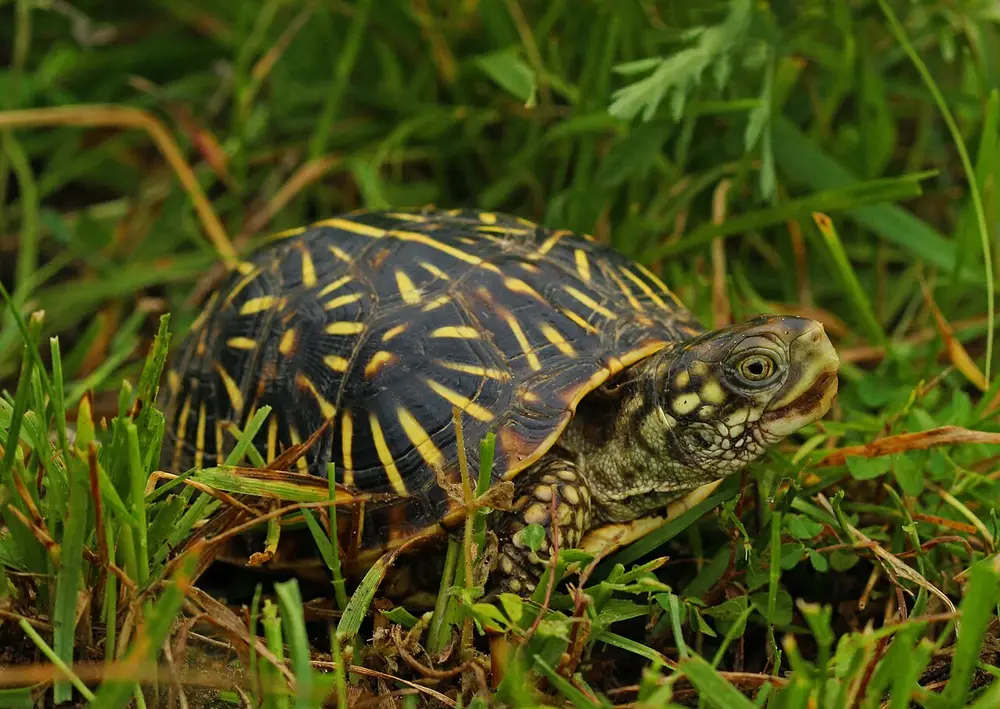
The genus Terrapene includes the common box turtle, the ornate box turtle, the Coahuilan box turtle and the spotted box turtle. The common box turtle has the most subspecies, including the eastern box turtle, the Florida box turtle, the Gulf Coast box turtle and the three-toed box turtle, along with Mexican and Yucatán forms. Asian box turtles share the name and the hinged shell but belong to a different family.
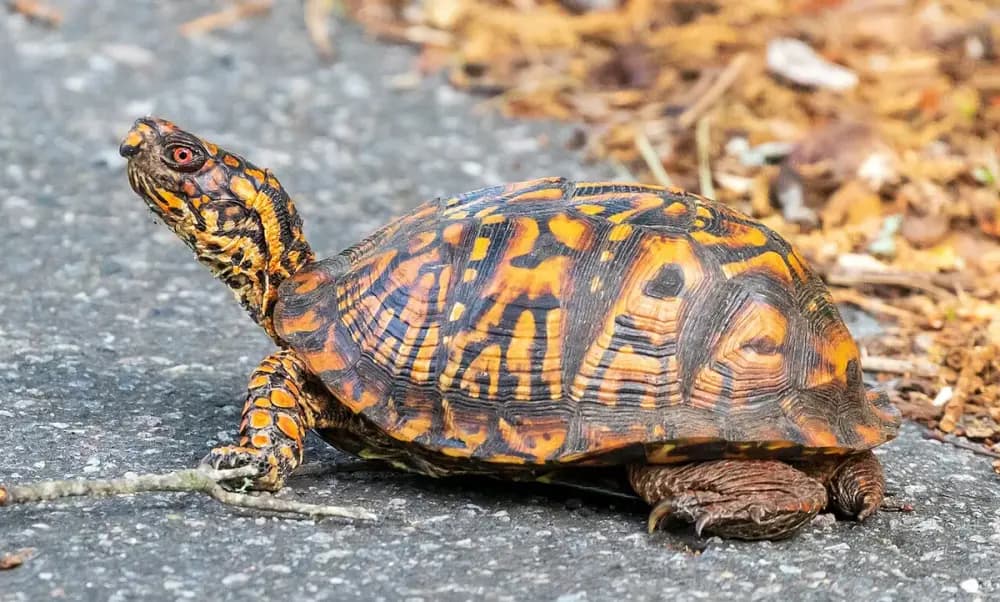
The shell is the key feature. The upper shell, or carapace, is high and domed, brown and often marked with variable orange or yellow lines, spots, bars or blotches. The lower shell, or plastron, has a hinge that lets the turtle pull both ends shut, sealing its head and limbs inside. The plastron is dark brown, either plain or blotched.
Subspecies differ in shell pattern, size and toe count. Shell sizes run about 11 by 8 cm (4.3 by 3.1 in) for the Florida box turtle, about 15 by 10 cm (5.9 by 3.9 in) for the eastern box turtle and about 18 by 12 cm (7.1 by 4.7 in) for the Gulf Coast box turtle, the largest. Some have three toes on each hind foot and others four.
The head is small to medium, with a hooked upper jaw. Most adult males have red eyes and females yellowish-brown ones. Males also have shorter, thicker, more curved claws on the hind feet, longer and thicker tails, and a dent in the rear of the lower shell.
Behavior and diet
Diet
Omnivorous: worms, snails, slugs, insects, berries, fungi, flowers, roots and carrion
Box turtles live mostly on land. They often come out early in the day or after rain, leaving shelter under rotting leaves, logs or a mammal burrow to forage. Air temperature controls how active they are; in summer heat they mostly move about in the morning and after rain, and they may stay near the edges of swamps and marshes to keep cool.
When a common box turtle gets too hot, around 32 °C (90 °F) body temperature, it smears saliva over its legs and head so evaporation cools it down. It may also urinate on its hind legs to cool the parts it cannot reach with saliva.
Box turtles are omnivores with a very wide diet. Sharp eyes and a keen sense of smell help them find earthworms, snails, slugs, insects, wild berries, roots, flowers and fungi, and they also eat fish, frogs, salamanders, snakes, birds, eggs and carrion. Young turtles are mainly carnivorous for their first five or six years and eat more plants as they grow.
Courtship usually happens in spring and starts with the male circling, biting and shoving the female. Rival males sometimes compete for the same female by head-butting, shoving and trying to flip each other, though these fights are almost never fatal. Females can store sperm for up to four years, so they do not need to mate every year.
Nesting runs from May through July. The female digs a flask-shaped nest in sandy or loamy soil with her hind legs, usually starting at twilight, and lays her eggs. The eggs hatch after about 70–80 days, and nest temperature decides the sex of the young: nests at 22–27 °C (72–81 °F) tend to produce males and those above 28 °C (82 °F) females. Hatchlings grow about 1.5 cm (0.6 in) a year and reach maturity at about five years.
In the northern part of the range, box turtles hibernate from about October or November, burrowing into loose soil, sand, leaves or the mud at the bottom of streams and pools.
Range and habitat
Habitat
Open woodland, marshy meadows, floodplains, scrub forest and brushy grassland
The common box turtle lives in much of the eastern United States, from Maine and Michigan south to Florida and west to eastern Texas, as well as along Mexico's Gulf Coast and on the Yucatán Peninsula. A gap in western Texas separates the Mexican subspecies from those in the United States. It once lived in southern Ontario but has disappeared from Canada.
It uses open woodlands, marshy meadows, floodplains, scrub forests, pastures and brushy grasslands, often near streams and ponds. Box turtles tend to stay in the area where they hatched. A turtle moved more than about 0.8 km (half a mile) from its home may not find its way back and can spend years searching, which exposes it to danger and disrupts breeding.
North American vs Asian box turtles
"Box turtle" covers two unrelated groups that happen to share a hinged, closable shell.
| Feature | North American box turtles | Asian box turtles |
|---|---|---|
| Genus | Terrapene | Cuora and Pyxidea |
| Family | Emydidae | Geoemydidae |
| Range | United States and Mexico | Asia |
| Main threats | Habitat destruction, roads, pet collecting | Capture for food markets |
Conservation status
There is no single status for box turtles as a group, because the IUCN Red List assesses each species separately. The common box turtle is listed as Vulnerable (P.P. van Dijk, 2011, with 2016 errata). The ornate box turtle is Near Threatened (2011), the Coahuilan box turtle of Mexico is Endangered (2007), and the spotted box turtle is Data Deficient (1996).
The common box turtle is also on CITES Appendix II, so international trade in it should be carefully monitored. NatureServe, by contrast, ranks it Secure.
Though once considered common across a wide range, many populations are declining. Farming and urban development destroy habitat, fire management degrades it, and roads kill many turtles as they try to cross. A necrotizing bacterial infection first found in box turtles in April 2011 has added to declines.
Collecting for the pet trade is another serious threat. A three-year study in Texas found more than 7,000 box turtles taken from the wild for commercial trade, and a 41-month study in Louisiana found about 30,000. More than half of captured turtles may die in poor conditions. Because box turtles live long and reproduce slowly, losses are hard to replace. Many states, including Indiana, restrict or ban collecting them.
Where to see box turtle in the U.S.
10 zoos across 8 states
Find the closest one
Rank the 10 zoos holding box turtle by how far they are from you. Your location is used in your browser to sort this list and is never sent to us.
California· 1
Florida· 2
Illinois· 2
Kansas· 1
Mississippi· 1
Pennsylvania· 1
Utah· 1
Wisconsin· 1
AZAThe Association of Zoos and Aquariums. Accredited members have passed an independent inspection of animal care and welfare, safety, conservation and education, repeated every five years. Many smaller facilities never apply, so “not accredited” isn't a verdict on its own. What accreditation means · How we check this
Built from each zoo's own published animal list.
Box Turtle: common questions
How long do box turtles live?
Commonly more than 20 years, with verified cases of 40 to 50 years. One common box turtle lived to at least 138, the longest known lifespan of any vertebrate other than tortoises.
What do box turtles eat?
Almost anything. They eat worms, snails, slugs, insects, berries, fungi, flowers and roots, plus frogs, salamanders, eggs and carrion. Young turtles eat mostly animal food.
How big do box turtles get?
Small. Common box turtle shells are about 11–18 cm (4.3–7.1 in) long, with the Gulf Coast subspecies the largest.
Can a box turtle close its shell?
Yes. A hinge in the lower shell lets it pull the front and back shut, sealing its head and legs inside.
Are box turtles endangered?
It depends on the species. The common box turtle is listed as Vulnerable, one step below Endangered, because of habitat loss, road deaths and the pet trade, while the Coahuilan box turtle of Mexico is Endangered.
Can you keep a box turtle as a pet?
It is not recommended for young children, and many states require a permit or ban collecting them. Box turtles stress easily, need outdoor space, sun and a varied diet, and taking wild turtles harms populations.
Where do box turtles live?
In the eastern United States, from Maine and Michigan to Florida and eastern Texas, and in parts of eastern Mexico, in open woods, meadows and floodplains.