
Conservation status
Data Deficient
Also called DD, IUCN Data Deficient
Definition
Data Deficient (DD) is the IUCN Red List label for species where there isn't enough information on population or distribution to judge their extinction risk. It is not a threat category, and a Data Deficient species could turn out to be anywhere from Least Concern to Critically Endangered.
On this page
What "Data Deficient" means
Data Deficient is a label on the IUCN Red List, the global inventory of extinction risk run by the International Union for Conservation of Nature.
A species is Data Deficient when there is inadequate information to make a direct, or indirect, assessment of its risk of extinction based on its distribution or population. Its official abbreviation is DD.
Data Deficient is not a threat category. It doesn't say a species is safe, and it doesn't say a species is in danger. It says the evidence isn't there yet.
Why a species ends up Data Deficient
It isn't always because a species is obscure. IUCN notes that a Data Deficient species may be well studied, with well-known biology, while still lacking the data on numbers and range that the Red List criteria need. Common reasons include:
- Remote or hard-to-survey habitat, such as deep oceans, dense rainforest or underground.
- Few recent records, so nobody knows whether the population is growing or shrinking.
- Unsettled taxonomy. If one "species" may actually be several, nobody can say how big each population is. That's why the orca is listed as Data Deficient.
How it compares to other categories
Data Deficient sits outside the Red List's risk scale:
- Not Evaluated (NE): never assessed.
- Data Deficient (DD): assessed, but there isn't enough data to place it.
- Least Concern through Critically Endangered: assessed and placed on the scale.
IUCN cautions assessors against using Data Deficient when a lack of records might itself be a warning sign. If a species has a small range and hasn't been seen in a long time, a threatened category may be more appropriate. Once better information comes in, a Data Deficient species can be reassessed and placed in any category, including a threatened one.
Data Deficient vs. U.S. law
Data Deficient has no legal meaning in the U.S. The Endangered Species Act is a separate system, so a species can be Data Deficient on the Red List and still have legal protections, or none at all.
Data Deficient animals at the zoo
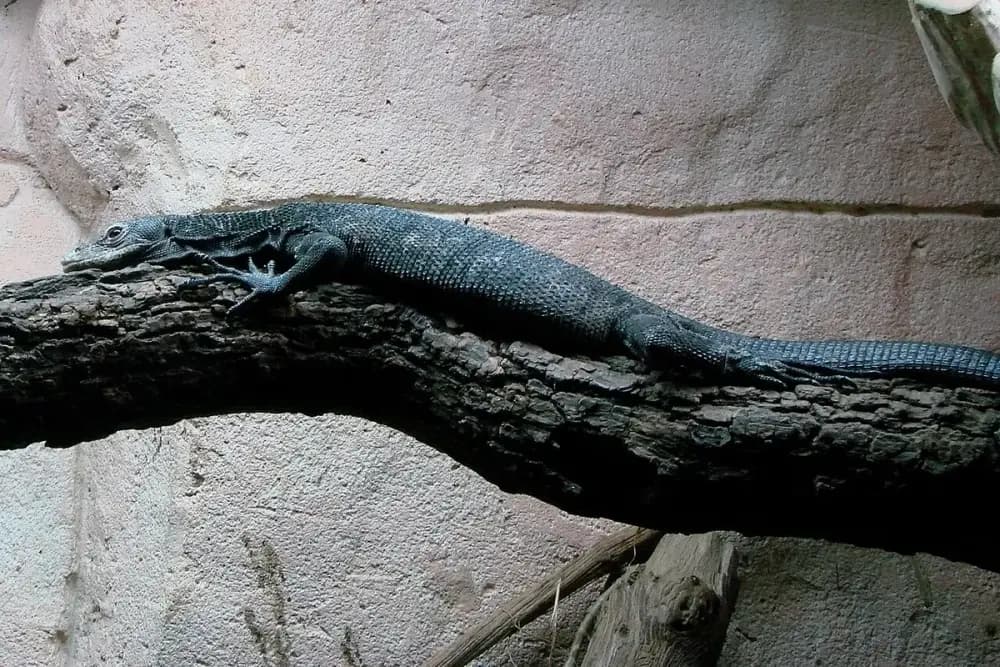
You'll occasionally see a Data Deficient species at a zoo, such as the black tree monitor. Animals in human care can help fill gaps in knowledge: records on breeding, growth, lifespan and behavior give field researchers a useful baseline for species that are hard to study in the wild.
Data Deficient animals you can see in U.S. zoos
Common questions
What does data deficient mean for an animal?
It means scientists don't have enough information about how many of the animals there are, or where they live, to decide how at risk of extinction the species is.
Is data deficient the same as endangered?
No. Data Deficient is not a threat category at all. It means the risk is unknown, so a Data Deficient species might be common or might be in serious trouble.
What is the difference between data deficient and not evaluated?
A Data Deficient species has gone through an IUCN assessment, but the assessors couldn't reach a conclusion. A Not Evaluated species hasn't been assessed at all.
Why is the orca listed as data deficient?
IUCN lists the orca as Data Deficient largely because of uncertainty over its classification: several orca types may be separate species, each with its own, possibly much smaller, population.
Related terms
- IUCN Red ListThe IUCN Red List of Threatened Species is the world's most widely used inventory of extinction risk. Run by the International Union for Conservation of Nature, it sorts assessed species into categories from Least Concern to Extinct using measurable scientific criteria.
- Least ConcernLeast Concern (LC) is the IUCN Red List category for species that have been assessed and do not qualify as threatened or Near Threatened. These species are usually widespread and abundant, although some still have declining populations.
- Near ThreatenedNear Threatened (NT) is the IUCN Red List category for species that do not currently qualify as threatened but are close to qualifying, or are likely to qualify in the near future. It sits between Least Concern and Vulnerable.
- Critically EndangeredCritically Endangered (CR) is the IUCN Red List category for species facing an extremely high risk of extinction in the wild. It is the most severe of the three 'threatened' categories, one step below Extinct in the Wild.
Sources
- IUCN Red List of Threatened Species
- IUCN Red List Categories and Criteria, Version 3.1
- Data deficient (Wikipedia)
Last reviewed
Get the Feather & Fang newsletter
Zoo news, animal features and what's new in the directory. Occasional, never spammy.