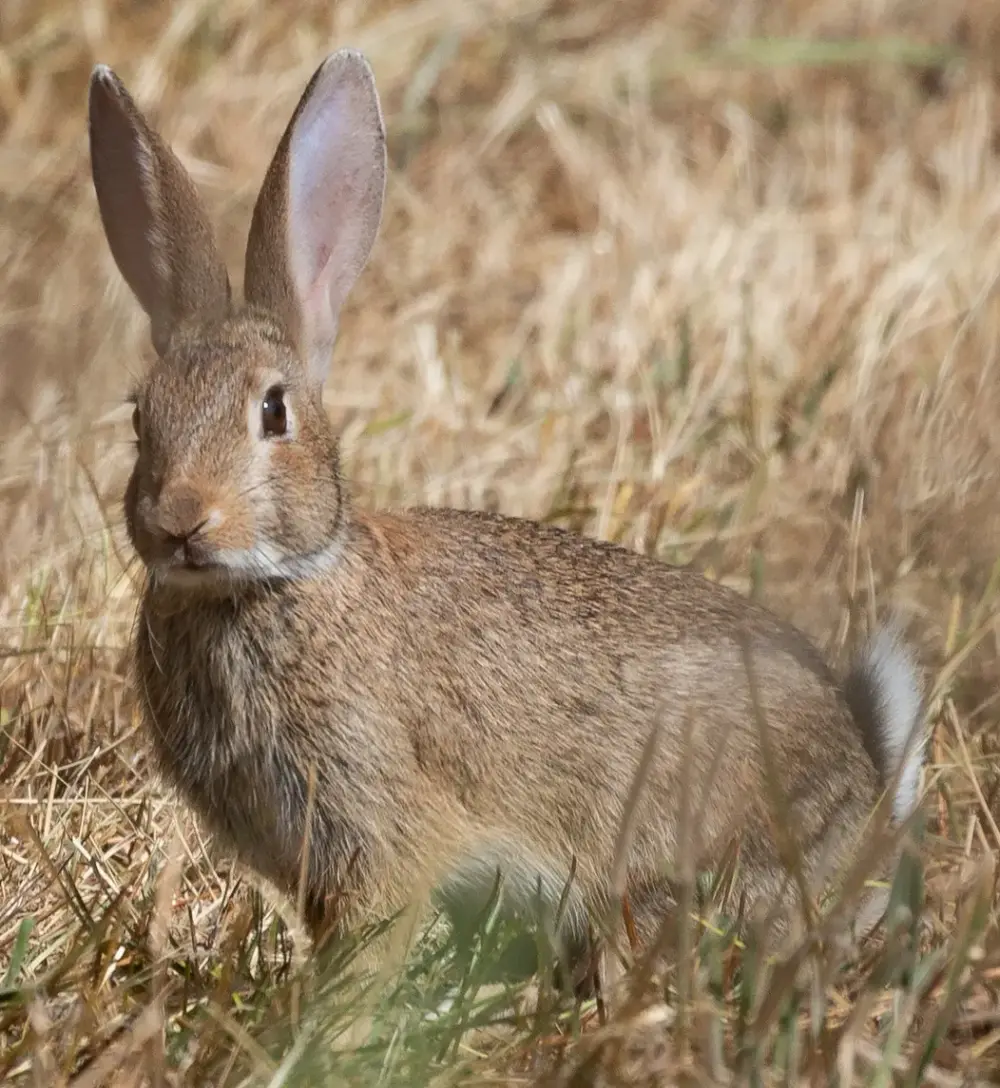
Domestic Rabbit
Oryctolagus cuniculus
Also known as Domestic European Rabbit, Rabbit
- Where to see one
- 29 U.S. zoos in our directory hold domestic rabbit, confirmed against each zoo's own animal list.
- Native range
- Iberian Peninsula and southwestern France (wild ancestor); introduced to hundreds of locations worldwide
- Size
- 36 to 38 cm (14 to 15 in) long; 1.5 to 3 kg (3.3 to 6.6 lb)
Conservation status
Not Evaluated
This species has not been assessed for the IUCN Red List, so it sits outside the threat scale entirely.
Not Evaluated (NE) as a domestic animal; its wild ancestor, the European rabbit, is Near Threatened (NT)
Rabbits are small mammals in the family Leporidae, which also includes hares, within the order Lagomorpha alongside pikas. The most widespread genera are Oryctolagus, whose European rabbit is the ancestor of hundreds of domestic breeds and has been introduced on every continent except Antarctica, and Sylvilagus, with over 13 wild species including the cottontails. As prey animals, rabbits stay constantly aware of their surroundings, with a wide field of vision and ears of high surface area. Longer hind legs allow quick hopping. They live alone or in groups in nests or burrows, are typically nocturnal and often sleep with their eyes open, and litters hold four to twelve kits.
About the domestic rabbit
The domestic rabbit is descended from the European rabbit, Oryctolagus cuniculus, a species native to the Iberian Peninsula and southwestern France that has since been introduced to hundreds of locations worldwide. It is the only species of rabbit ever domesticated, and every domestic breed alive today traces back to it. Wild and domesticated European rabbits vary widely in size, shape, and color, but the wild adult typically runs 36 to 38 cm (14 to 15 in) long and weighs 1.5 to 3 kg (3.3 to 6.6 lb), with a tail of 6.5 to 7 cm (2.6 to 2.8 in), ears 7 to 8 cm (2.8 to 3.1 in) long, and hind feet 8 to 8.9 cm (3.1 to 3.5 in). Size and weight shift with food and habitat quality — rabbits on plain grassland run smaller than those with access to cultivated fields full of roots and clover, and within its native Iberian range the species tends to be smaller still, from 0.9 to 1.4 kg (2.0 to 3.1 lb).
The rabbit's fur is soft down hair covered by stiffer guard hairs, usually greyish-brown, with the guard hairs banded brown and black or grey, a reddish nape and scrotum, a brown chest patch, and white or grey underparts. Kits often show a white star on the forehead that fades in adulthood, and the tail's white underside flashes as the animal flees, which may signal danger to other rabbits nearby. Color varies enormously, from white and light sandy shades to dark grey or black. The skeleton is unusually light for the animal's size, making up only about 8 percent of body weight, versus roughly 13 percent in a domestic cat, with most of the muscle concentrated in the lower back and hind limbs — an arrangement built for a fast escape rather than a fight.
Two subspecies are currently recognized: O. c. cuniculus, the common rabbit, native to parts of southern France and northeastern Spain, and O. c. algirus, the Iberian rabbit, from the southwestern Iberian Peninsula. The common rabbit is by far the more widely introduced of the two, while the Iberian rabbit is non-native only on a handful of islands. The two lineages are thought to have diverged around two million years ago and differ enough in size, sexual dimorphism, and parasite susceptibility that some researchers have proposed splitting them into separate species outright.
Behavior and diet
Diet
Herbivore — grasses, leaves, berries, bark, and field crops
The European rabbit is a highly social, burrowing animal. It digs extensive tunnel systems called warrens, which shelter social groups of one to five adult males (bucks) and one to eight adult females (does), centered around both a dominant male and territorial females, with subordinate males and females beneath them. Groups mark their territory with dung piles called latrines, and females tend to defend territory more fiercely than males do. A rabbit rarely strays far from its warren: while feeding in cultivated fields it usually stays within about 25 m (80 ft) of the burrow and seldom moves beyond 50 m (160 ft), though a sudden change in its surroundings, like a harvest, can push it as far as 500 m (1,600 ft) away, and rabbits in areas where predators are heavily controlled may range up to three times farther from the burrow than those where predators are not managed. Home range size, generally around 4 hectares (9.9 acres), depends on food, cover, and breeding sites.
Feeding-wise, the rabbit is herbivorous, mainly grazing on grasses and leaves and supplementing that with berries, tree bark, and field crops such as maize. In the wild it is prey to birds of prey, weasels, cats, and canids, and its chief defense is simply to run and vanish into cover or down a burrow rather than to fight. Unlike hares, rabbits are altricial: kits are born blind and helpless and depend on maternal care until they are old enough to leave the nest, with does typically only leaving the warren itself to establish separate nesting burrows for raising young.
Range and habitat
Habitat
Grassland; burrows in warrens
The wild ancestor of the domestic rabbit is native to the Iberian Peninsula and southwestern France, where the common rabbit (O. c. cuniculus) and Iberian rabbit (O. c. algirus) occupy adjoining ranges — the common rabbit toward the north and east, the Iberian rabbit toward the southwest. From that base, the species has been introduced to at least 800 islands and to every continent except Antarctica, most often as a food source or for sport hunting, and in many of those places it has caused serious ecological damage in the absence of natural predators. European rabbits prefer grassland habitats, and their populations in the native range were historically confined during past glacial periods to two isolated refugia in Iberia and southern France, later spreading into central Spain as the ice retreated roughly 11,500 years ago.
Despite that success as an introduced species elsewhere, the European rabbit itself is now listed as Near Threatened by the IUCN because of population declines in its native range, driven by overhunting, habitat destruction, and diseases such as myxomatosis and rabbit haemorrhagic disease.
Conservation status
Domestic animals are not assessed on the IUCN Red List, so the domestic rabbit has no Red List category of its own. Its wild ancestor, the European rabbit, is listed as Near Threatened on the IUCN Red List (2025 European assessment), having declined in its native Iberian range because of overhunting, habitat loss, and disease outbreaks including myxomatosis and rabbit haemorrhagic disease.
That decline carries knock-on effects: it has directly hurt populations of the Iberian lynx and Spanish imperial eagle, two predators that depend heavily on rabbits as prey.
The species has been hunted by humans since the Paleolithic period and raised as a food source since at least the first century BCE. Its native-range decline sits oddly alongside its very different reputation as a damaging invasive species almost everywhere else it has been introduced.
Where to see domestic rabbit in the U.S.
29 zoos across 22 states
Find the closest one
Rank the 23 zoos holding domestic rabbit by how far they are from you. Your location is used in your browser to sort this list and is never sent to us.
6 more zoos hold domestic rabbit but have no coordinates on file yet, so they aren't ranked here. They're in the full list below.
Alaska· 1
Arkansas· 1
California· 5
Colorado· 1
Connecticut· 1
Delaware· 1
Georgia· 1
Idaho· 1
Illinois· 1
Indiana· 1
Kentucky· 1
Louisiana· 1
Massachusetts· 1
Michigan· 1
Minnesota· 1
New York· 2
Ohio· 1
Oklahoma· 1
Texas· 1
Utah· 1
Washington· 1
Wisconsin· 3
AZAThe Association of Zoos and Aquariums. Accredited members have passed an independent inspection of animal care and welfare, safety, conservation and education, repeated every five years. Many smaller facilities never apply, so “not accredited” isn't a verdict on its own. What accreditation means · How we check this
Built from each zoo's own published animal list.
Domestic Rabbit: common questions
Is the domestic rabbit endangered?
No. Domestic animals are not assessed on the IUCN Red List. Its wild ancestor, the European rabbit, is listed as Near Threatened because of declines in its native range.
How big does a domestic rabbit get?
The wild ancestor typically measures 36 to 38 cm (14 to 15 in) long and weighs 1.5 to 3 kg (3.3 to 6.6 lb), though size varies with food and habitat.
What does a domestic rabbit eat?
It's a herbivore, feeding mainly on grasses and leaves and supplementing that diet with berries, tree bark, and field crops such as maize.
Where do domestic rabbits live in the wild?
Their wild ancestor is native to the Iberian Peninsula and southwestern France, though the species has since been introduced to hundreds of locations worldwide.
Which U.S. zoos have domestic rabbits?
Six U.S. zoos list them, including Oakland Zoo and the Palo Alto Junior Museum and Zoo in California, plus Cheyenne Mountain Zoo in Colorado.