- Where to see one
- 17 U.S. zoos in our directory hold common raven, confirmed against each zoo's own animal list.
- Native range
- Across the Northern Hemisphere, from the Arctic to the deserts of North Africa and islands in the Pacific
- Size
- Length 54–71 cm (21–28 in); wingspan 116–153 cm (46–60 in); weight 0.69–2.25 kg (1.5–5.0 lb)
- Lifespan
- Typically 10–15 years in the wild; more than 40 years in captivity
- Group name
- An "unkindness" or a "conspiracy"
- Clutch
- Usually 4–6 eggs, incubated 18–21 days
Conservation status
Least Concernassessed 2017
IUCN Red List category LC — step 1 of 7.
The common raven is a large all-black passerine and the most widely distributed corvid, found across the Northern Hemisphere from Arctic and temperate habitats to the deserts of North Africa. It is the heaviest passerine, averaging 63 centimetres in length and 1.47 kilograms. Ravens are omnivorous and opportunistic, eating carrion, insects, grain, berries, small animals, nesting birds and food waste. Pairs mate for life and defend a territory, building a deep nest of sticks in a large tree or on a cliff ledge. Wild birds can live more than 23 years, and their problem-solving points to unusual intelligence.
About the common raven
The common raven is a large, all-black songbird in the crow family, Corvidae, found across the Northern Hemisphere. It is the most widely distributed corvid, one of the two largest alongside the thick-billed raven, and the heaviest passerine bird. It lives everywhere from Arctic tundra to deserts, sea cliffs and mountain forests.
Carl Linnaeus described it in 1758, and it still carries his name, Corvus corax. It is the type species of the genus Corvus, which also includes smaller crows such as the American crow and the carrion crow. Its closest relatives are the brown-necked raven, the pied crow of Africa and the Chihuahuan raven of the American Southwest. Genetic work shows ravens of the southwestern United States form a distinct "California clade" that split from other ravens about two million years ago.
An adult averages about 63 cm (25 in) long and 1.47 kg (3.2 lb), with the heaviest birds near 2 kg (4.4 lb). Size varies with climate: ravens from cold places such as Greenland and the Himalayas are bigger, with larger bills. Californian ravens averaged 0.784 kg (1.73 lb), while birds from Nova Scotia averaged 1.23 kg (2.71 lb).
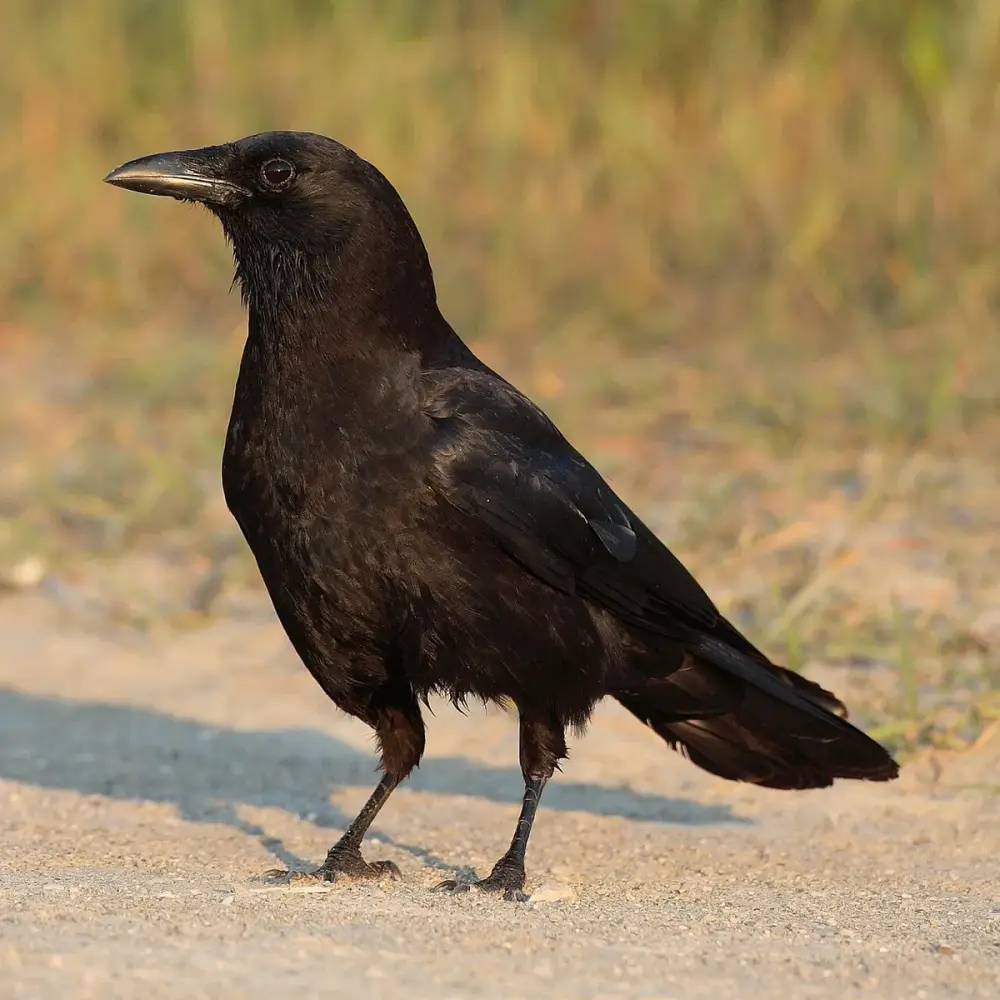
The plumage is glossy, iridescent black, and the eye is dark brown. The bill is large and slightly curved, 5.7–8.5 cm (2.2–3.3 in) long along the top, one of the biggest of any passerine. Throat feathers are long and pointed, giving the raven a shaggy "beard," and the wedge-shaped tail measures 20–26.3 cm (7.9–10.4 in). Young birds look similar but duller, with blue-grey eyes. In flight the wings make a creaking sound likened to rustling silk.
Behavior and diet
Diet
Omnivore: carrion, small animals, eggs and nestlings, insects, grain, berries and human food waste
Ravens usually travel in mated pairs, while young birds often gather in flocks. Pairs tend to stay together for life and nest in the same place year after year. Every breeding pair needs its own territory and defends it hard, and family life can be quarrelsome as well as devoted.
They are true opportunists. Ravens on Alaska's Arctic North Slope got about half their energy from hunting, mostly small rodents, and half from scavenging caribou and ptarmigan carcasses. Elsewhere they eat carrion and its maggots, grain, acorns, berries, fruit, insects, amphibians, reptiles, small mammals, bird eggs and nestlings, and plenty of human garbage. Because their bills cannot open large carcasses well, they often wait for a predator to do it, and they follow wolves to scavenge kills. They have even been seen leading wolves toward prey that only the birds can see from the air.
Ravens store spare food, especially fatty items, and learn to hide it out of sight of other ravens. They watch where neighbors bury food so they can steal it, and some fake a cache without leaving anything behind, apparently to mislead onlookers. Juveniles use loud yells to recruit other ravens to a carcass.
The raven's brain is among the largest of any bird. In one classic test, meat hung from a perch on a string. To reach it, a bird had to pull up the string bit by bit and pin each loop under a foot. Four of five ravens solved it, switching from failure to steady success with no visible trial and error. Ravens have also been shown to deceive each other, to remember unfair trades with people or other ravens for a long time, and, by four months old, to perform about as well as adult chimpanzees and orangutans on tests of causal reasoning and social learning.
They also play. Young ravens slide down snowbanks, play chase games with wolves, otters and dogs, perform loops and talon-locking stunts in the air, and break off twigs to use as toys, which few wild animals do.
Vocally, ravens are remarkable. Researchers have recorded 15 to 30 categories of calls, from the deep, resonant "prruk-prruk-prruk" to a knocking "toc-toc-toc" and grating "kraa." Like other corvids they can mimic sounds, including human speech, and a bird that loses its mate may call in the partner's voice to encourage its return.
Nests are deep bowls of sticks up to 150 cm (59 in) long, lined with softer material such as deer fur, set in large trees, on cliff ledges or sometimes on utility poles. The female lays four to six pale bluish-green, brown-blotched eggs and incubates them alone for 18–21 days. Chicks fledge at 35–49 days and stay with their parents about six months more.
Range and habitat
Habitat
Woodland near open country, sea cliffs and coasts, mountains, deserts and tundra
The common raven has the largest range of any member of its genus and one of the largest of any passerine. It lives throughout the Holarctic, from the Arctic and temperate zones of North America and Eurasia to North Africa's deserts and Pacific islands. In Tibet ravens have been recorded at 5,000 m (16,400 ft), and on Mount Everest as high as 6,350 m (20,600 ft). Most are resident year-round, including in Arctic Canada and Alaska.
They prefer heavily contoured landscapes: wooded areas next to open land, mountains, and coasts, where they often nest on sea cliffs. Compared with smaller crows they tend to favor undisturbed mountains, forests and rural areas over cities. Even so, they take advantage of human food sources. In the western Mojave Desert, towns, landfills and roads helped drive an estimated 16-fold rise in raven numbers over 25 years.
Common raven vs crow
Ravens and crows are big black birds of the same genus, and they are easy to confuse at a distance. The raven is larger, with a few telltale features.
| Feature | Common raven | Crows |
|---|---|---|
| Size | Larger, about 63 cm (25 in) on average | Distinctly smaller |
| Bill | Larger and heavier, with longer bristles above it | Smaller |
| Throat | Shaggy, pointed throat feathers | Lacks the raven's shaggy throat feathers |
| Tail in flight | Long and wedge-shaped | Typical crow shape |
| Flight | Soars more, with less flapping | Flaps more |
| Call | Deep, resonant croak | Less sonorous call |
Conservation status
The common raven is listed as Least Concern by the IUCN, in a 2017 assessment by BirdLife International. Its huge range and flexible diet have served it well, and in some places it has become so numerous that people treat it as an agricultural pest that damages grain and nut crops or kills young lambs, goat kids and calves.
In parts of the range, persecution has shaped where ravens live. In the British Isles they were wiped out of many areas by gamekeeping and are now concentrated in Scotland, Wales, western England and Ireland, although the range in the United Kingdom is spreading again under improved legal protection. Finland paid hunting bounties on ravens from the mid-1700s until 1923.
Rising raven numbers can also be a conservation problem for other species. In the Mojave, ravens prey on soft-shelled juvenile desert tortoises, a threatened species, and control measures have included shooting, trapping and asking landfills to cover garbage. Ravens are considered perhaps the main natural threat to nesting California condors, since they readily take condor eggs. Like other corvids, ravens can also carry West Nile virus.
Where to see common raven in the U.S.
17 zoos across 12 states
Find the closest one
Rank the 15 zoos holding common raven by how far they are from you. Your location is used in your browser to sort this list and is never sent to us.
2 more zoos hold common raven but have no coordinates on file yet, so they aren't ranked here. They're in the full list below.
Alaska· 1
California· 4
Connecticut· 1
Delaware· 1
Maryland· 1
Michigan· 3
Minnesota· 1
Montana· 1
New Mexico· 1
Pennsylvania· 1
South Dakota· 1
Tennessee· 1
AZAThe Association of Zoos and Aquariums. Accredited members have passed an independent inspection of animal care and welfare, safety, conservation and education, repeated every five years. Many smaller facilities never apply, so “not accredited” isn't a verdict on its own. What accreditation means · How we check this
Built from each zoo's own published animal list.
Common Raven: common questions
How big is a common raven?
About 54–71 cm (21–28 in) long with a wingspan of 116–153 cm (46–60 in). Adults average around 1.47 kg (3.2 lb), making it the heaviest passerine bird.
What is the difference between a raven and a crow?
Size, bill and tail. Ravens are bigger, with a heavier bill, a shaggy throat, a wedge-shaped tail and a deep croak rather than a crow's less sonorous call.
What do ravens eat?
Almost anything. Carrion, small mammals, reptiles, insects, bird eggs and nestlings, grain, berries and human food waste are all on the menu.
How long do ravens live?
Typically 10–15 years in the wild, with a ringed wild bird recorded at 23 years 3 months. Captive ravens have lived more than 40 years.
Are ravens smart?
Yes. They solve problems by insight, deceive other ravens, remember unfair trades, and as young birds perform about as well as adult great apes on some cognitive tests.
Can ravens talk?
Yes, in a sense. Like other corvids they can mimic sounds from their surroundings, including human speech.
Are ravens dangerous to people?
Not usually. Ravens occasionally attack people who come too close to a nest, but serious injuries are unlikely.
What is a group of ravens called?
An "unkindness" or a "conspiracy." Mated adults usually travel in pairs, while young birds form flocks.