- Where to see one
- 8 U.S. zoos in our directory hold american crow, confirmed against each zoo's own animal list.
- Native range
- Throughout most of North America, from the Pacific to the Atlantic in Canada, south through the United States and into northern Mexico
- Size
- 40–53 cm (16–21 in) in length, with a wingspan of 85–100 cm (33–39 in); body mass 316–620 g (11.1–21.9 oz)
- Lifespan
- 7–8 years in the wild; captive birds have lived up to 30 years
About the American crow
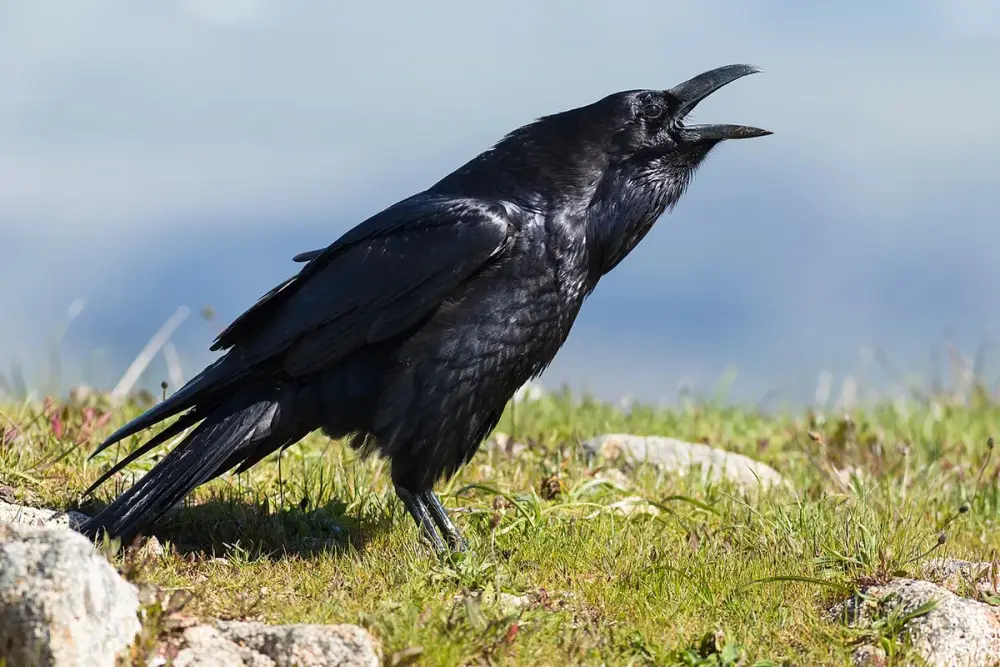
The American crow is a large passerine bird in the family Corvidae, common and widespread across nearly all of North America, absent only from the tundra biome. It's the New World counterpart to the Old World's carrion crow and hooded crow, filling a similar ecological niche. Its plumage is all black with an iridescent sheen, as are its legs, feet, and bill. It can be distinguished from the larger common raven by its smaller size and less pronounced beak, and from the similarly sized fish crow mainly by behavior — fish crows fluff their throat feathers when calling, a habit American crows don't share.
The species was formally described by German ornithologist Christian Ludwig Brehm in 1822, and its scientific name, translating to "short-billed crow," comes from the Ancient Greek for "short" and "billed." Between three and five subspecies are recognized depending on the authority, differing mainly in bill proportion and forming a rough size gradient across North America, with birds smallest in the far west and along the southern coast. One former subspecies, the northwestern crow, was reclassified in 2020 as part of the American crow rather than its own species.
Adults measure 40–53 cm (16–21 in) in length, with the tail making up about 40% of that, and have a wingspan of 85–100 cm (33–39 in). Bill length varies from 3 to 5.5 cm (1.2–2.2 in) depending on location, and body mass ranges from 316 to 620 g (11.1–21.9 oz), with males tending to be larger than females. Its most familiar call is a loud, rapid caaw-caaw-caaw, typically delivered with the head thrust up and down, though American crows can also produce a wide range of other sounds and sometimes mimic other animals, including birds like the barred owl.
Behavior and diet
Diet
Omnivorous — insects, seeds, nuts, small animals, eggs, nestlings, carrion, and human food scraps
American crows are omnivores with a notably broad diet: invertebrates of all kinds, carrion, scraps of human food, fruits, nuts such as walnuts and almonds, seeds, eggs, nestlings, stranded fish, and grain. They actively hunt small animals too, including mice, young rabbits, and frogs, and their diet shifts toward nuts and acorns in winter and autumn. They'll scavenge at landfills and visit bird feeders, and where crops like corn and wheat are available, they favor them — a habit that has historically made the species unpopular with farmers, though it's suspected the damage is at least partly offset by the crow's appetite for insect pests.
Socially, American crows are monogamous cooperative breeders. Mated pairs form family groups of up to 15 individuals spanning several breeding seasons, and offspring from earlier nesting seasons often stay on to help raise new nestlings. Crows don't reach breeding age for at least two years, and most don't leave the family group to breed until four or five years old. The nesting season starts early, with some birds incubating eggs by early April; nests are bulky stick structures built mainly in trees, with oaks the most commonly used, and clutches run three to six eggs, incubated for 18 days. Young typically fledge about 36 days after hatching. Nest predators include snakes, raccoons, ravens, and domestic cats, while adult crows face occasional attacks from great horned owls, red-tailed hawks, peregrine falcons, and North American eagles.
American crows are considered highly intelligent, with a brain-weight-to-body ratio matching that of humans, though they process information using a different brain structure — the pallium rather than the neocortex. They can recognize individual people by appearance, have been documented using and modifying tools to get food, and have been observed cooperating to steal food from other animals — in one case, one crow distracted a river otter by pecking its tail while others made off with its fish. They've also been seen at play, including sliding down tree bark in a kind of snowboarding motion.
Range and habitat
Habitat
Nearly all types of country — wilderness, farmland, parks, open woodland, towns, and major cities — but absent from tundra
The American crow's range extends from the Pacific to the Atlantic across Canada, including the French islands of Saint-Pierre and Miquelon, south through the entire United States and into northern Mexico, and it has also been recorded in Bermuda since 1876. It's a permanent resident across most of the U.S., while most Canadian birds migrate south to some degree in winter. Range expansion has been aided by an increase in trees across the Great Plains over the past century, driven by fire suppression and tree planting. Outside the breeding season, American crows often form large communal roosts numbering in the thousands or even millions of birds at night.
The species inhabits virtually every type of landscape apart from tundra — wilderness, farmland, parks, open woodland, towns, and major cities are all used.
Conservation status
The American crow is listed as Least Concern (LC), a status supported by its large population — estimated at 31 million birds as of 2012 by BirdLife International — and its extensive range. That said, the species has faced real pressures. Since West Nile virus arrived in North America in 1999, apparently carried by a single infected air traveler, American crow populations have dropped by an estimated 45%, with mortality in some local populations reaching up to 72% in a single season; the species' high susceptibility makes it a useful sentinel for tracking the virus's spread, though crows cannot transmit it to humans directly. Humans have also killed crows in large numbers historically, both for sport and through organized extermination campaigns — a program in Oklahoma between 1934 and 1945 dynamited 3.8 million birds without meaningfully reducing crop damage. In a study of banded birds recovered between 1917 and 1999, intentional killing accounted for 68% of all recorded deaths. Hunting protections vary widely: Canada offers American crows no protection except in Quebec during nesting season, while U.S. states differ, with New Jersey allowing limited hunting and Oklahoma permitting it even during nesting season.
Where to see american crow in the U.S.
8 zoos across 6 states
Find the closest one
Rank the 8 zoos holding american crow by how far they are from you. Your location is used in your browser to sort this list and is never sent to us.
California· 3
Idaho· 1
Maryland· 1
Montana· 1
New York· 1
Tennessee· 1
AZAThe Association of Zoos and Aquariums. Accredited members have passed an independent inspection of animal care and welfare, safety, conservation and education, repeated every five years. Many smaller facilities never apply, so “not accredited” isn't a verdict on its own. What accreditation means · How we check this
Built from each zoo's own published animal list.
American Crow: common questions
Is the American crow endangered?
No. It's listed as Least Concern, though its population has fallen sharply — by an estimated 45% — since West Nile virus arrived in North America in 1999.
How big does an American crow get?
It measures 40–53 cm (16–21 in) in length with a wingspan of 85–100 cm (33–39 in), and weighs 316–620 g (11.1–21.9 oz).
What does an American crow eat?
It's an omnivore, eating insects, seeds, nuts, small animals, eggs, nestlings, carrion, grain, and scraps of human food.
How long do American crows live?
About 7–8 years in the wild, though captive birds have lived up to 30 years.
Where do American crows live in the wild?
Across nearly all of North America, from the Pacific to the Atlantic in Canada, through the United States, and into northern Mexico — everywhere except tundra habitat.
Which U.S. zoos have American crows?
Six zoos in the Feather & Fang directory have them, including Zoo Idaho, Salisbury Zoo, and CuriOdyssey.