- Where to see one
- 15 U.S. zoos in our directory hold chinese alligator, confirmed against each zoo's own animal list.
- Native range
- Anhui province, China; possibly Jiangsu and Zhejiang
- Size
- 1.5–2.1 m (5–7 ft) in length; 36–45 kg (80–100 lb) as an adult
- Lifespan
- Past 50 years in the wild; up to 70 in captivity
Conservation status
IUCN Red List category CR — step 5 of 7.
About the Chinese alligator
The Chinese alligator, also called the Yangtze alligator or China alligator, is one of only two living species in the genus Alligator, alongside the American alligator. It is endemic to China, and it is one of the smallest crocodilians alive: an adult reaches 1.5 to 2.1 meters (5 to 7 feet) in length and weighs 36 to 45 kilograms (80 to 100 pounds), less than half the size of its American cousin, which typically grows to 3.4 meters for males. The largest reliably reported female measured 2.07 meters and weighed 50 kilograms; the largest male measured 2.46 meters and weighed 84 kilograms. Females run roughly three-quarters the length of males.
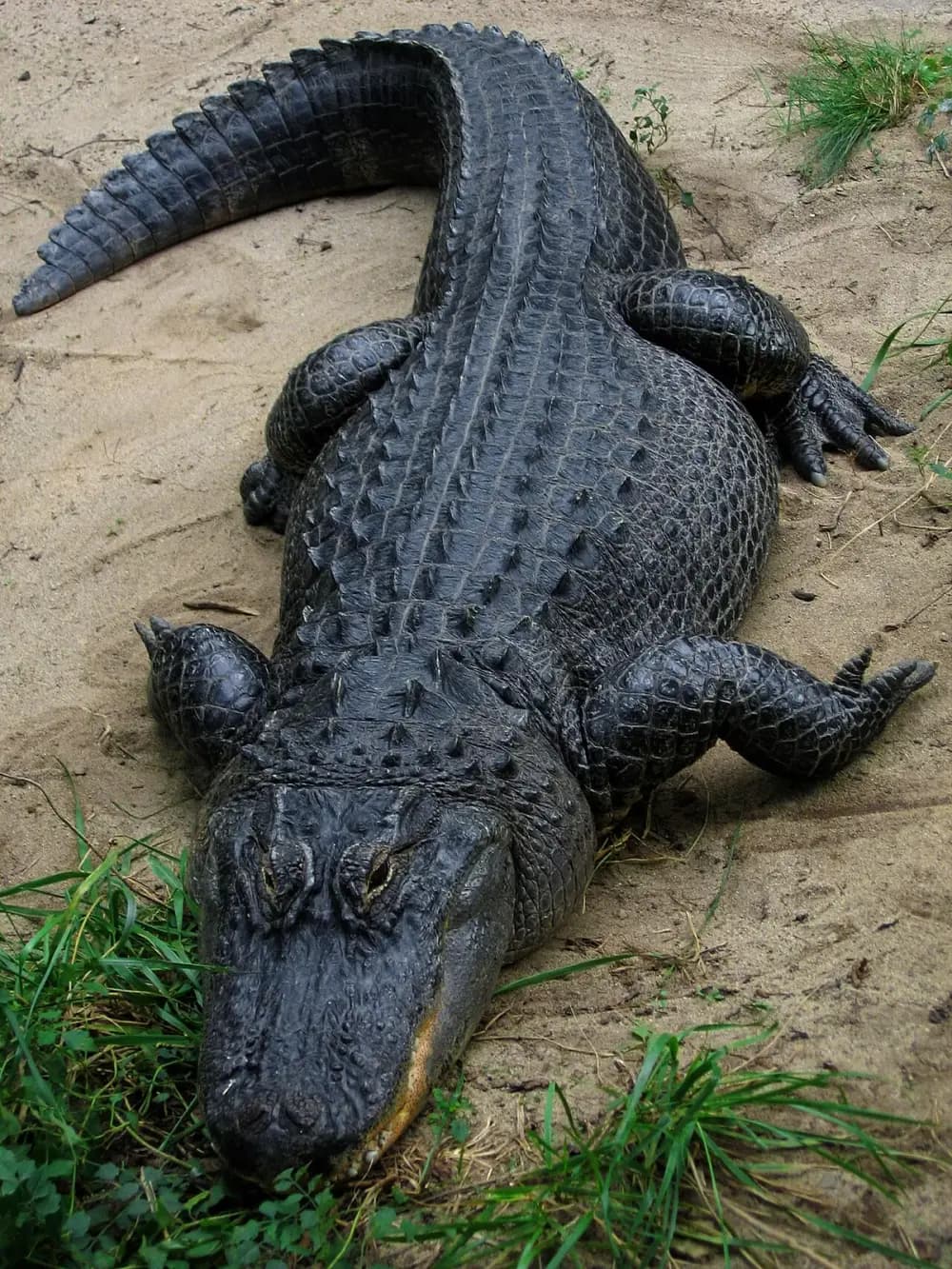
Adults are almost entirely black or dark gray, with a short, broad snout that points slightly upward and narrows near the tip. The head is more robust than an American alligator's, with a bony septum dividing the nostrils and bony plates on the upper eyelids, a trait rarely seen in its American relative. The body is fully armored, including the belly, with up to 17 rows of scales that are soft on the belly and sides and rougher along the back. It has 72 to 76 teeth in total, and its tail is proportionally wider than that of the American alligator. Unlike the American alligator, it lacks webbed feet.
The species was formally described in 1879 by French naturalist Albert-Auguste Fauvel, though references to it appear in Chinese literature dating back to roughly 222–227 CE, and the oldest known fossil record, from Japan, is about 3 million years old. Pleistocene fossils show its range once extended much farther, north to Shandong and south to the Taiwan Strait. Today it survives only in freshwater habitats within a small part of Anhui province, with possible presence in Jiangsu and Zhejiang.
Behavior and diet
Diet
Fish, invertebrates, and small mammals
The Chinese alligator brumates in burrows from late October to mid-April, emerging in early May, then spends time basking in the sun before summer arrives. Through the summer it becomes nocturnal, hunting at night and sheltering by day, a pattern that lets it avoid both the heat and human activity in the areas it shares with people. It is generally docile and does not intentionally harm humans. Its burrows, dug with the head and front legs next to ponds and other small water bodies, are typically 10 to 25 meters (33 to 82 feet) long, with multiple rooms and pools, and stay no colder than 10°C (50°F) inside even in winter.
It is an opportunistic carnivore, primarily eating fish and invertebrates such as crustaceans, insects, mussels, clams, and snails, and taking rodents, other small mammals, and aquatic birds when it can. A 1985 study of its diet found snails made up 63 percent of intake, alongside 16 percent rabbits, 8.3 percent mollusks, and 4.1 percent shrimp. Its teeth are dull, which suits feeding on shelled prey.
Breeding runs from early summer, peaking in mid-June, and the species is polygamous. A study of 50 clutches found multiple paternity in 60 percent of them. Females build nests of rotting vegetation 2 to 3 weeks after mating, laying 20 to 30 eggs on average (the IUCN cites a range of 10 to 40) that are smaller than those of any other crocodilian, at about 6 centimeters long and 45 grams. Eggs incubate roughly 70 days at 25–26°C, a temperature that determines the hatchling's sex. Hatchlings, born in September at 20 to 22 centimeters and 25 to 30 grams, are also the smallest of any crocodilian and depend on their mothers through their first winter. The species is notably vocal, using head-slapping, hissing, whining, and low-frequency bellows to communicate, with both sexes bellowing in chorus during the mating season.
Range and habitat
Habitat
Freshwater ponds, rivers, and burrows
The Chinese alligator's modern range is confined to freshwater ponds and rivers in six counties of southeastern Anhui province, with possible presence in Jiangsu and Zhejiang. As of 2015, the IUCN estimated its area of occupation at only about 5 square kilometers. Historically, the species ranged across the wider Yangtze river system and once extended as far as Japan, but its range and population have contracted sharply since roughly 6000 BC because of habitat destruction.
Conservation status
The Chinese alligator is listed as Critically Endangered by the IUCN. Its wild population was estimated at about 1,000 individuals in the 1970s, falling below 130 by 2001. Numbers have since grown, reaching an estimated 300 individuals by 2017, following multiple conservation actions targeting the species.
Where to see chinese alligator in the U.S.
15 zoos across 15 states
Find the closest one
Rank the 15 zoos holding chinese alligator by how far they are from you. Your location is used in your browser to sort this list and is never sent to us.
California· 1
District of Columbia· 1
Illinois· 1
Kansas· 1
Louisiana· 1
Maryland· 1
Michigan· 1
Missouri· 1
New Mexico· 1
New York· 1
Ohio· 1
Oklahoma· 1
Tennessee· 1
Texas· 1
Wisconsin· 1
AZAThe Association of Zoos and Aquariums. Accredited members have passed an independent inspection of animal care and welfare, safety, conservation and education, repeated every five years. Many smaller facilities never apply, so “not accredited” isn't a verdict on its own. What accreditation means · How we check this
Built from each zoo's own published animal list.
Chinese Alligator: common questions
Is the Chinese alligator endangered?
Yes. It is listed as Critically Endangered by the IUCN, with a wild population estimated at around 300 as of 2017.
How big does a Chinese alligator get?
Adults reach 1.5 to 2.1 meters (5 to 7 feet) in length and weigh 36 to 45 kilograms (80 to 100 pounds), making it one of the smallest crocodilians.
What does a Chinese alligator eat?
It is an opportunistic feeder that mostly eats fish and invertebrates such as snails, mussels, and insects, along with rodents and small mammals when available.
How long do Chinese alligators live?
Wild individuals can live past 50 years, and captive specimens have reached age 70.
Where do Chinese alligators live in the wild?
Their range today is restricted to six counties in Anhui province, China, with possible presence in Jiangsu and Zhejiang.
Which U.S. zoos have Chinese alligators?
Eight zoos in our directory list them, including the Saint Louis Zoo, Detroit Zoo, and the Maryland Zoo in Baltimore.