
Crocodilians in U.S. zoos
Crocodilians (order Crocodylia) are semiaquatic, predatory reptiles: alligators, caimans, crocodiles and gharials. The IUCN recognizes 26 species, found mainly in warm parts of the Americas, Africa, Asia and Oceania. With birds, they are the only surviving archosaurs, and they give their young more parental care than most reptiles.
Most widely held
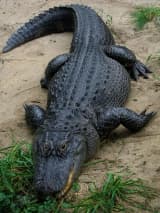 American AlligatorAlligator mississippiensisAt 94 zoos · Least Concern
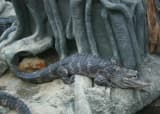 Chinese AlligatorAlligator sinensisAt 15 zoos · Critically Endangered
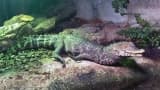 Cuvier's Dwarf CaimanPaleosuchus palpebrosusAt 8 zoos · Least Concern
 West African Dwarf CrocodileOsteolaemus tetraspisAt 7 zoos · Vulnerable
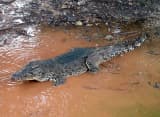 Cuban CrocodileCrocodylus rhombiferAt 6 zoos · Critically Endangered
What makes a crocodilian
Every crocodilian shares the same basic plan: a solid, lizard-like body, a flat head with a long snout, and a tail flattened from side to side for swimming. Eyes, ears and nostrils sit on top of the head, so the animal can watch and breathe with almost its whole body underwater. The skin is covered in non-overlapping scutes, many strengthened by bony plates.
The order splits into alligators and caimans, true crocodiles and gharials. Size varies widely. The American alligator can reach 4.8 m (15.7 ft), while Cuvier's dwarf caiman, the smallest crocodilian in the Americas, rarely exceeds 1.6 m (5.2 ft). The West African dwarf crocodile is the smallest living crocodile, at 1.7 to 1.9 m (5.6 to 6.2 ft).
Telling alligators from crocodiles
The snout is the quickest clue. Alligators and caimans tend to have broad, U-shaped snouts, and the lower teeth fit into pits inside the upper jaw, so only the upper teeth show when the mouth is shut. Crocodiles usually have narrower, V-shaped snouts, with both rows of teeth visible.
There are exceptions. The Chinese alligator has an unusually short, broad, upturned snout and bony plates on its eyelids. The Cuban crocodile is the most land-adapted living crocodile, with long, strong legs and rough, pebbled scales.
Behavior worth watching for
Crocodilians control their body temperature mainly through behavior, basking on land and moving into water as the day warms. Most are stalk-and-ambush predators. They also vocalize, and alligators and caimans are the noisiest; the American alligator is exceptionally loud.
Parental care is unusual for a reptile. Females build hole or mound nests, and the mother helps dig hatchlings out and carries them to the water in her mouth. The young gather together and follow her.
Conservation picture
Human activity is the main threat, through hunting and habitat destruction. By the early 1970s more than 2 million wild crocodilian skins had been traded, pushing some species toward extinction, and farming has since greatly reduced the illegal skin trade. Of the 26 species on the IUCN Red List, 11 are threatened.
The Chinese alligator and Cuban crocodile are both Critically Endangered. The Cuban crocodile also faces hybridization with the American crocodile, and captive breeding projects aim to support its recovery. The American alligator shows what protection can do: listed as endangered in 1967, it recovered and was removed from the list in 1987.
Common questions
What is the difference between an alligator and a crocodile?
Look at the snout and teeth. Alligators and caimans usually have broad, U-shaped snouts, and with the mouth closed only the upper teeth show; crocodiles have narrower, V-shaped snouts with teeth from both jaws visible.
What is the largest crocodilian?
The saltwater crocodile and Nile crocodile are the largest, reaching 6 m (20 ft) and up to 1,000 kg (2,200 lb). The smallest are the dwarf caimans and African dwarf crocodiles, at about 1 to 1.5 m (3 ft 3 in to 4 ft 11 in).
How many species of crocodilians are there?
The IUCN Red List recognizes 26 species of crocodilian and classes 11 of them as threatened.
Are crocodilians related to dinosaurs?
Yes. Crocodilians and birds are the only surviving archosaurs, the group that also included the dinosaurs, which makes crocodilians the closest living relatives of birds.
Where do alligators live?
There are only two alligator species. The American alligator lives in the southeastern United States and the Chinese alligator along the Yangtze River in China, and both tolerate occasional winter frost.
Are alligators endangered?
The American alligator is not; it was listed as endangered in 1967 but recovered under protection and was removed from the list in 1987. The Chinese alligator, by contrast, is Critically Endangered.
Sources
Last reviewed