- Where to see one
- 9 U.S. zoos in our directory hold bullsnake, confirmed against each zoo's own animal list.
- Native range
- Southern Canada, the continental United States, and Mexico
- Lifespan
- 12 to 15 years in the wild; the oldest recorded captive individual lived more than 33 years
- Size
- 36–84 in (91–213 cm) long as an adult
About the bullsnake
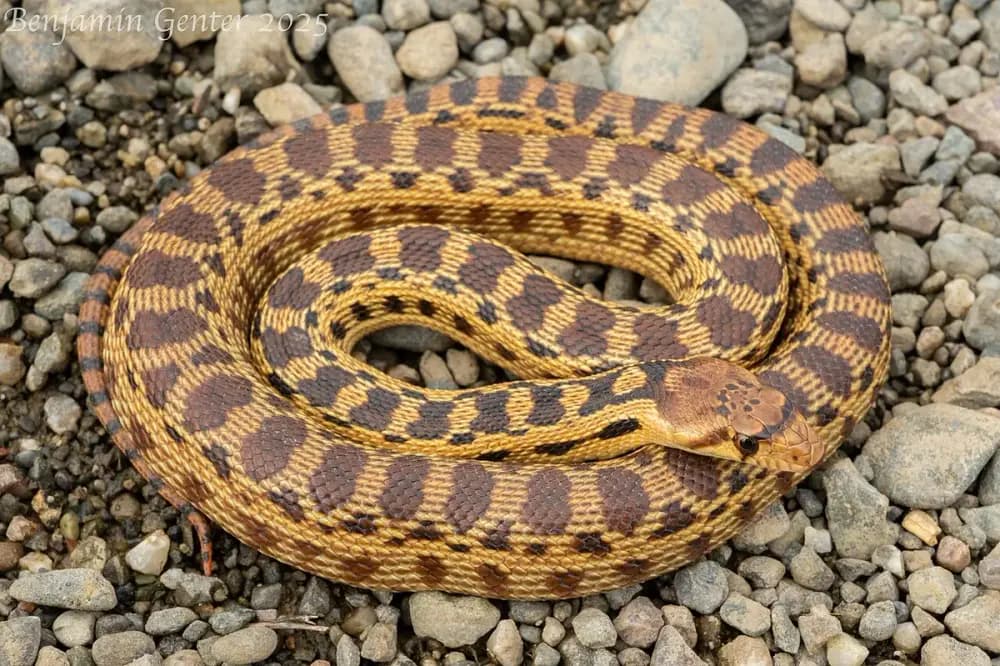
The bullsnake is one of the common names used for Pituophis catenifer, a nonvenomous colubrid snake found only in North America. Nine subspecies are currently recognized across the species' range, and "bullsnake" is one of several regional names applied to these populations, alongside gopher snake, Pacific pine snake, and blow snake, among others. The scientific name comes from the Latin catenifer, meaning "chain-bearing," a reference to the chain-like pattern of dark markings running down the snake's back.
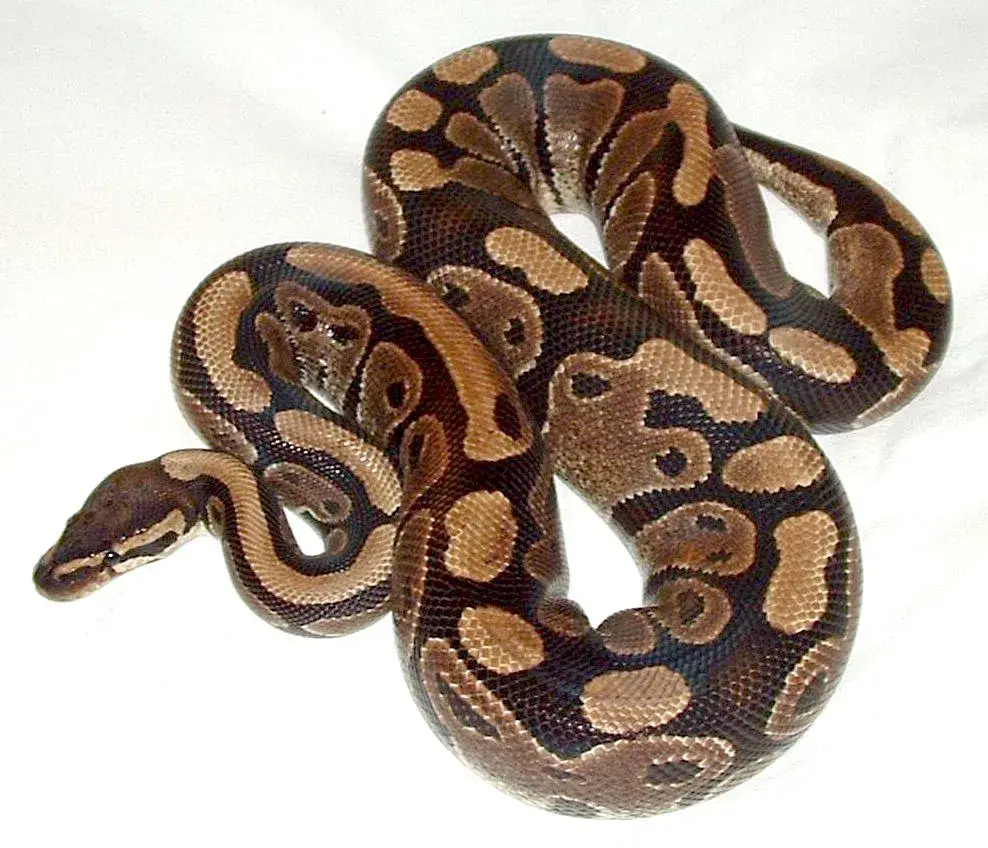
Adult bullsnakes typically measure 36 to 84 inches (91 to 213 cm) in length when fully grown, making them one of the larger nonvenomous snakes in their range. Their coloring is yellowish or light sandy brown on top, marked with a series of large, dark brown or black blotches and smaller, darker spots along the sides. The underside is a lighter yellowish tone, sometimes plain and sometimes patterned with brown markings. Because color and pattern vary by subspecies, individual bullsnakes can look noticeably different from one population to the next.
Bullsnakes are frequently confused with the prairie rattlesnake, but the two are easy to tell apart on close inspection. A bullsnake has no tail rattle and no black-and-white banding near the tail tip, and its head is narrower and more cylindrical than a rattlesnake's more angular, rounded head, which in rattlesnakes is shaped in part by large venom glands behind each eye.
Behavior and diet
The bullsnake's most distinctive trait is a defensive display that closely imitates a rattlesnake. When threatened, it puffs up its body and coils into the classic rattlesnake strike pose. Rather than striking with an open mouth, though, it typically strikes with its mouth closed, using its blunt nose to bump and warn off a potential predator. It also vibrates its tail rapidly, producing a buzzing effect similar to a rattlesnake's rattle even though it has no rattle of its own.
Researchers who studied gopher snake populations on islands without rattlesnakes found that those snakes vibrated their tails for shorter periods than snakes on the California mainland, where several rattlesnake species are common. This suggests the tail-vibrating behavior may in fact be a form of rattlesnake mimicry, since it appears to be breaking down in areas without rattlesnakes — possibly because predators there have no reason to evolve avoidance of tail-vibrating snakes.
In the wild, bullsnakes live an average of 12 to 15 years. In captivity, they can live much longer: the oldest captive individual on record lived more than 33 years.
Range and habitat
Bullsnakes and their close relatives occur from southern Canada through the continental United States and into Mexico, making Pituophis catenifer one of the more widely distributed snake species in North America. Six subspecies are broadly agreed upon by taxonomists, though populations in Baja California and on some offshore islands remain a subject of debate, with a few island forms considered by some researchers to be distinct species rather than subspecies of the mainland snake.
The mainland-versus-island distinction also shows up in behavior: gopher snakes on California's offshore islands, which lack native rattlesnakes, vibrate their tails for shorter periods than their mainland counterparts do.
Conservation status
The bullsnake is listed as Least Concern by the IUCN. No specific population threats or conservation programs for this species are documented here.
Where to see bullsnake in the U.S.
9 zoos across 6 states
Find the closest one
Rank the 9 zoos holding bullsnake by how far they are from you. Your location is used in your browser to sort this list and is never sent to us.
Colorado· 2
Illinois· 1
Kansas· 1
Minnesota· 2
Missouri· 2
Wisconsin· 1
AZAThe Association of Zoos and Aquariums. Accredited members have passed an independent inspection of animal care and welfare, safety, conservation and education, repeated every five years. Many smaller facilities never apply, so “not accredited” isn't a verdict on its own. What accreditation means · How we check this
Built from each zoo's own published animal list.
Bullsnake: common questions
Is the bullsnake endangered?
No. It is listed as Least Concern by the IUCN, meaning it is not currently considered at risk.
How big does a bullsnake get?
Adults typically reach 36 to 84 inches (91 to 213 cm) in length.
How long do bullsnakes live?
Wild bullsnakes typically live 12 to 15 years. The oldest known captive individual lived more than 33 years.
Where do bullsnakes live in the wild?
They range across southern Canada, the continental United States, and Mexico.
Which U.S. zoos have bullsnakes?
Five zoos in our directory list this species, including Cheyenne Mountain Zoo in Colorado, the Minnesota Zoo, and the Saint Louis Zoo.