- Where to see one
- 9 U.S. zoos in our directory hold gopher snake, confirmed against each zoo's own animal list.
- Native range
- Southwestern Canada through the central and western United States to northern Mexico and Baja California
- Size
- Adults typically 91–213 cm (3–7 ft) long
- Lifespan
- 12–15 years in the wild; more than 33 years in captivity
- Venom
- None; kills prey by constriction
- Clutch size
- 2 to 24 eggs, incubated about 65 to 75 days
Conservation status
Least Concernassessed 2007
IUCN Red List category LC — step 1 of 7.
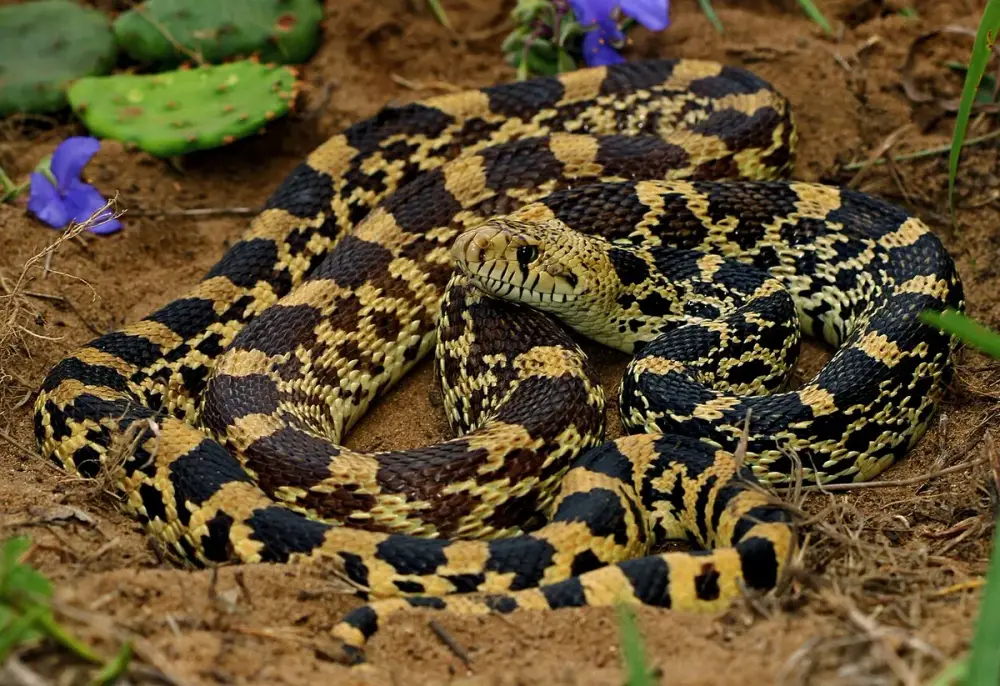
The gopher snake is a nonvenomous colubrid endemic to North America, with populations from southern Canada through the continental United States into Mexico. Adults are usually yellowish or light sandy brown, marked with large dark brown or black blotches along the back and smaller dark spots on the sides, and typically measure 91 to 213 cm when fully mature. It is often mistaken for a rattlesnake, but has a narrower head and no rattle. When threatened it puffs up its body, vibrates its tail and may strike with a closed mouth. Wild individuals typically live 12 to 15 years.
About the gopher snake
The gopher snake is a large, nonvenomous constrictor in the colubrid family, native to western and central North America from southern Canada to Mexico. It is famous for imitating a rattlesnake when threatened. Its several subspecies go by many local names, including bullsnake, Pacific gopher snake and Sonoran gopher snake.
The scientific name is Pituophis catenifer, and catenifer is Latin for "chain-bearing," a nod to the linked row of blotches down the back. Most gopher snakes are yellowish, straw-colored, gray or light sandy brown, with large dark brown or black blotches along the spine and smaller dark spots on the sides. The belly is white to yellowish, plain or spotted with brown. A dark line usually crosses the face in front of the eyes and runs from behind each eye to the angle of the jaw.
Color patterns vary from region to region and often match the dominant vegetation, which helps the snake stay hidden. Blotched, striped and even albino individuals are known from wild populations. The scales are keeled, and there are 27 to 37 rows of scales around the middle of the body.
Adults commonly reach 91 to 213 cm (3 to 7 ft), and some measurements put large individuals as long as 275 cm (9 ft). Compared with other snakes of similar length, gopher snakes have relatively large heads, narrow necks and big eyes. Males and females look alike.
Behavior and diet
Diet
Mostly rodents and other small mammals; also birds, eggs, lizards, smaller snakes and insects
Gopher snakes live alone except in the mating season. They are mainly diurnal, though they are sometimes active at night, and they spend a surprising share of their lives out of sight. Radio-tracking studies have found individuals spending up to 90% of their time in underground burrows. They swim and climb well, and like other snakes they go through spells of dormancy, including when food is scarce.
They are also homebodies. Four radio-tracked males in California used home ranges of 0.89 to 1.78 hectares (2.2 to 4.4 acres), yet spent most of their time in a core area of only 0.1 to 0.29 hectares. Neighbors' ranges rarely overlap, and long-term studies have recaptured snakes about 150 m (490 ft) from where they were released six years earlier.
What gopher snakes eat
Rodents and other small mammals are the main prey everywhere the species lives. In some areas pocket gophers make up much of the diet, which is how the snake got its name. Gopher snakes actively search burrows and hiding places and follow small-mammal runways, catching voles, harvest mice, deer mice, kangaroo rats, ground squirrels and young rabbits. They also take birds and eggs, lizards, smaller snakes including rattlesnakes, insects, and occasionally bats in their roosts. Prey is killed by constriction.
That appetite makes the gopher snake valuable to farmers. It preys heavily on rodents that damage crops and can greatly reduce small-mammal numbers in an area.
The rattlesnake bluff
When cornered, a gopher snake puts on a convincing act. It puffs up its body, raises its head, and coils into the classic striking pose of a rattlesnake. It also vibrates its tail rapidly, just as a rattlesnake would. If it strikes, it often does so with its mouth closed, using its blunt nose to warn off the threat.
Researchers think the tail-shaking really is rattlesnake mimicry. One study found that gopher snakes on islands without rattlesnakes shake their tails for shorter periods than mainland California snakes that live alongside many rattlesnake species. The behavior seems to be fading where there is no dangerous model to copy.
Breeding and life cycle
Gopher snakes breed once a year, usually from June to August. Receptive females release skin secretions that males detect with their tongues, and males compete for access and try to mate with as many females as they can find. Females lay 2 to 24 eggs in nests that are sometimes shared with other females, and some females lay two clutches in a year.
There is no parental care. The eggs hatch after about 65 to 75 days into young 30 to 35 cm (12 to 14 in) long that fend for themselves. Growth is rapid for the first three years and then slows, but never fully stops. Males mature at about 1.5 years, while females take around four years.
Predators
Kit foxes, red-tailed hawks and coyotes are the most common predators. Other foxes, hawks and large king snakes probably take them too. Gopher snakes rely on camouflage, staying hidden except when hunting or basking in the open, and on their rattlesnake bluff when found.
Range and habitat
Habitat
Grasslands, prairies, deserts, chaparral, shrublands, open woodland, forest edges and farm fields
The gopher snake occurs from south-central British Columbia and southern Alberta and Saskatchewan, through the central and western United States, and south through Baja California and into the Mexican states of Sinaloa, Durango, Zacatecas and Tamaulipas. In the U.S. it ranges from the Pacific coast east to Wisconsin, Illinois, Missouri, Oklahoma and western Texas.
Habitat is just as varied: woodland, desert, prairie, chaparral, shrubland and cultivated fields. Even where gopher snakes live near marshes or moist woods, tracking studies show they favor the open parts, such as grassland and forest edges, likely because that is where they hunt. Several subspecies are confined to islands off Baja California, including the Cedros Island, San Martin Island and Coronado Island gopher snakes, though taxonomists disagree on how many of these island forms are valid.
"Bullsnake" is one of the names used for the gopher snake or its subspecies. Others include Pacific gopher snake, Henry snake, Sonoran gopher snake, Great Basin gopher snake, western pine snake and blow snake.
Gopher snake vs rattlesnake
Gopher snakes are often mistaken for rattlesnakes, especially the prairie rattlesnake, and many are killed for it. A few features tell them apart.
| Feature | Gopher snake | Rattlesnake |
|---|---|---|
| Venom | None; kills by constriction | Venomous |
| Tail tip | Pointed, no rattle | Rattle at the end |
| Tail banding | No black-and-white bands | Prairie rattlesnake has black-and-white banding near the tail |
| Head shape | Narrow, slender, cylindrical | Broader, rounder head from large venom glands behind the eyes |
| Strike when bluffing | Often closed-mouthed | Open-mouthed bite |
Conservation status
The gopher snake is listed as Least Concern on the IUCN Red List, assessed in 2007. It is considered fairly stable across its range and has no special U.S. federal or CITES status.
Two pressures stand out: persecution and isolation. Because it looks and acts so much like a rattlesnake, many gopher snakes are killed by people who mistake them for venomous snakes. The small island populations off Baja California may be especially vulnerable to environmental change or persecution.
Where to see gopher snake in the U.S.
9 zoos across 5 states
Find the closest one
Rank the 8 zoos holding gopher snake by how far they are from you. Your location is used in your browser to sort this list and is never sent to us.
1 more zoo holds gopher snake but has no coordinates on file yet, so it isn't ranked here. It's in the full list below.
California· 5
Florida· 1
Pennsylvania· 1
Texas· 1
Utah· 1
AZAThe Association of Zoos and Aquariums. Accredited members have passed an independent inspection of animal care and welfare, safety, conservation and education, repeated every five years. Many smaller facilities never apply, so “not accredited” isn't a verdict on its own. What accreditation means · How we check this
Built from each zoo's own published animal list.
Gopher Snake: common questions
Is a gopher snake venomous?
No. Gopher snakes have no venom and kill their prey by constriction. A large one can give a painful bite if harassed, but it bites only in self-defense.
How big do gopher snakes get?
Adults are typically 91 to 213 cm (3 to 7 ft) long, with some sources reporting lengths up to 275 cm (9 ft). Hatchlings are 30 to 35 cm (12 to 14 in).
What do gopher snakes eat?
Mostly rodents and other small mammals, including pocket gophers, voles, mice, kangaroo rats, ground squirrels and young rabbits. They also eat birds, eggs, lizards, smaller snakes and insects.
How long do gopher snakes live?
About 12 to 15 years in the wild. The oldest known captive lived more than 33 years.
How can you tell a gopher snake from a rattlesnake?
Check the tail and head. A gopher snake has no rattle and no black-and-white tail bands, and its head is narrow rather than broad and rounded.
Is a bullsnake the same as a gopher snake?
Closely. Bullsnake is one of the common names used for the gopher snake or for its subspecies, so a bullsnake is a form of gopher snake.
Where do gopher snakes live?
Across western and central North America, from southern British Columbia, Alberta and Saskatchewan south through the western U.S. into Mexico. They favor open grassland, desert, chaparral, farmland and woodland edges.
Can you keep a gopher snake as a pet?
Yes. They are kept in the pet trade and make good pets if well cared for.