- Where to see one
- 25 U.S. zoos in our directory hold red wolf, confirmed against each zoo's own animal list.
- Native range
- Southeastern United States
- Size
- 136–165 cm (54–65 in) long including a roughly 37 cm (15 in) tail; males average 29 kg (64 lb), females 25 kg (55 lb)
Conservation status
Critically Endangeredassessed 2018
IUCN Red List category CR — step 5 of 7.
Critically Endangered (CR), assessed in 2018
About the red wolf
The red wolf is a canine native to the southeastern United States, roughly intermediate in size between a coyote and a gray wolf. Some individuals overlap in size with small gray wolves, but studies of skull and body measurements from eastern North Carolina have found red wolves to be morphometrically distinct from both coyotes and coyote hybrids. Adults run 136 to 165 centimeters (54 to 65 inches) long, tail included, with the tail itself about 37 cm (15 in). Weights range from 20 to 39 kilograms (44 to 86 pounds); males average 29 kg (64 lb) and females 25 kg (55 lb).
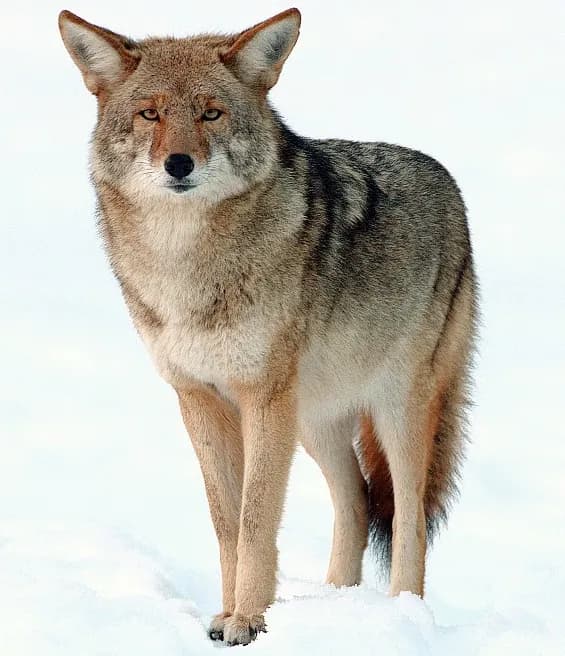
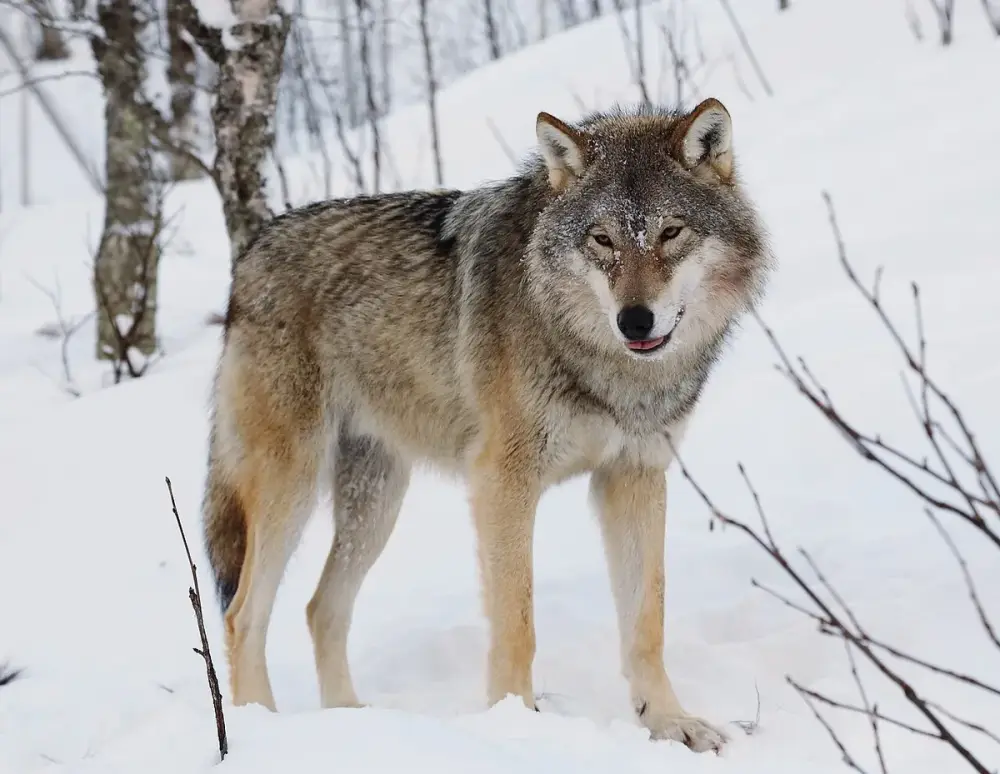
Its coat is typically more reddish and sparsely furred than a coyote's or gray wolf's, running tawny to grayish with lighter markings around the lips and eyes, though black individuals do occur. The build has been compared to a greyhound's, with long, slender limbs and ears proportionately larger than a coyote's or gray wolf's. The skull is narrow, with a long, slim muzzle, a small braincase, and a well-developed sagittal crest. Its cerebellum is unusual for the genus Canis, resembling that of fox-like canids more than that of other wolves — one of several traits researchers point to when arguing the red wolf holds a distinct place in its family tree.
That place has been argued over for close to a century. The red wolf has been described at various times as its own species, a subspecies of the gray wolf, a coyote-wolf hybrid, or a distinct lineage that has since interbred with coyotes. Naturalists John James Audubon and John Bachman first distinguished the wolves of the southern United States from other North American wolves in 1851, describing a "Red Texan Wolf" and a "Black American Wolf." In 1937, zoologist Edward Alphonso Goldman proposed the species Canis rufus, with three subspecies, two of which — the Florida black wolf and the Texas red wolf — are now extinct. In 2021, the American Society of Mammalogists recognized the red wolf as its own species.
Two competing models try to explain how the red wolf fits among North American canines. One holds that gray wolves and coyotes are distinct species that gave rise to several hybrid populations, including the red wolf. The other holds that the red wolf is historically the same species as the eastern wolf, with its modern genetic makeup shaped by a population bottleneck during captive breeding. Genetic studies have produced conflicting results depending on the markers used and the specimens sampled, and the debate remains unresolved.
Behavior and diet
Diet
Carnivore; white-tailed deer, raccoons, rice rats, muskrats, nutria, rabbits, and carrion
The red wolf is more sociable than the coyote but less so than the gray wolf. It is monogamous, and both parents help raise the young. Mating takes place in January and February, with an average of six or seven pups born between March and May. Denning sites include hollow tree trunks, stream banks, and the abandoned burrows of other animals. Pups begin to range away from the den around six weeks of age, reach full size at one year, and become sexually mature two years later.
Long-term pedigree data show that red wolves largely avoid inbreeding among close relatives. Young wolves typically disperse from their birth pack independently, spending time alone or in small non-breeding groups made up of unrelated individuals before pairing off — the union of two unrelated wolves establishing a new home range is the usual pattern for forming a breeding pair. Avoiding inbreeding matters because it prevents the reduced fitness that comes from offspring inheriting two copies of harmful recessive genes.
Range and habitat
The red wolf is native to the southeastern United States. Its historical range once extended from Florida north into the Mid-Atlantic and Ohio Valley states and west through the Gulf Coast into Texas, but its populations collapsed through the 20th century as three named subspecies were reduced to one small population along the Texas-Louisiana coast. That surviving population, the Mississippi Valley red wolf, was removed from the wild in the 1970s to found a captive breeding program, then reintroduced to eastern North Carolina in 1987 — the basis of the wild population that still exists there today.
Conservation status
The red wolf is Critically Endangered on the IUCN Red List, most recently assessed in 2018. It was recognized as endangered by the U.S. Fish and Wildlife Service in 1973, and the International Union for Conservation of Nature first listed it as critically endangered in 1996. Only around 30 red wolves are estimated to remain in the wild, all descended from the reintroduced eastern North Carolina population, in addition to wolves held in captivity as part of ongoing breeding efforts.
Part of the difficulty in protecting the red wolf has been the decades-long dispute over its taxonomic status: because some researchers have argued it is a hybrid or subspecies rather than a full species, it has at times been excluded from conservation lists that apply only to distinct species. That question was central to the near-total loss of the historic wild population before the captive-breeding and reintroduction program began.
Genetic research on red wolves has itself been part of the conservation debate. A 1980 study found a unique gene variant tied to the enzyme lactate dehydrogenase in red wolves that was absent in the dogs and coyotes sampled alongside them, evidence some researchers point to for a distinct lineage. Later mitochondrial DNA work, published in 1991, found red wolf genotypes matching those of both gray wolves and coyotes, which the study's authors read as evidence of extensive hybridization — though they still argued the red wolf was unique and threatened enough to warrant continued protection. A 2000 study using genetic markers found that red wolves cluster most closely with eastern Canadian wolves, both groups known to interbreed readily with coyotes.
Where to see red wolf in the U.S.
25 zoos across 20 states
Find the closest one
Rank the 24 zoos holding red wolf by how far they are from you. Your location is used in your browser to sort this list and is never sent to us.
1 more zoo holds red wolf but has no coordinates on file yet, so it isn't ranked here. It's in the full list below.
California· 1
Connecticut· 1
District of Columbia· 1
Florida· 3
Georgia· 1
Illinois· 1
Louisiana· 1
Maryland· 1
Minnesota· 1
Missouri· 1
New Jersey· 1
New York· 3
North Carolina· 1
Ohio· 1
Rhode Island· 1
South Dakota· 1
Tennessee· 1
Virginia· 2
West Virginia· 1
Wisconsin· 1
AZAThe Association of Zoos and Aquariums. Accredited members have passed an independent inspection of animal care and welfare, safety, conservation and education, repeated every five years. Many smaller facilities never apply, so “not accredited” isn't a verdict on its own. What accreditation means · How we check this
Built from each zoo's own published animal list.
Red Wolf: common questions
Is the red wolf endangered?
Yes. It is listed as Critically Endangered on the IUCN Red List (2018), with an estimated 30 or so remaining in the wild, all in eastern North Carolina, alongside a captive population.
How big does a red wolf get?
Adults measure 136 to 165 cm (54 to 65 in) long including the tail. Males average 29 kg (64 lb) and females 25 kg (55 lb).
Where do red wolves live in the wild?
The only wild population is in eastern North Carolina, descended from wolves reintroduced there in 1987 after being bred from a small remnant population on the Texas-Louisiana coast.
Are red wolves social animals?
They are more social than coyotes but less social than gray wolves. Breeding pairs are monogamous, and pups stay with the pack before dispersing to form new pairs with unrelated wolves.
Which U.S. zoos have red wolves?
14 U.S. zoos keep them, including the North Carolina Zoo in Asheboro, Lincoln Park Zoo in Chicago, and Zoo Knoxville in Tennessee.