Pueblan Milk Snake
Lampropeltis triangulum campbelli
Also known as Peublan Milksnake, Pueblan Milksnake
- Where to see one
- 14 U.S. zoos in our directory hold pueblan milk snake, confirmed against each zoo's own animal list.
- Native range
- southern Puebla, eastern Morelos, and northern Oaxaca, Mexico
- Size
- adults reach 24 to 36 inches
Conservation status
Least Concernassessed 2019
IUCN Red List category LC — step 1 of 7.
Least Concern (LC) at the species level
About the Pueblan milk snake
The Pueblan milk snake, also known as Campbell's milk snake, is a non-venomous, egg-laying subspecies of colubrid snake, formally named Lampropeltis triangulum campbelli. The genus name Lampropeltis comes from the Ancient Greek for "bright shield," a reference to the sheen of the animal's scales, and the subspecies name honors American herpetologist Jonathan A. Campbell. It is closely related to the corn and rat snakes of the genus Pantherophis.
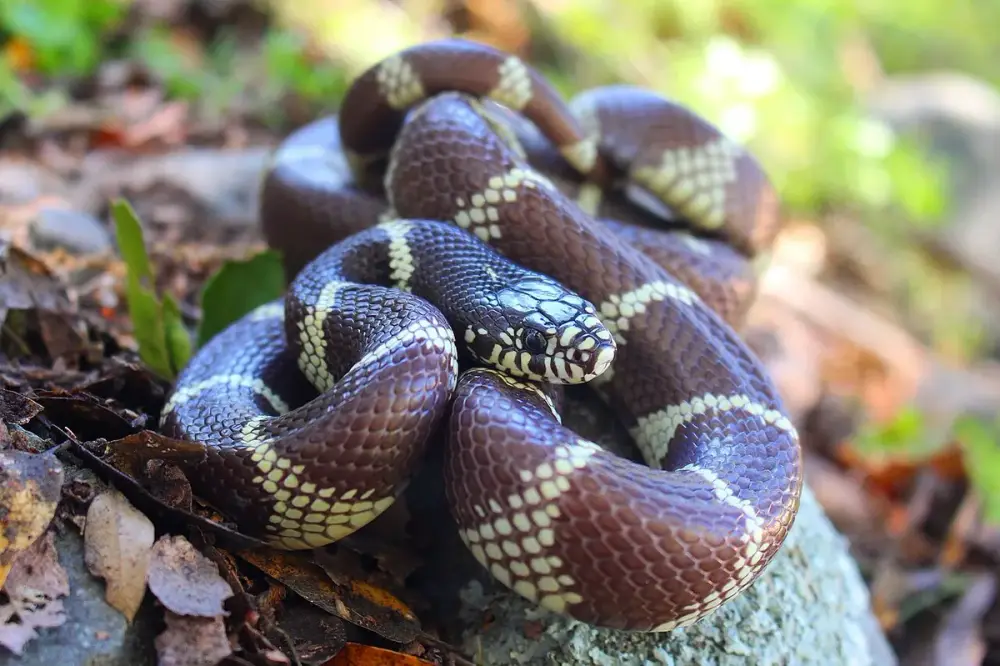
Adults grow to 24 to 36 inches long and display the tri-color banding — red, black, and white — that gives the wider milk snake group its striking look. In this particular subspecies, the white bands run especially wide, black tipping frequently overlays the red bands, and the red itself tends to run especially vibrant and bright compared with other milk snake subspecies. Aside from occasional black speckling, the light bands stay a pure white in animals without a color morph. That pattern closely resembles the venomous coral snake, an example of Batesian mimicry that likely helps protect the harmless Pueblan milk snake from predators that avoid the real thing.
When handled, the Pueblan milk snake can release a pungent-smelling exudate from its cloaca, a presumed defense mechanism, and it will often defecate on first handling as well — though it rarely bites, and becomes more docile with regular, consistent handling.
Behavior and diet
Diet
mice, rats, birds, lizards, frogs, and other snakes, including venomous species
Pueblan milk snakes are crepuscular, most active around dawn and dusk. They tend to be flighty and nervous when disturbed by people, though actual biting is rare even when provoked. As predators, they are opportunistic and will take on prey they can physically overpower, including mice, rats, birds, lizards, frogs, and other snakes — notably including venomous species, which milk snakes are known for preying on despite being non-venomous themselves.
Reproduction follows a seasonal cycle tied to brumation, the reptile equivalent of hibernation. Pueblan milk snakes brumate for three to four months, from November through early March, emerging afterward to mate. That period of dormancy triggers females to ovulate and release a pheromone trail that males follow to find them. Being oviparous, females lay a clutch of 2 to 15 eggs about 30 days after mating, and the young hatch roughly 55 to 60 days later.
Range and habitat
The Pueblan milk snake is native to a relatively narrow area of Mexico: southern Puebla, eastern Morelos, and northern Oaxaca.
Conservation status
The Pueblan milk snake has no separate assessment of its own. The milk snake as a species, Lampropeltis triangulum, is rated Least Concern on the IUCN Red List in a 2019 assessment.
It is widely bred in captivity and is likely the most commonly kept milk snake subspecies among reptile keepers. Because king snakes and milk snakes are cannibalistic toward one another, keepers house them separately except during the breeding season. The subspecies is generally considered easy to maintain given stable temperatures, an escape-proof enclosure, and a hide box, since Pueblan milk snakes are more comfortable in confined spaces.
Where to see pueblan milk snake in the U.S.
14 zoos across 10 states
Find the closest one
Rank the 14 zoos holding pueblan milk snake by how far they are from you. Your location is used in your browser to sort this list and is never sent to us.
Georgia· 1
Illinois· 1
Maine· 1
Maryland· 1
Massachusetts· 2
Michigan· 1
Minnesota· 1
New York· 2
North Dakota· 1
Pennsylvania· 3
AZAThe Association of Zoos and Aquariums. Accredited members have passed an independent inspection of animal care and welfare, safety, conservation and education, repeated every five years. Many smaller facilities never apply, so “not accredited” isn't a verdict on its own. What accreditation means · How we check this
Built from each zoo's own published animal list.
Pueblan Milk Snake: common questions
Is the Pueblan milk snake endangered?
No. The milk snake as a species is rated Least Concern on the IUCN Red List (2019), and the subspecies is widely bred in captivity.
How big does a Pueblan milk snake get?
Adults typically reach 24 to 36 inches in length.
What does a Pueblan milk snake eat?
Mice, rats, birds, lizards, frogs, and other snakes, including venomous species, which it can overpower despite being non-venomous itself.
Where do Pueblan milk snakes live in the wild?
In a limited area of Mexico covering southern Puebla, eastern Morelos, and northern Oaxaca.
Which U.S. zoos have Pueblan milk snakes?
8 U.S. zoos keep them, including the Maryland Zoo in Baltimore, Buffalo Zoo, and Elmwood Park Zoo.
Is the Pueblan milk snake venomous?
No. It is a non-venomous colubrid, but its red, black, and white bands mimic the venomous coral snake closely enough to discourage predators.