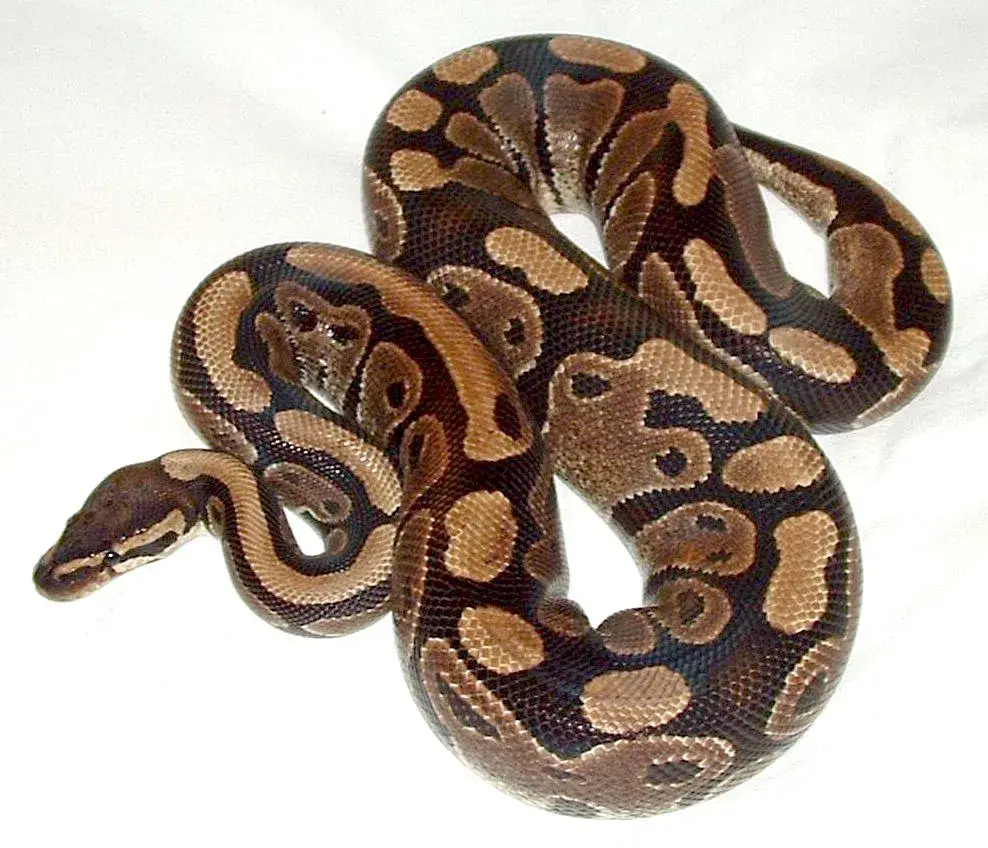
California Kingsnake
Lampropeltis californiae
Also known as Black And White California King, Black And White California Kingsnake, California King Snake
- Where to see one
- 14 U.S. zoos in our directory hold california kingsnake, confirmed against each zoo's own animal list.
- Native range
- Western United States and northern Mexico
- Size
- Typically 2.5–3.5 ft (76–107 cm); some populations reach up to 78 in (2 m)
- Lifespan
- Around 10 to 15 years, sometimes surpassing 20 in captivity
About the California kingsnake
The California kingsnake is a nonvenomous colubrid snake found only in the western United States and northern Mexico. It lives in a wide range of habitats and, thanks to its ease of care and the wide array of color patterns bred in captivity, has become a widely kept pet snake around the world.
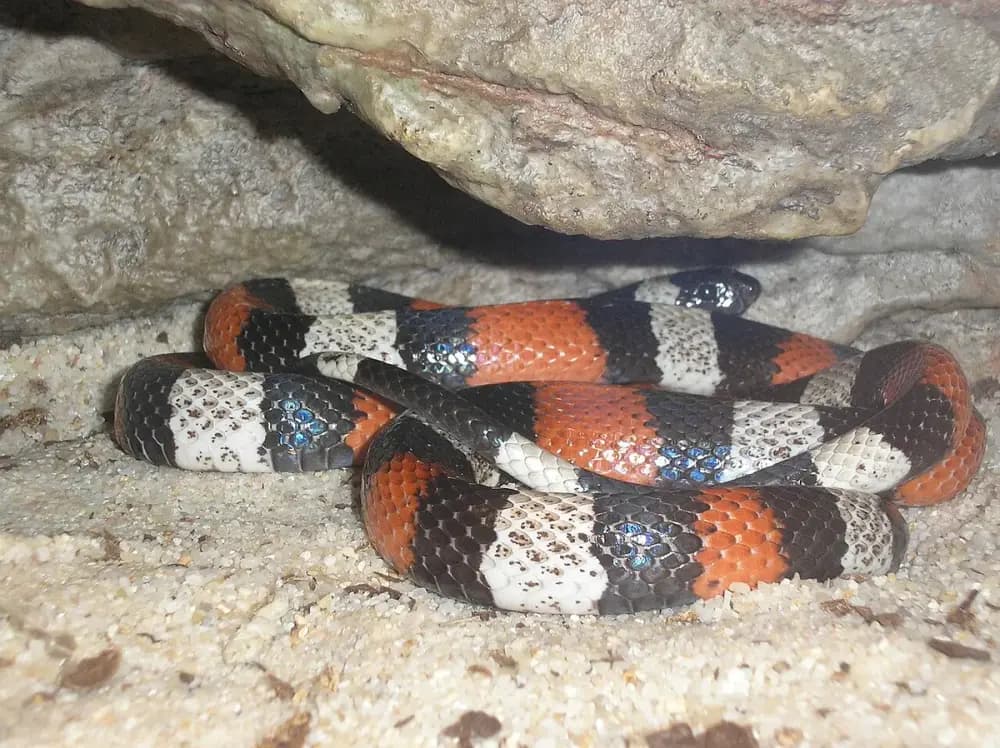
In the wild, California kingsnakes are typically 2.5 to 3.5 ft (76 to 107 cm) long, though some grow larger; on Isla Ángel de la Guarda in Baja California, Mexico, individuals have been documented reaching 78 inches (2 m). Wild kingsnakes display a wide range of color patterns, usually alternating dark and light bands that range from black and white to brown and cream, though some populations show longitudinal stripes instead of banding. These patterns are more than decorative — the banding and striping camouflage the snake from predators, which include hawks, eagles, coyotes, skunks, foxes, bobcats, and even other kingsnakes. Most California kingsnakes live around 10 to 15 years, and captive individuals well cared for can live past 20.
The species ranges along the West Coast of North America up to elevations of about 6,100 ft (1,900 m) in the Tehachapi Mountains and over 7,000 ft (2,100 m) in the southeastern Sierra Nevada. It occupies an unusually broad range of habitats for a single species, including woodland chaparral, grassland, deserts, marshes, and even suburban neighborhoods, and it is found in Oregon, California, Nevada, Utah, Arizona, southwestern Colorado, northwestern New Mexico, and northwestern Mexico. It thrives at temperatures between 80 and 84°F with humidity around 35 to 60 percent, though its preferences shift with its biological state — warmer temperatures during reproduction, higher humidity while shedding.
A California kingsnake born in the wild near South Mountain Park and Reserve in Arizona and later raised at the Arizona State University reptile collection became a rare documented case of two-headed serpentine polycephaly, living to age 17 after being discovered beneath a public restroom toilet seat and relocated to the university. Researchers believe the condition most likely resulted from failed cell division during the formation of twins.
Behavior and diet
Diet
Rodents, birds, other reptiles (including venomous rattlesnakes), and amphibians
The California kingsnake is cathemeral, meaning it may be active by day or by night depending on the ambient temperature. When disturbed, it often coils into a ball to hide its head, hisses, and rattles its tail to produce a sound that can resemble a rattlesnake's rattle, even though it has none of its own. Nervous individuals also tend to twitch their tails. The species is considered harmless to people, though a handled snake commonly bites and may release musk and waste from its cloaca, a defensive habit that also shows up whenever the snake feels threatened. Kingsnakes are generally solitary, coming together mainly during the mating season or while brumating. During brumation in the winter months they neither eat nor excrete waste, though they occasionally wake to drink, and they regulate their body temperature the rest of the year by burrowing under vegetation to cool off or basking in the sun to warm up.
True to the "king" in its name, the California kingsnake hunts and eats other snakes, including venomous rattlesnakes, and it is naturally resistant to rattlesnake venom. Its broader diet is opportunistic and includes rodents, birds, other reptiles, and amphibians. It is nonvenomous and kills by constriction, and it is considered the strongest constrictor relative to body size of any snake species, an adaptation likely shaped by its preference for reptilian prey, which needs less oxygen to survive a constriction attack than mammalian prey does.
Courtship begins in spring, typically after hibernation or the snake's first shed of the year, and involves males competing for available females; a male asserting dominance over a rival will climb onto the other snake and bite it, and courtship itself begins with the male vibrating uncontrollably. The California kingsnake is oviparous, laying eggs rather than giving live birth. Eggs are laid between May and August, generally 42 to 63 days after mating, in clutches typically of five to 12 eggs (averaging nine), though clutches of 20 or more have been recorded. Hatchlings emerge 40 to 65 days later at roughly 8 to 13 inches long, remain in the nest for about a week, then shed their first skin before leaving.
Range and habitat
Habitat
Woodland chaparral, grassland, deserts, marshes, and suburban areas
The California kingsnake is native to the West Coast of North America, ranging through Oregon, California, Nevada, Utah, Arizona, southwestern Colorado, northwestern New Mexico, and northwestern Mexico, at elevations reaching over 7,000 ft (2,100 m) in the southeastern Sierra Nevada. Within that range it uses an unusually broad set of habitats, from woodland chaparral and grassland to desert, marsh, and suburban settings, and in Arizona it intergrades with the desert kingsnake and the Mexican black kingsnake.
The species has also become established as an invasive animal on the Spanish island of Gran Canaria, where the population was estimated at around 20,000 individuals by 2014. There, California kingsnakes favor rocky or stony habitats with good vegetation cover, often using other invasive plant species such as prickly pear and fountaingrass for shelter.
Conservation status
The California kingsnake is listed as Least Concern by the IUCN. No specific threats to wild populations within its native range are documented here. Within California itself, the sale of wild-type kingsnakes is technically restricted without a special permit under a law barring the sale of native California species within the state, though albino morphs are exempt and the law is loosely enforced; this restriction concerns the pet trade rather than conservation status.
Where to see california kingsnake in the U.S.
14 zoos across 6 states
Find the closest one
Rank the 13 zoos holding california kingsnake by how far they are from you. Your location is used in your browser to sort this list and is never sent to us.
1 more zoo holds california kingsnake but has no coordinates on file yet, so it isn't ranked here. It's in the full list below.
California· 7
Georgia· 1
Massachusetts· 3
Missouri· 1
Oregon· 1
Pennsylvania· 1
AZAThe Association of Zoos and Aquariums. Accredited members have passed an independent inspection of animal care and welfare, safety, conservation and education, repeated every five years. Many smaller facilities never apply, so “not accredited” isn't a verdict on its own. What accreditation means · How we check this
Built from each zoo's own published animal list.
California Kingsnake: common questions
Is the California kingsnake endangered?
No. It is listed as Least Concern by the IUCN.
How big does a California kingsnake get?
Most adults reach 2.5 to 3.5 ft (76 to 107 cm), though some populations, such as those on Isla Ángel de la Guarda in Mexico, have been recorded at up to 78 inches (2 m).
What does a California kingsnake eat?
Rodents, birds, other reptiles, and amphibians. It is notable for hunting and eating venomous rattlesnakes, to whose venom it is naturally resistant.
How long do California kingsnakes live?
Around 10 to 15 years, sometimes surpassing 20 years with good care in captivity.
Where do California kingsnakes live in the wild?
Along the West Coast of North America, including Oregon, California, Nevada, Utah, Arizona, southwestern Colorado, northwestern New Mexico, and northwestern Mexico.
Which U.S. zoos have California kingsnakes?
Eight zoos in our directory list this species, including the Los Angeles Zoo, the Oakland Zoo, and the Fossil Rim Wildlife Center.