- Where to see one
- 6 U.S. zoos in our directory hold green tree monitor, confirmed against each zoo's own animal list.
- Native range
- New Guinea and nearby islands, including the northern Torres Strait Islands
- Size
- About 67–114 cm (26–45 in) long including the tail, averaging about 80 cm (31 in); average weight about 300 g (10.6 oz)
- Lifespan
- Averages 14.4 years in captivity; the oldest known lived to 25
- Clutch size
- Up to about 5 eggs, incubated 154 to 190 days
- Other name
- Emerald tree monitor
Conservation status
Least Concernassessed 2018
IUCN Red List category LC — step 1 of 7.
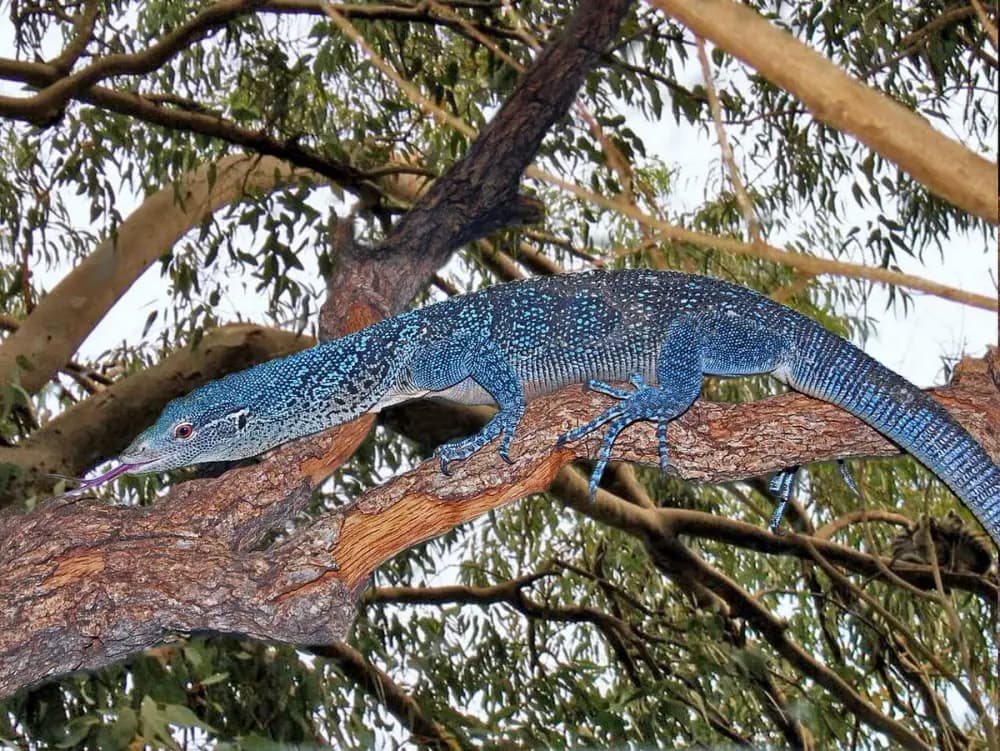
The emerald tree monitor, also called the green tree monitor, is a small to medium arboreal monitor lizard from New Guinea, nearby islands and the northern Torres Strait Islands. It is 75 to 100 cm long, green to turquoise with dark banding that camouflages it among leaves. A slender body, prehensile tail and long claws help it grip narrow branches. Its diet consists of large tree-dwelling arthropods such as katydids and stick insects, plus birds and small mammals. It is one of the few social monitors, living in small groups with a dominant male.
About the green tree monitor
The green tree monitor, also called the emerald tree monitor, is a slender, bright green monitor lizard that lives almost entirely in trees. It belongs to the monitor family, Varanidae, alongside the Komodo dragon, and it is native to the rainforests of New Guinea and nearby islands. It climbs with the help of a long, gripping, prehensile tail.
Varanus prasinus was first described in 1831, but the original specimen was lost, and the species was described again eight years later under its current name. Varanus comes from the Arabic word for "monitor," and prasinus is Latin for "green." It belongs to a group of closely related tree monitors, each living on its own island or region, including the black tree monitor of the Aru Islands. Genetic work suggests that what is called Varanus prasinus may actually include more than one species.
The coloring is the green tree monitor's calling card. Most are a vivid emerald green, though the shade can run to yellow-green or turquoise, with dark crossbands across the back. That color camouflages the lizard among leaves and has also made it highly prized in the pet trade. Hatchlings look almost exactly like small adults.
This is a small to medium-sized monitor. Adults measure about 67 to 114 cm (26–45 in) in total length, averaging about 80 cm (31 in), and weigh around 300 g (10.6 oz). The tail is extremely long, typically about 1.75 times the length of the head and body. Males tend to be slightly larger than females.
Every part of the body is built for climbing. The slender build lets it balance on narrow branches. The prehensile tail wraps around branches for grip, and the soles of the feet carry enlarged scales for traction. Long, slender toes end in extremely sharp claws that help it climb, move and catch prey. Unlike most monitors, it does not lash its tail as a weapon; instead it protects the tail when threatened.
Behavior and diet
Diet
Mostly large insects such as katydids and grasshoppers, plus spiders, centipedes, crabs, birds and small mammals
Green tree monitors spend most of their lives in the canopy and rarely come down to the forest floor. They hunt, shelter and even lay eggs in trees. They are mainly diurnal. When a predator approaches, they are thought to leap from tree to tree, and if threatened they flee through the vegetation or bite when cornered.
Reports of their social life differ. Some accounts describe them as solitary. Others describe the species as one of the few social monitors, living in small groups made up of a dominant male, several females, a few other males and juveniles. Because they live so high in the trees, much of their behavior in the wild is still poorly known.
The diet centers on large tree-dwelling insects and other arthropods. Katydids are the most common prey, followed by grasshoppers and other related insects. Green tree monitors also eat stick insects, cockroaches, beetles, centipedes, spiders and crabs. They take birds and small mammals too, such as Moncton's mosaic-tailed rat.
Their feeding technique is surprisingly careful. Before swallowing a stick insect, the lizard tears off its legs. With rodents, it uses its sharp claws to rake and tear the prey and pulls off the limbs before eating. This lets it swallow fairly large meals: one 135 g lizard was recorded eating a 40 g rodent, almost a third of its own weight. An elongated skull and jaw may help it cope with the strain of handling big prey.
Fruit may play a small role too. Captive green tree monitors have eaten bananas and cantaloupe, and plant material made up about 12% of the droppings of wild-caught animals. One captive animal was even seen swimming and foraging under shallow water, despite having no obvious adaptations for it.
Like other monitors, green tree monitors probably rely heavily on scent. Monitor lizards flick their tongues to pick up chemicals and pass them to sensory organs in the roof of the mouth, which helps them track prey and mates.
Breeding is unusual. Females lay small clutches, from about two to five eggs, each weighing about 11 g (0.4 oz) and measuring about 2 by 4.5 cm (0.8 by 1.8 in). A female can lay up to three clutches a year. She places her eggs inside arboreal termite nests, which shelter the eggs. The eggs hatch after about 154 to 190 days, and within minutes the hatchlings start eating the termites and their eggs. Young monitors reach maturity at about one to two years old.
Range and habitat
Habitat
Lowland tropical rainforest, mangroves, palm swamps and cocoa plantations, from sea level to about 830 m (2,720 ft)
The green tree monitor lives on the island of New Guinea, which is split between Indonesia and Papua New Guinea, and on several nearby islands, including the northern Torres Strait Islands. Of all its close relatives, it has the largest range. It is known as wbl km in the Kalam language of Papua New Guinea.
It is a lowland species, found from sea level to about 830 m (2,720 ft). Typical habitats include tropical evergreen rainforest, mangroves, palm swamps and cocoa plantations. These forests are heavily wooded and humid, and the lizards get much of their water from the moist air around them.
The tree monitor group it belongs to is found only east of a biogeographic boundary called Lydekker's line, and it likely arose in the Moluccas. The lack of large placental predators in this region may have helped these tree-dwelling monitors spread and diversify.
Green tree monitor vs black tree monitor
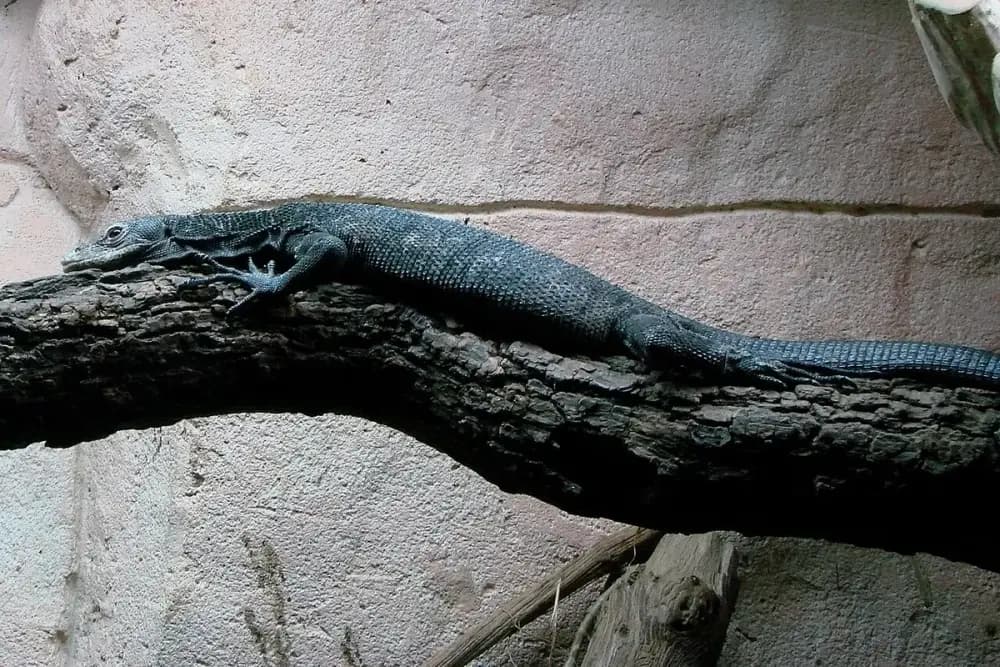
The black tree monitor, Varanus beccarii, was once treated as a subspecies of the green tree monitor. Genetic evidence now supports keeping them as separate species, though both belong to the same species complex.
| Trait | Green tree monitor | Black tree monitor |
|---|---|---|
| Scientific name | Varanus prasinus | Varanus beccarii |
| Adult color | Emerald to yellow-green or turquoise, with dark bands | Completely black |
| Young | Look like small adults | Dark gray with rows of yellow-green dots |
| Total length | About 67–114 cm (26–45 in) | About 90–120 cm (35–47 in) |
| Range | New Guinea and nearby islands | Aru Islands, Indonesia only |
Conservation status
The green tree monitor is listed as Least Concern on the IUCN Red List, assessed in 2018. It has the widest range of any lizard in its group, covering the whole of New Guinea and surrounding islands.
Its bright color makes it one of the most popular monitor lizards in the international pet trade. It is listed on Appendix II of CITES so that trade can be closely monitored, and it is protected in Indonesia, though weak enforcement lets wild-caught animals still enter the trade. Eggs are vulnerable before they hatch, and larger placental carnivores may also pose a threat.
Where to see green tree monitor in the U.S.
6 zoos across 6 states
Find the closest one
Rank the 6 zoos holding green tree monitor by how far they are from you. Your location is used in your browser to sort this list and is never sent to us.
California· 1
Illinois· 1
New York· 1
Pennsylvania· 1
Virginia· 1
Wisconsin· 1
AZAThe Association of Zoos and Aquariums. Accredited members have passed an independent inspection of animal care and welfare, safety, conservation and education, repeated every five years. Many smaller facilities never apply, so “not accredited” isn't a verdict on its own. What accreditation means · How we check this
Built from each zoo's own published animal list.
Green Tree Monitor: common questions
Are green tree monitors dangerous?
Not to most people. They usually flee through the branches when threatened, though they will bite if cornered.
How big do green tree monitors get?
About 67 to 114 cm (26–45 in) long including the tail, with an average of about 80 cm (31 in) and a weight of roughly 300 g (10.6 oz).
What do green tree monitors eat?
Mostly large insects such as katydids, grasshoppers and stick insects, plus spiders, centipedes, crabs, birds and small mammals.
How long do green tree monitors live?
They average about 14.4 years in captivity, and the oldest known individual lived to 25.
Where do green tree monitors live?
In lowland rainforests, mangroves and swamps of New Guinea and nearby islands, including the northern Torres Strait Islands.
Is a green tree monitor the same as an emerald tree monitor?
Yes. Both names refer to Varanus prasinus.
Can green tree monitors be kept as pets?
They are kept and widely traded as pets, highly prized for their color. In the wild they live in humid forest and get much of their water from the moist air.
Is the green tree monitor endangered?
No. It is listed as Least Concern and has a wide range across New Guinea.