- Where to see one
- 4 U.S. zoos in our directory hold blue tree monitor, confirmed against each zoo's own animal list.
Conservation status
Not Evaluated
This species has not been assessed for the IUCN Red List, so it sits outside the threat scale entirely.
About the blue tree monitor
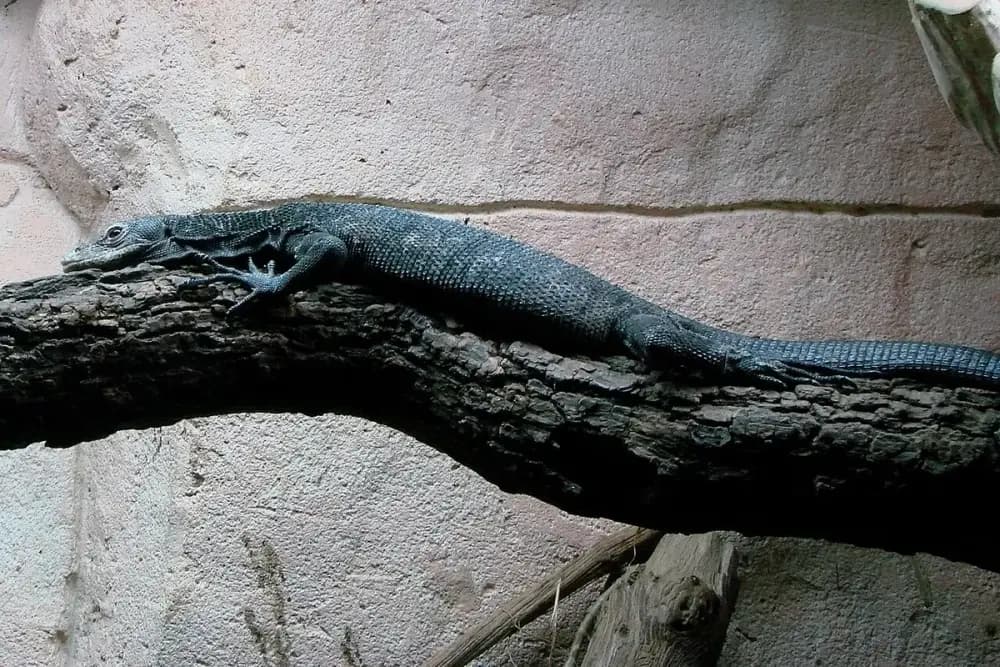
The blue tree monitor, also called the blue-spotted tree monitor, is a monitor lizard found only on Batanta, an Indonesian island off the northwestern tip of the Vogelkop peninsula. It lives in tropical forest and is diurnal and arboreal, with a prehensile tail about twice as long as the head and body. The body is black with scattered blue scales, and the tip of the snout is light blue. Adult males may reach 1.1 m in total length, making it the largest known species of its group. When threatened it flees up a tree and keeps the trunk between itself and the intruder. It was formally described in 2001.
Blue Tree Monitor facts
- Its range may be the smallest of any tree monitor: Batanta island, only about 450 km2.
- It was described in 2001 after reports of a large blue lizard on Batanta reached a Bali reptile-park founder.
- Females are about 10 cm shorter than males, which reach 1.1 m in total length.
- It is protected in Indonesia, so no legal collection from the wild takes place.
Where to see blue tree monitor in the U.S.
4 zoos across 4 states
Find the closest one
Rank the 4 zoos holding blue tree monitor by how far they are from you. Your location is used in your browser to sort this list and is never sent to us.
AZAThe Association of Zoos and Aquariums. Accredited members have passed an independent inspection of animal care and welfare, safety, conservation and education, repeated every five years. Many smaller facilities never apply, so “not accredited” isn't a verdict on its own. What accreditation means · How we check this
Built from each zoo's own published animal list.