- Where to see one
- 9 U.S. zoos in our directory hold black tree monitor, confirmed against each zoo's own animal list.
- Native range
- Aru Islands, Indonesia
- Size
- 90–120 cm (35–47 in) total length, including tail
Conservation status
Too little is known about this species to assess how threatened it is — that is a gap in the science, not a sign it is safe.
About the black tree monitor
The black tree monitor, also called Beccari's monitor, is a lizard in the monitor family, Varanidae. It was first described in 1874 as Monitor beccarii by the naturalist Giacomo Doria, and for decades afterward it was treated as a subspecies of the closely related emerald tree monitor. A 1991 review restored it to full species status on the strength of its solid black coloring and the keeled scales on its neck, though its hemipenial structure still resembles that of the emerald tree monitor closely enough that some researchers argue it could be classed as a subspecies. Genetic work has since backed the two-species split. Both belong to what herpetologists call the Varanus prasinus species complex, a group of small, slender, tree-dwelling monitors from New Guinea and its surrounding islands. The species name beccarii honors the Italian explorer Odoardo Beccari, and the genus name Varanus comes from the Arabic waral, meaning "monitor."
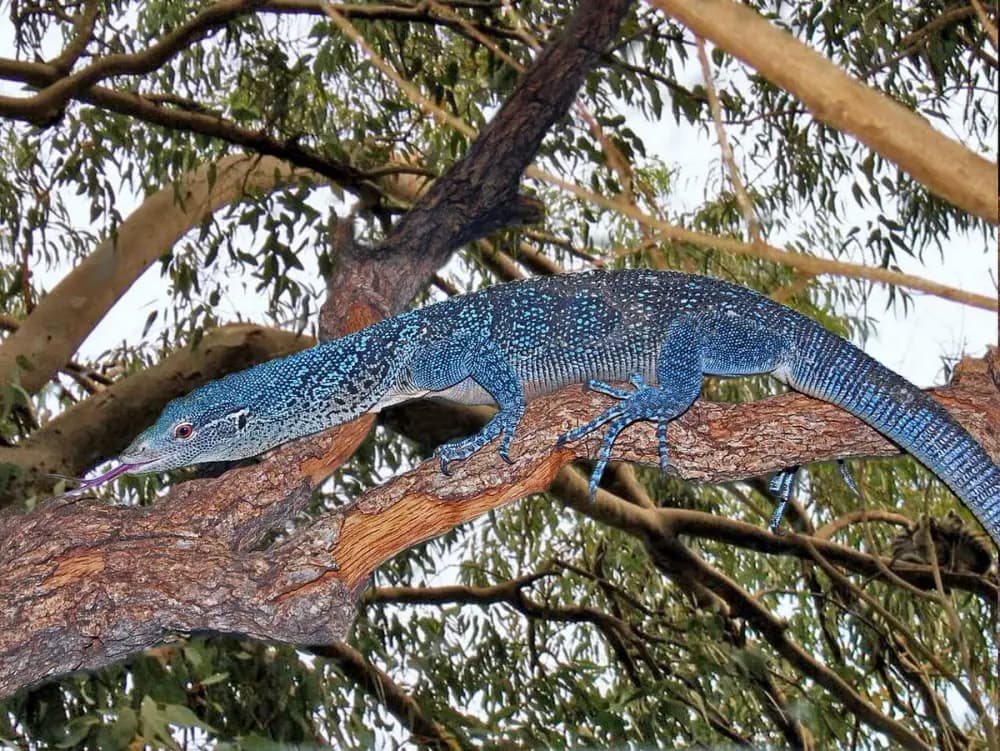
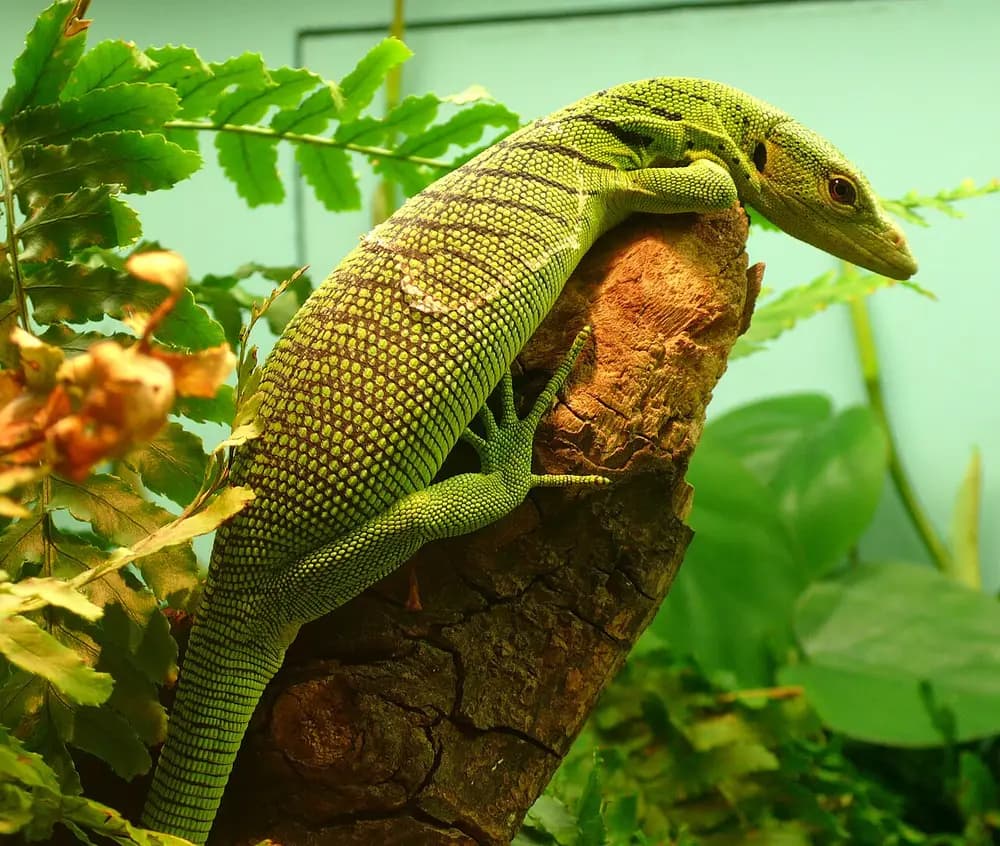
It is a relatively small monitor lizard, reaching about 90–120 cm (35–47 in) in total length, tail included, with males running slightly larger than females. As the name suggests, adults are entirely black. Hatchlings and juveniles look quite different: they're dark gray with rows of bright yellow-green spots, especially along the back, and lose those markings entirely as they mature into solid black adults.
The animal's build reflects a fully arboreal life. Its tail, sometimes two-thirds of its total length, is prehensile and used to anchor the lizard among branches — unlike many other monitor species, it doesn't use the tail as a defensive weapon. The forelimbs are among the longest and most slender of any monitor, ending in elongated digits with large claws and adhesive soles that give it grip in the canopy. Its teeth are unusually long for a monitor its size, likely an adaptation for holding onto prey caught overhead. In the wild, the species has a reputation for being nervous and high-strung: it tends to flee from threats, and an animal that is handled roughly may bite, scratch, and defecate on whoever is holding it.
Behavior and diet
Diet
Insects, small lizards, small mammals, scorpions, eggs, bird nestlings
The black tree monitor is primarily insectivorous, but its diet in the wild also includes smaller lizards, small mammals such as shrews, scorpions, eggs, and the nestlings of birds. In captivity, members of this species complex are occasionally seen eating plant matter, though wild individuals examined for gut contents did not show any.
What sets this monitor apart behaviorally is its intelligence. Like other monitor lizards, it ranks among the more cognitively capable reptiles, and researchers studying the Varanus prasinus complex have documented complex problem-solving, fine motor coordination, and skilled forelimb use during hunting. When prey is wedged into a crevice too tight for the jaws to reach, the lizard will use a forelimb instead, hooking the prey out with its claws — a technique that lets it exploit hiding spots other predators can't reach.
Reproduction in the wild is not well documented. Some reports suggest that black tree monitors, like others in their species complex, lay eggs inside arboreal termite nests, where the surface stays relatively dry despite high humidity around it. Captive breeding has had mixed success, with embryo deaths shortly before hatching being a recurring problem; possible causes researchers have proposed include excess substrate humidity late in incubation and nutritional deficits in the mother. Courtship involves the larger male aggressively pursuing the smaller female, and copulation — which can occur while both animals are suspended off the ground — may last up to two hours. Females bury their eggs in damp substrate, and hatchlings often refuse food for more than two weeks before beginning to eat on their own.
Range and habitat
Habitat
Humid forest and mangrove swamp, arboreal
The black tree monitor is endemic to the Aru Islands, part of Indonesia, where it is known locally as waweyaro. It lives almost entirely in the trees, occupying humid forest and mangrove swamp habitats across the islands.
In the wild, the black tree monitor faces predation from larger lizards and snakes, as well as from foxes that have been introduced to the region. Humans have also hunted the species; that pressure has eased somewhat over time, though it continues at some level.
Conservation status
The black tree monitor is listed as Data Deficient (DD) on the IUCN Red List as of 2020, meaning there isn't enough population data available to assess its conservation status with confidence. That doesn't mean the species is free of pressure — deforestation, the encroachment of farmland into its habitat, and demand from the international pet trade are all noted as possible current threats to its long-term survival on the Aru Islands.
Where to see black tree monitor in the U.S.
9 zoos across 8 states
Find the closest one
Rank the 9 zoos holding black tree monitor by how far they are from you. Your location is used in your browser to sort this list and is never sent to us.
California· 2
District of Columbia· 1
Illinois· 1
Indiana· 1
Kansas· 1
Oregon· 1
Virginia· 1
Washington· 1
AZAThe Association of Zoos and Aquariums. Accredited members have passed an independent inspection of animal care and welfare, safety, conservation and education, repeated every five years. Many smaller facilities never apply, so “not accredited” isn't a verdict on its own. What accreditation means · How we check this
Built from each zoo's own published animal list.
Black Tree Monitor: common questions
Is the black tree monitor endangered?
Its status isn't well defined — the IUCN lists it as Data Deficient, meaning there isn't enough population information to classify it as threatened or not. Deforestation, farmland encroachment, and the pet trade are named as possible threats.
How big does a black tree monitor get?
Adults reach about 90–120 cm (35–47 in) in total length, including the tail, which can make up roughly two-thirds of that length. Males tend to be slightly larger than females.
What does a black tree monitor eat?
Mostly insects, plus smaller lizards, small mammals like shrews, scorpions, eggs, and bird nestlings.
Where do black tree monitors live in the wild?
They're endemic to the Aru Islands in Indonesia, where they live an arboreal life in humid forests and mangrove swamps.
Which U.S. zoos have black tree monitors?
Five zoos in our directory list this species, including Fresno Chaffee Zoo, Lincoln Park Zoo, and the Oregon Zoo.