- Where to see one
- 11 U.S. zoos in our directory hold fossa, confirmed against each zoo's own animal list.
- Native range
- Madagascar (endemic)
- Size
- Head-body length 70–80 cm (28–31 in), tail 65–70 cm (26–28 in); males 6.2–8.6 kg (14–19 lb), females 5.5–6.8 kg (12–15 lb)
- Lifespan
- Up to 20 years in captivity
About the fossa
The fossa is a slender, long-tailed, cat-like carnivore found only on Madagascar. Despite its resemblance to a small cougar, it isn't a cat at all — it belongs to Eupleridae, a family made up entirely of Madagascar's native carnivorans, all of which descend from a single ancestor that colonized the island around 18 to 20 million years ago. The fossa's classification was debated for well over a century, bouncing between the cat family and the civet family Viverridae, before genetic studies in the early 2000s confirmed that it and Madagascar's other native carnivores form their own distinct branch, most closely related to mongooses.
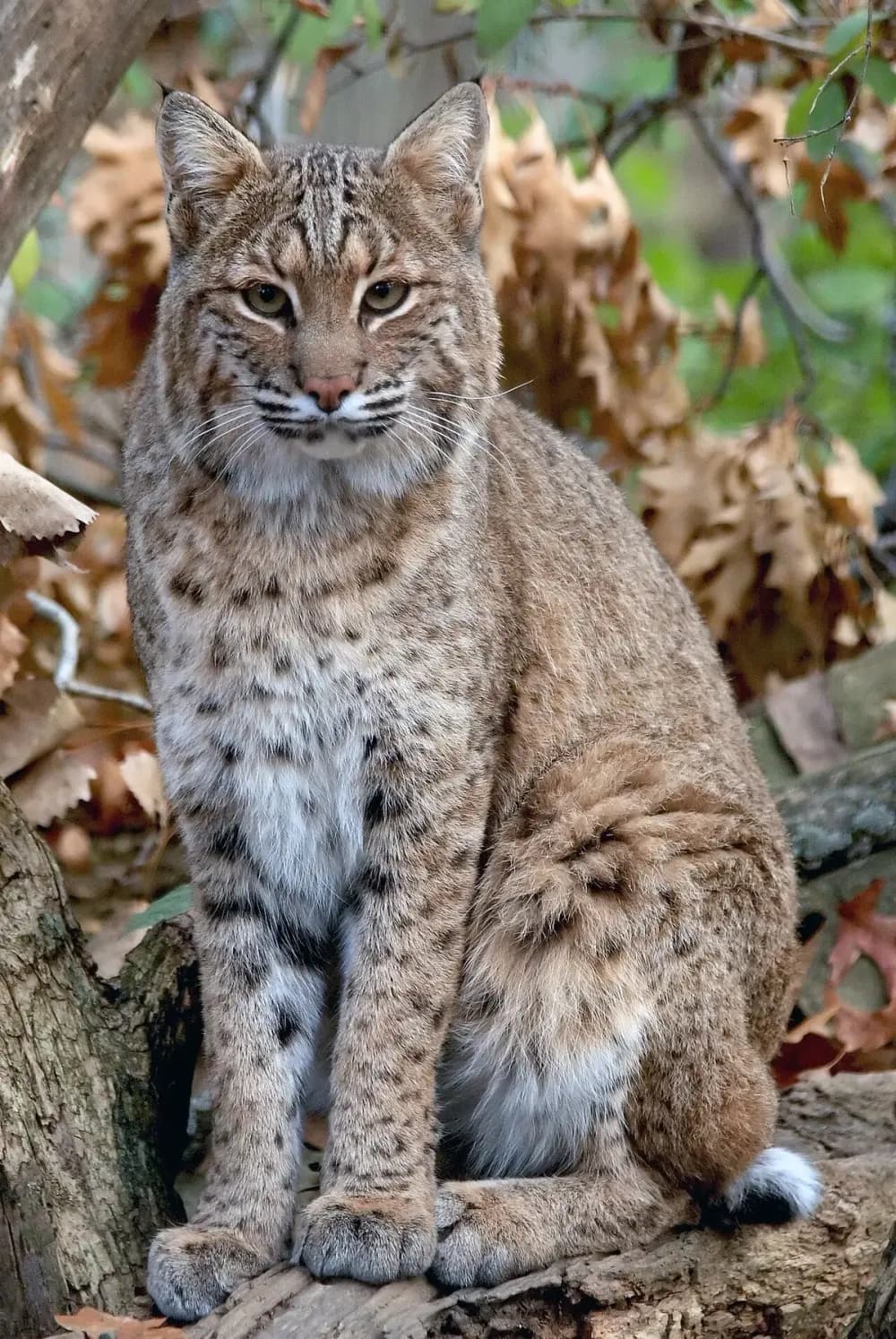
Adults measure 70 to 80 cm (28 to 31 in) in head-body length, with a tail nearly as long at 65 to 70 cm (26 to 28 in), and males, at 6.2 to 8.6 kg (14 to 19 lb), outweigh females, at 5.5 to 6.8 kg (12 to 15 lb). It has a mongoose-like head with a short, broad muzzle, large rounded ears, and wide-set brown eyes with slit pupils that reflect light orange at night. The fur is short, dense, and reddish-brown on the back with a cream-colored underside, while juveniles are gray or nearly white. Its most cat-like features are built for the diet: sharp, specialized teeth for an exclusively carnivorous diet, paired with a body plan — flexible ankles, semi-retractable claws, and a long balancing tail — clearly built for climbing.
That climbing ability is central to how the fossa lives. Its ankles are flexible enough to let it climb straight up or down a tree trunk head-first and to leap between trees, a level of agility unusual among carnivorans. Captive juveniles have even been seen swinging upside down from ropes by their hind feet. Two larger extinct relatives are known from the fossil record, Cryptoprocta spelea and the more recently described Cryptoprocta bevatabe, the latter estimated at 27 to 43 kg (60 to 95 lb) and considered the largest land carnivore Madagascar has ever had; C. spelea is believed to have died out before 1400.
Behavior and diet
Diet
Carnivorous — more than half lemurs, plus tenrecs, rodents, lizards, and birds
The fossa is active during both day and night, a pattern called cathemeral, with activity peaks in the early morning, late afternoon, and late at night. It generally doesn't reuse sleeping sites, though females with young return repeatedly to the same den. Male home ranges in Kirindy Forest run up to 26 km² (10 sq mi), roughly double the 13 km² (5.0 sq mi) typical of females, and these ranges expand during the dry season, perhaps because less food and water are available then. Radio-collared fossas typically travel 2 to 5 km (1.2 to 3.1 mi) a day, though one was recorded covering a straight-line distance of 7 km (4.3 mi) in 16 hours.
More than half of the fossa's diet consists of lemurs, Madagascar's endemic primates, supplemented by tenrecs, rodents, lizards, birds, and other animals. The species is usually solitary — aside from mothers with young and occasional pairs of males — but a 2009 study documented three male fossas cooperatively hunting a 3 kg (6.6 lb) sifaka lemur for 45 minutes before sharing the kill, a behavior researchers suggested might be a holdover from a time when cooperative hunting was needed to take down larger lemur species that have since gone extinct.
Mating usually takes place in trees, on horizontal limbs, and can last for several hours. Litters range from one to six pups, born altricial — blind and toothless — and requiring significant early care. Pups wean at around 4.5 months and become independent at about a year old, though they don't reach sexual maturity until three to four years of age. In captivity, fossas can live up to 20 years.
Range and habitat
Habitat
Forested habitat island-wide, including dry deciduous forest, rainforest, and spiny forest; more common in humid forest
The fossa is found only on Madagascar, and it has the widest geographic range of any of the island's native carnivores, though it generally occurs in low population densities. It lives in forested habitat across the island, including western dry deciduous forest, eastern rainforest, and southern spiny forest, and while it can tolerate some degraded forest, it's seen more often in undisturbed habitat and appears more frequently in humid forest than in dry forest. It is absent from Madagascar's most heavily disturbed areas and, like much of the island's native wildlife, from the central high plateau. Researchers have documented fossas from low elevations up to at least 2,000 m (6,600 ft) in protected mountain reserves, showing the species can adapt across a considerable elevational range as long as suitable forest is present.
Conservation status
The fossa is listed as Vulnerable on the IUCN Red List. Population density surveys in Kirindy Forest, where the species is considered relatively common, have estimated roughly one animal per 3.8 to 4 km² (about 1.5 sq mi), an indication of how thinly fossas are spread even in good habitat. The greatest threat to the species is habitat destruction, as Madagascar's forests are cleared and fragmented. Culturally, the fossa is generally feared by the Malagasy people, and in many areas it is protected by a traditional taboo known as fady, which affords the animal some measure of informal protection alongside its Red List status.
Where to see fossa in the U.S.
11 zoos across 9 states
Find the closest one
Rank the 11 zoos holding fossa by how far they are from you. Your location is used in your browser to sort this list and is never sent to us.
Arkansas· 1
California· 1
Florida· 1
Maryland· 1
New York· 1
North Carolina· 1
North Dakota· 1
Texas· 3
Wisconsin· 1
AZAThe Association of Zoos and Aquariums. Accredited members have passed an independent inspection of animal care and welfare, safety, conservation and education, repeated every five years. Many smaller facilities never apply, so “not accredited” isn't a verdict on its own. What accreditation means · How we check this
Built from each zoo's own published animal list.
Fossa: common questions
Is the fossa endangered?
It's classified as Vulnerable on the IUCN Red List. Habitat destruction across Madagascar is described as the greatest threat to the species.
How big does a fossa get?
Adults measure 70–80 cm (28–31 in) head-to-body with a nearly equally long tail. Males weigh 6.2–8.6 kg (14–19 lb) and females 5.5–6.8 kg (12–15 lb).
What does a fossa eat?
More than half its diet is lemurs, supplemented by tenrecs, rodents, lizards, and birds. It hunts alone as a rule, though cooperative hunting by groups of males has been documented.
How long do fossas live?
Up to 20 years in captivity, according to recorded lifespans.
Where do fossas live in the wild?
Only on Madagascar, across all of the island's forest types, though they're seen more often in humid forest than in dry forest.
Which U.S. zoos have fossas?
Seven zoos in our directory list the fossa, including the San Diego Zoo in California, the Houston Zoo in Texas, and the Little Rock Zoo in Arkansas.