- Where to see one
- 13 U.S. zoos in our directory hold cownose ray, confirmed against each zoo's own animal list.
- Native range
- western Atlantic and Caribbean, from New England to southern Brazil
- Size
- males typically about 2.5 ft (0.76 m) in width; females about 3.0 ft (0.9 m) in width
- Lifespan
- 16 to 21 years, varying by sex, with a recorded maximum of 21 for females and 18 for males
Conservation status
Vulnerableassessed 2020
IUCN Red List category VU — step 3 of 7.
Vulnerable (VU), assessed 2020
About the cownose ray
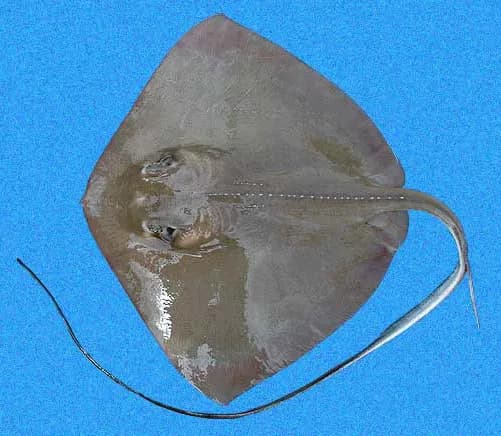
The cownose ray is found throughout a large stretch of the western Atlantic and Caribbean, from New England south to Brazil. It belongs to the order Myliobatiformes, the same group that includes bat rays, manta rays, and eagle rays. Its most distinctive feature is its head shape: a pair of lobes at the front give it a rounded, split profile that resembles a cow's nose, which is where the species gets its common name. Its scientific name carries a different animal reference: bonasus comes from the Ancient Greek word for bison.
A cownose ray typically has a brown back with a slightly white or yellow belly, and while its coloring is unremarkable, its shape makes it easy to identify. It has a broad head with wide-set eyes and a set of dental plates built for crushing the shells of clams and oysters. Males generally reach about 2.5 ft (0.76 m) in width, while females run larger, at roughly 3.0 ft (0.9 m). Beachgoers sometimes mistake a cownose ray for a shark, since the tips of its fins can break the surface of the water in a way that resembles a shark's dorsal fin. For defense, the species carries a venomous, tooth-edged barb at the base of its tail, which it can use against threats; a sting causes symptoms similar to a bee sting.
Behavior and diet
Diet
hard-shelled organisms such as clams, crustaceans, and mollusks
The cownose ray has a durophagous diet, meaning it specializes in hard-shelled prey such as mollusks and crustaceans, with a particular preference for scallops and clams. It tends to feed in the early morning or late afternoon, when the water is calm and visibility is better, foraging along the benthic zone at the bottom of the ocean. It captures prey by opening and closing its jaws to create suction, and its jaws and teeth are built to match its diet, with a hardness comparable to concrete. The cephalic lobes on its head also help push prey toward its mouth.
Cownose rays are social, migratory animals that travel in large schools organized by size and sex. Their annual migration takes them north in late spring and south in late fall, with much of what is known about this pattern coming from studies in the Chesapeake Bay, where the species is known to gather in the summer for mating and to use the estuarine waters as a nursery. Males tend to leave the bay earlier than females, heading to a second feeding ground by a longer route whose purpose is not fully understood, though one idea is that it reduces competition for food and shelter. Breeding occurs from April through October. Rays reach maturity at about 70% of their maximum size, with females maturing between ages 7 and 8 and males slightly earlier, around ages 6 to 7. The species is ovoviviparous, meaning embryos develop inside the mother until ready to be born, with a gestation period of about 11 to 12 months and pups born live, tail first. With few natural predators aside from cobia, hammerhead sharks, and humans who fish for them, the cownose ray sits relatively high on the food chain within its coastal habitat.
Range and habitat
Habitat
shallow, coastal waters and estuaries, including the Chesapeake Bay in summer
The cownose ray ranges along the East Coast of the United States, into the Gulf of Mexico, and south to Brazil, favoring nearshore coastal waters and estuarine ecosystems. It tolerates a wide range of salinities, which lets it move between habitats when crowding or competition for resources becomes a problem in one area. The species is especially abundant in the Chesapeake Bay, where it migrates seasonally, typically arriving in late spring and summer and often spotted near the surface of the water. East Atlantic populations that resemble the cownose ray are now generally treated as a separate species, the Lusitanian cownose ray.
Conservation status
The cownose ray is listed as Vulnerable on the IUCN Red List, based on an assessment published in 2020. The main driver behind this status is overfishing, much of it tied to a perceived threat that cownose ray overpopulation was contributing to a decline in oyster and other bivalve populations in the Chesapeake Bay. Campaigns such as "Save the Bay, Eat a Ray" promoted fishing the species on the theory that removing rays would protect shellfish, even though some research has found that cownose rays do not actually consume large amounts of oysters or clams, and other studies suggest their impact on shellfish depends heavily on shell size rather than sheer ray numbers.
Because cownose rays mature late and have long gestation periods, they are a K-selected species, meaning their populations are slow to recover once depleted by overfishing. Few dedicated conservation strategies exist for the species, though cownose ray-killing contests have been banned in Maryland, one of the few concrete protective measures in place.
Where to see cownose ray in the U.S.
13 zoos across 10 states
Find the closest one
Rank the 13 zoos holding cownose ray by how far they are from you. Your location is used in your browser to sort this list and is never sent to us.
California· 1
Florida· 2
Indiana· 1
Louisiana· 1
Michigan· 1
Missouri· 2
New Jersey· 1
North Carolina· 1
Ohio· 1
Texas· 2
AZAThe Association of Zoos and Aquariums. Accredited members have passed an independent inspection of animal care and welfare, safety, conservation and education, repeated every five years. Many smaller facilities never apply, so “not accredited” isn't a verdict on its own. What accreditation means · How we check this
Built from each zoo's own published animal list.
Cownose Ray: common questions
Is the cownose ray endangered?
It is listed as Vulnerable on the IUCN Red List (2020 assessment), largely because of overfishing driven by the mistaken belief that it was overpopulating the Chesapeake Bay and depleting shellfish.
How big does a cownose ray get?
Males typically reach about 2.5 ft (0.76 m) in width, while females grow larger, to around 3.0 ft (0.9 m).
What does a cownose ray eat?
Hard-shelled prey such as clams, scallops, and other mollusks and crustaceans, crushed with robust jaws and dental plates.
How long do cownose rays live?
Between 16 and 21 years depending on sex, with the oldest recorded female reaching 21 and the oldest male 18.
Is a cownose ray dangerous to touch?
It carries a venomous barb at the base of its tail that can cause a painful sting, though many aquarium touch tanks use rays whose barbs have been trimmed, which regrow over time like human nails.
Which U.S. zoos have cownose rays?
Seven U.S. zoos list cownose rays, including the Saint Louis Zoo, Detroit Zoo, and Houston Zoo.