- Where to see one
- 10 U.S. zoos in our directory hold southern stingray, confirmed against each zoo's own animal list.
- Native range
- Western Atlantic Ocean, from New Jersey to southern Brazil
- Size
- Females reach a disc width of up to 150 cm (59 in); males max out around 67 cm (26 in)
Conservation status
Near Threatenedassessed 2020
IUCN Red List category NT — step 2 of 7.
Near Threatened (NT), assessed in 2020
About the southern stingray
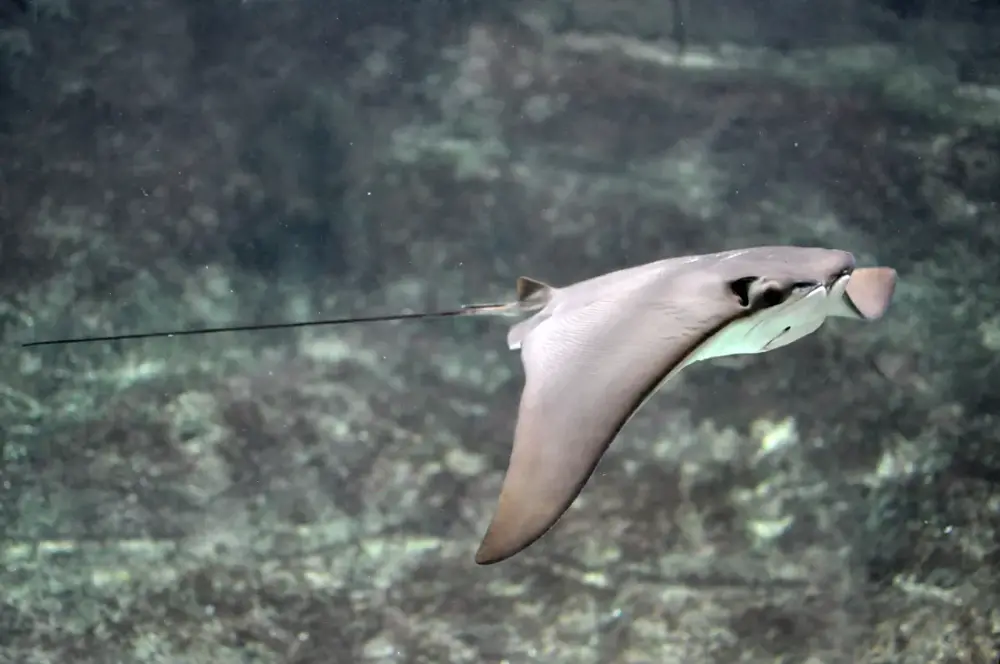
The southern stingray is a whiptail stingray built for life on the ocean floor. Its body forms a flat, diamond-shaped disc that's more angular than that of many other rays, with wing-like pectoral fins it uses to glide across the seabed. Adults are colored mud brown, olive, or green on top, with juveniles running darker grey, while the underside is white. It ranges through tropical and subtropical waters of the Western Atlantic, from as far north as New Jersey down to southern Brazil.
The species carries a long, serrated tail spine coated in venomous mucus, positioned at the base of the tail and used purely for self-defense. The sting isn't fatal to people, but stepping on one is described as extremely painful. Its eyes sit on top of its head alongside small openings called spiracles, an arrangement that lets the stingray draw in water even while lying flat on the bottom or half-buried in sediment. That water passes out through the gill openings rather than the mouth, which is on the underside of the body, out of view.
Females grow substantially larger than males — up to 150 cm across the disc compared to a maximum of 67 cm for males. Larger females also tend to produce more offspring per litter.
Behavior and diet
Diet
Small fishes, worms, crustaceans and bivalves
Southern stingrays are nocturnal hunters. They disturb the sea floor by spraying water from their mouths or flapping their fins vigorously, a technique that flushes hidden prey out of the substrate. The species is usually found alone or in pairs, though in certain shallow systems thought to serve as nursery grounds, population densities have been estimated as high as 245 per square kilometer. Groups tend to form specifically around mating, predator avoidance, or simply resting together.
Their pectoral fins produce a wave-like swimming motion that lets them escape predators, forage efficiently, and cover large distances — researchers have observed the rays traveling with the tide, likely because food is more available along tidal currents. As foragers, they're opportunistic and more or less continuously feeding; a stomach content study found small fishes, worms, crustaceans and bivalves inside a single ray. To avoid predators such as great hammerhead sharks — and humans — the rays bury themselves in the substrate, relying on the venomous tail spine as a last line of defense. In parts of the Gulf of Mexico, the species has even been observed in a loose partnership with double-crested cormorants, which follow behind foraging stingrays to snap up fish the rays expose while digging.
Reproduction is ovoviviparous: fertilized eggs develop inside the mother, with embryos drawing nutrients first from a yolk sac and then from uterine "histotroph" once the yolk is used up. Females reproduce annually in the wild, giving live birth after a pregnancy that runs seven to eight months; in captivity, recorded gestation has ranged from 135 to 226 days, producing litters of two to ten young. Parental care ends at birth. Mating itself is rarely observed in the wild, though one detailed study recorded two males chasing and biting the fin of a single female before copulation, after which she was released — and females are able to mate again soon after giving birth. Sexual maturity depends partly on geography and rearing conditions; captive females have been considered mature around five or six years old, with males mature at three or four, and researchers have identified separate "primary" nurseries, such as one in Belize, where females return seasonally to mate and give birth, and "secondary" nurseries where juveniles grow toward adulthood.
Range and habitat
Habitat
Sandy sea bed of tropical and subtropical coastal waters
The southern stingray's range spans the Western Atlantic from New Jersey south to southern Brazil, making it a wide-ranging coastal species across a large stretch of ocean. It lives on the sea bed in tropical and subtropical waters, favoring sandy or soft-bottom areas where it can forage and partially bury itself.
Specific nursery sites have been documented within this range, including a primary nursery in Belize used seasonally for mating and birth, and study sites in Bimini, Bahamas, and Grand Cayman where breeding behavior has been observed. Juveniles have also been caught at rock reef sites 10 to 20 meters deep, believed to function as secondary nurseries where young rays mature.
Conservation status
The southern stingray is listed as Near Threatened on the IUCN Red List, in a 2020 assessment.
Human contact affects the species in parts of its range. In areas of the Caribbean, including Grand Cayman, Antigua, and the Turks and Caicos, southern stingrays are hand-fed at tourist sites where they swim with divers and snorkelers, sometimes becoming tame enough to be cradled and fed by hand. There is documented concern that this level of feeding and human contact may be altering the rays' natural behavior and ecology.
The species also appears in the aquarium trade, though it requires an enormous tank, around 4,200 gallons, and will eat any tankmate it can catch. It is kept in public aquariums and touch pools, including facilities in California and New York, where it has also been observed breeding.
Where to see southern stingray in the U.S.
10 zoos across 9 states
Find the closest one
Rank the 10 zoos holding southern stingray by how far they are from you. Your location is used in your browser to sort this list and is never sent to us.
California· 1
Florida· 2
Indiana· 1
Kansas· 1
Louisiana· 1
Michigan· 1
Minnesota· 1
Missouri· 1
North Carolina· 1
AZAThe Association of Zoos and Aquariums. Accredited members have passed an independent inspection of animal care and welfare, safety, conservation and education, repeated every five years. Many smaller facilities never apply, so “not accredited” isn't a verdict on its own. What accreditation means · How we check this
Built from each zoo's own published animal list.
Southern Stingray: common questions
Is the southern stingray endangered?
It is listed as Near Threatened on the IUCN Red List (2020). Tourism-related feeding at some Caribbean sites has also raised concerns about behavioral and ecological impacts.
How big does a southern stingray get?
Females can reach a disc width of up to 150 cm (59 in); males are smaller, topping out around 67 cm (26 in).
What does a southern stingray eat?
It preys on small fishes, worms, crustaceans and bivalves, foraging by disturbing the sea floor to expose hidden prey.
Where do southern stingrays live in the wild?
They're found on the sea bed of tropical and subtropical waters of the Western Atlantic, from New Jersey to southern Brazil.
Which U.S. zoos and aquariums have southern stingrays?
Seven U.S. facilities list this species, including the Detroit Zoo, the Minnesota Zoo, and the Saint Louis Zoo.