
Sharks and rays in U.S. zoos
Sharks and rays are cartilaginous fish, members of the subclass Elasmobranchii, with skeletons of tough, elastic cartilage instead of bone. They have five to seven pairs of separate gill slits and no swim bladder. Rays are flattened, with wing-like pectoral fins fused to the head and gill slits on the underside.
Most widely held
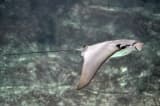 Cownose RayRhinoptera bonasusAt 13 zoos · Vulnerable
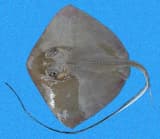 Southern StingrayHypanus americanusAt 10 zoos · Near Threatened
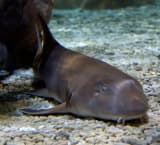 Bamboo SharkChiloscyllium punctatumAt 6 zoos · Near Threatened
 White-spotted Bamboo SharkChiloscyllium plagiosumAt 6 zoos · Near Threatened
What sharks and rays have in common
Sharks and rays are cartilaginous fish. Together they form the subclass Elasmobranchii, from Greek words for "plate" and "gill," a nod to their broad, flattened gills. Their skeletons are made of cartilage rather than bone, and their skin is covered in tiny placoid scales.
They share several other features. Each has five to seven pairs of gill slits that open separately to the outside, rather than under a single gill cover. None has a swim bladder; instead, a large liver rich in oil helps keep them buoyant. All reproduce by internal fertilization, though some lay eggs and others give birth to live young.
How to tell them apart
Rays are the flattened branch of the family, with well over 600 species. Their pectoral fins are enlarged into wings fused to the head, and their gill slits lie on the underside. Most sharks have a spindle-shaped body with gill slits on the sides of the head.
Bottom-dwelling rays breathe differently from most fish. Their eyes and spiracles sit on top of the head, so they can draw in water from above while lying flat on the sea floor. The southern stingray uses this to rest half-buried in sediment. It flushes prey out of the sediment by spraying water from its mouth or flapping its fins, and it carries a venomous tail spine for defense.
Many rays have heavy, rounded teeth for crushing shells. The cownose ray specializes in hard-shelled prey such as scallops and clams, and gets its name from the two lobes at the front of its head.
Bamboo sharks up close
Bamboo sharks are small, bottom-dwelling carpet sharks with a tail longer than the rest of the body. The brownbanded bamboo shark is nocturnal and sedentary, and it can survive out of water for up to 12 hours. The white-spotted bamboo shark has a white body crossed with dark bands and dotted with purple and pink spots, a pattern unique in its family.
Both are egg-layers. White-spotted bamboo shark egg cases are about 13 cm (5 in) long and hatch after 14 or 15 weeks. Females of both species have surprised keepers by producing eggs after years without a male, possibly through parthenogenesis.
Conservation picture
In 2026, the IUCN Red List counted 38% of shark and ray species as threatened with extinction. Fishing affects them in less obvious ways too: capture often triggers premature birth or abortion in live-bearing sharks and rays, something documented in at least 88 species but rarely considered in fisheries management.
The cownose ray was listed as Vulnerable in 2019, mainly because of overfishing; it matures late and has a long pregnancy, so its numbers recover slowly. Both bamboo sharks are Near Threatened, and the white-spotted bamboo shark is caught for food in Madagascar and Taiwan.
Common questions
Are rays related to sharks?
Yes. Sharks and rays together make up the Elasmobranchii, a subclass of cartilaginous fish. Molecular evidence shows, though, that rays did not evolve from sharks.
What is the difference between a shark and a ray?
Rays are flattened, with broad pectoral fins fused to the head and gill slits on the underside. Most sharks have a spindle-shaped body with gill slits on the sides of the head.
Do sharks have bones?
No. Sharks and rays have skeletons made of cartilage. Instead of a swim bladder, they stay buoyant with large, oil-rich livers.
Are sharks and rays endangered?
Many are. In 2026, the IUCN Red List counted 38% of sharks and rays as threatened with extinction.
Can a stingray sting you?
Yes. The southern stingray has a serrated, venomous tail spine it uses only in self-defense. The sting isn't fatal to people, but stepping on one is extremely painful.
How many kinds of rays are there?
Well over 600 species in 26 families, which makes rays the most species-rich group of cartilaginous fish.
Sources
Last reviewed