Bamboo Shark
Chiloscyllium punctatum
Also known as Brownbanded Bamboo Shark
- Where to see one
- 6 U.S. zoos in our directory hold bamboo shark, confirmed against each zoo's own animal list.
- Native range
- Indo-West Pacific, from Japan to northern Australia (34° N to 26° S)
- Size
- Up to 1.04 m (41 in) long
- Lifespan
- Up to 25 years in public aquariums
- Reproduction
- Lays eggs (oviparous)
- Activity
- Nocturnal
Conservation status
Near Threatenedassessed 2024
IUCN Red List category NT — step 2 of 7.
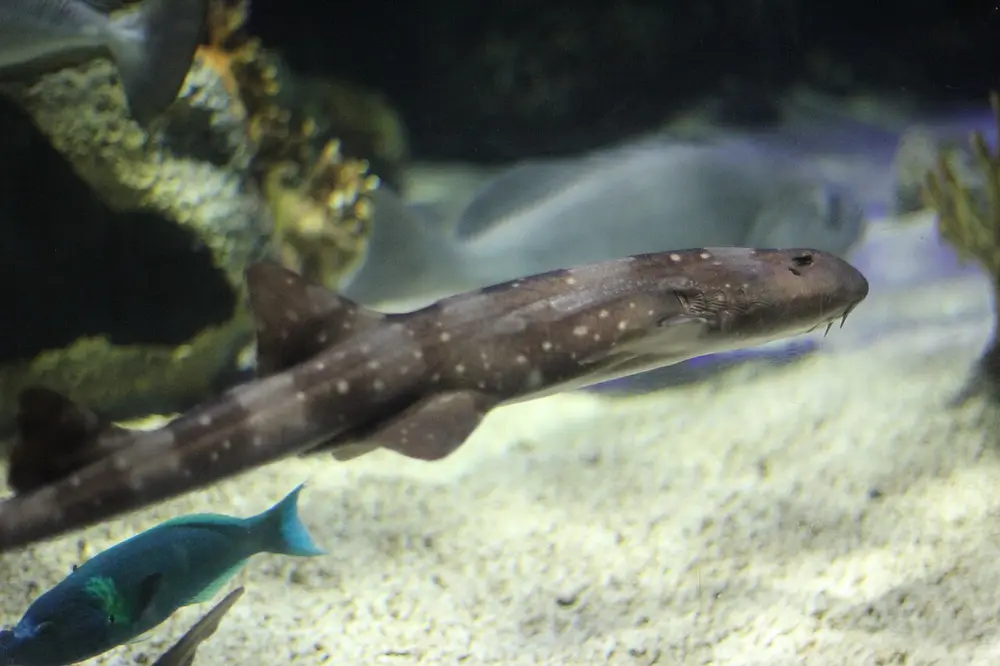
The brownbanded bamboo shark is a small, sedentary shark of the Indo-West Pacific, ranging from Japan to northern Australia. It lives around coral reefs and tide pools at depths down to 85 m. Nocturnal, it grows up to 1.04 m, and juveniles have dark crossbands and some spots that adults lack. Barbels resembling cat whiskers give it the name cat shark, although it is not a true catshark and is more closely related to nurse sharks, wobbegongs, epaulette sharks and whale sharks. It is a carnivore, reproduces by laying eggs, and can survive out of water for up to 12 hours.
About the bamboo shark
The brownbanded bamboo shark is a small, bottom-dwelling shark of coral reefs and tide pools in the Indo-West Pacific, from Japan to northern Australia. It belongs to the longtail carpet shark family, Hemiscylliidae, in the same order as nurse sharks, wobbegongs and the whale shark. Adults grow to about 1 m (41 in) and are docile.
Its scientific name is Chiloscyllium punctatum, and it is often called simply the bamboo shark. Several other bamboo sharks exist, including the white-spotted bamboo shark, Chiloscyllium plagiosum, which is a separate species.
Like other members of its family, the brownbanded bamboo shark has an elongated, cylindrical body, short barbels, large spiracles, and a remarkably long tail that is longer than the rest of the body. The barbels near the mouth look a little like a cat's whiskers, which is why people sometimes call it a "cat shark." It is not a true catshark, though; it is more closely related to the nurse sharks, wobbegongs, epaulette sharks and whale sharks.
Members of the genus Chiloscyllium share a fairly long snout with the nostrils set just below the tip. The eyes and the ridges above them are barely raised. The mouth sits closer to the eyes than to the snout tip, and the pectoral and pelvic fins are thin rather than heavily muscled. There is no black hood on the head and no large black spot on the side.
The brownbanded bamboo shark changes pattern as it grows. Juveniles carry dark bands across the body with some dark spots. Adults lose this pattern and are plain. The species can also be identified by its dorsal fin, whose rear edge is concave.
Behavior and diet
Diet
Carnivore; its family feeds on bottom-dwelling invertebrates and small fish
Bamboo sharks are nocturnal and sedentary, and they do not swim around much. They are also very strong and will knock over anything unstable in a tank. The family as a whole is described as sluggish, feeding on bottom-dwelling invertebrates and smaller fish. In aquariums, brownbanded bamboo sharks are fed foods such as shrimp, scallop, squid and marine fish, two to three times a week, with iodine supplements to prevent goiter.
One of the species' most unusual abilities is surviving out of water for up to 12 hours.
Bamboo sharks also make noise. They make popping and sucking sounds when feeding, click their jaws when handled as a stress signal, and hiss by forcing water out through their gills.
The brownbanded bamboo shark reproduces by laying eggs. Bamboo sharks have also surprised keepers with virgin births: in 2016 a bamboo shark in a British aquarium that had not been near another bamboo shark since 2013 was found carrying two fertilized eggs, a rare case of parthenogenesis in this group. Its minimum population doubling time is between 4.5 and 14 years.
The species has also played a role in genetics. In 2018 a team led by Shigehiro Kuraku published a draft genome for the brownbanded bamboo shark. The genome is about 4.7 billion base pairs, and it showed that sharks still carry several Hoxc genes, which scientists had once thought sharks and their relatives had lost.
Range and habitat
Habitat
Coral reefs and tide pools, down to 85 m (279 ft)
The brownbanded bamboo shark lives in the Indo-West Pacific, from Japan south to northern Australia, roughly between latitudes 34° N and 26° S. It is found around coral reefs and in tide pools, at depths down to 85 m (279 ft).
The family as a whole lives in shallow waters of the tropical Indo-Pacific, typically in tide pools, coral beds and around boulders. That preference for confined spaces is one reason members of the family adapt well to home aquariums, along with their small size and a liking for water temperatures similar to those of other common aquarium fish.
The genus Chiloscyllium includes several other bamboo sharks besides the brownbanded and white-spotted species, among them the grey bamboo shark, the slender bamboo shark, Hasselt's bamboo shark, the Burmese bamboo shark and the Arabian carpetshark. Their cousins in the genus Hemiscyllium, the epaulette sharks, have shorter snouts, thick muscular fins, and either a black hood on the head or a large black spot on each side.
Bamboo shark vs white-spotted bamboo shark
The brownbanded and white-spotted bamboo sharks share a genus and the name "bamboo shark," but they are different species.
| Feature | Brownbanded bamboo shark | White-spotted bamboo shark |
|---|---|---|
| Scientific name | Chiloscyllium punctatum | Chiloscyllium plagiosum |
| Adult pattern | Plain; juveniles have dark bands and spots | Dark bands with many light spots, a pattern unique in the family |
| Rear edge of dorsal fins | Concave | Convex |
| Maximum length | 1.04 m (41 in) | 93 cm (37 in) |
| Range | Japan to northern Australia | Japan to India, common around Indonesia |
| IUCN status | Near Threatened (2024) | Near Threatened (2021) |
The quickest check on an adult is color: a plain brown adult is a brownbanded bamboo shark, while an adult covered in light spots and dark bands is a white-spotted bamboo shark.
Conservation status
The brownbanded bamboo shark is listed as Near Threatened on the IUCN Red List (2024). Its main threats are habitat loss, pollution, and capture, both for the aquarium trade and for food.
The species is regularly bred in public aquariums. It is arguably one of the sharks best suited to captivity because of its docile nature, sedentary habits and relatively small size.
Where to see bamboo shark in the U.S.
6 zoos across 6 states
Find the closest one
Rank the 6 zoos holding bamboo shark by how far they are from you. Your location is used in your browser to sort this list and is never sent to us.
California· 1
Kansas· 1
Michigan· 1
New York· 1
North Carolina· 1
Ohio· 1
AZAThe Association of Zoos and Aquariums. Accredited members have passed an independent inspection of animal care and welfare, safety, conservation and education, repeated every five years. Many smaller facilities never apply, so “not accredited” isn't a verdict on its own. What accreditation means · How we check this
Built from each zoo's own published animal list.
Bamboo Shark: common questions
Are bamboo sharks dangerous?
No. The brownbanded bamboo shark is docile and sedentary, and the closely related white-spotted bamboo shark is described as harmless to humans.
How big do bamboo sharks get?
The brownbanded bamboo shark grows up to 1.04 m (41 in) long. No member of its family exceeds about 121 cm (48 in).
What do bamboo sharks eat?
It is a carnivore, and its family as a whole feeds on bottom-dwelling invertebrates and small fish. In aquariums it is fed shrimp, scallop, squid and marine fish.
How long do bamboo sharks live?
Up to 25 years in public aquariums.
Can a bamboo shark really survive out of water?
Yes. The brownbanded bamboo shark can survive out of water for up to 12 hours.
Where do bamboo sharks live?
In the Indo-West Pacific, from Japan to northern Australia, around coral reefs and tide pools down to 85 m (279 ft).
Can you keep a bamboo shark as a pet?
Some people do, but it takes a very large aquarium. An adult brownbanded bamboo shark needs a tank of about 180 gallons (680 L) or more, with stable decor and a shaded hiding place. It should not share a tank with triggerfish or puffers, which nip at its fins.
Why is it called a cat shark?
Its barbels look like a cat's whiskers. Despite the nickname, it is not a member of the true catshark family.