- Where to see one
- 9 U.S. zoos in our directory hold american bullfrog, confirmed against each zoo's own animal list.
- Native range
- Eastern North America, from the Canadian Maritimes and Nova Scotia west to the Rockies, Idaho and Texas
- Size
- Usually 9–15 cm (3.6–6 in) snout to vent; up to 20 cm (8 in) and 500–800 g (1.1–1.8 lb)
- Lifespan
- 7–9 years in the wild on average; almost 16 years recorded in captivity
- Clutch size
- Up to about 20,000 eggs in a floating sheet
- Call
- A deep "jug-o-rum" that can be heard more than 1 km (0.6 mi) away
Conservation status
Least Concernassessed 2022
IUCN Red List category LC — step 1 of 7.
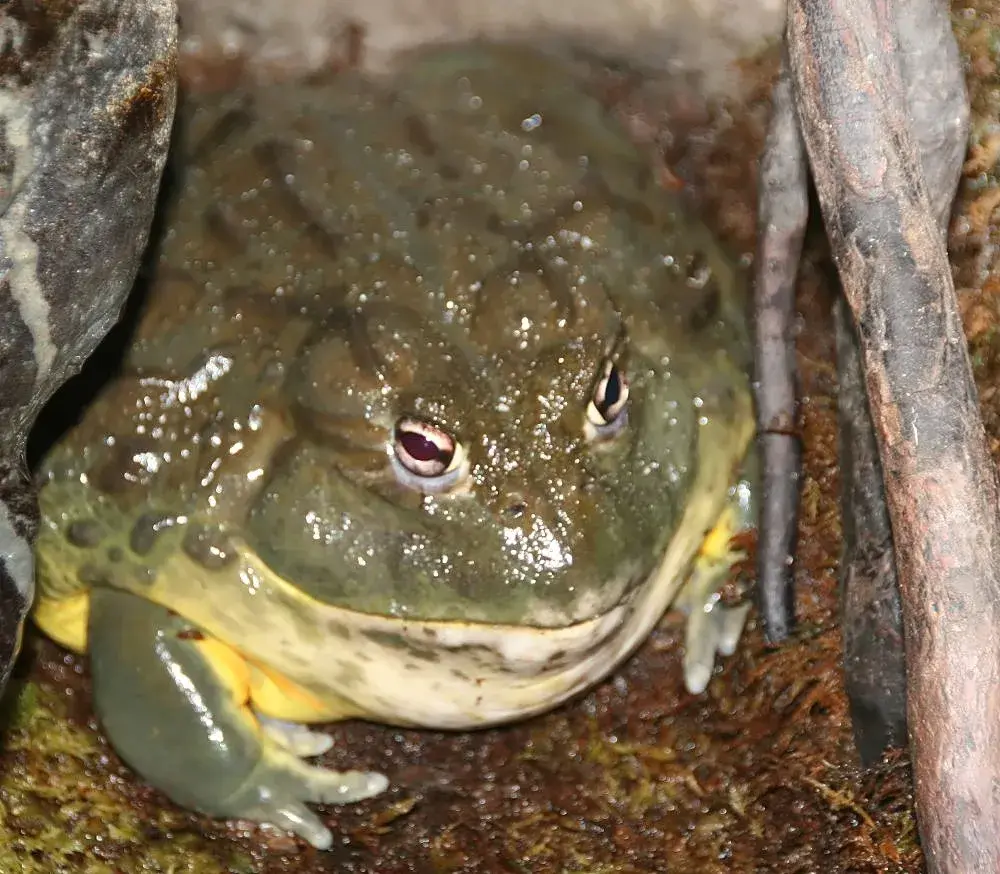
The American bullfrog is the largest true frog in North America, native to the east of the continent, where it lives in large permanent water bodies such as swamps, ponds and lakes. It has an olive-green back, an off-white belly blotched with yellow or gray, and measures about 9 to 15 cm from snout to vent. It is a generalist carnivore that eats a wide variety of prey, while alligators, snakes and birds eat it in turn. The name comes from the male's breeding call, which sounds like a bull bellowing. Introduced to more than 40 countries, it is considered invasive in many of them.
About the American bullfrog
The American bullfrog is a large true frog of the family Ranidae, native to the ponds, lakes and swamps of eastern North America. It is the largest true frog on the continent and takes its name from the male's deep, bull-like call. People have spread it to more than 40 countries, where it is often invasive.
Its scientific name, Lithobates catesbeianus, honors the English naturalist Mark Catesby, though some authorities still file it under the older genus Rana as Rana catesbeiana. The upper body is olive green, either plain or mottled and banded with grayish brown, while the belly is off-white with yellow or gray blotches. A green upper lip often contrasts sharply with a pale lower one, and the legs carry gray bands or blotches.
The head is broad, with prominent eyes that have a brown iris and a horizontal, almond-shaped pupil. Just behind each eye sits the tympanum, the round external eardrum, wrapped by a fold of skin. The teeth are tiny and serve only to grip. Forelegs are short and sturdy and the hind legs long and powerful. The back feet are webbed between the toes except for the fourth toe, and the front toes have no webbing at all.
Telling the sexes apart is easier than with most frogs. In males the eardrum is noticeably larger than the eye, while in females it is about the same size as the eye or smaller. Males are smaller overall but have yellow throats in the breeding season, and the female's throat is white. Typical adults measure 9 to 15 cm (3.6 to 6 in) from snout to vent. Young frogs grow fast, going from about 5 g to 175 g (0.18 to 6.17 oz) in their first eight months, and big adults can reach 500 g (1.1 lb). A few have topped 800 g (1.8 lb) and 20 cm (8 in).
Behavior and diet
Diet
Carnivore; insects, crayfish, fish, tadpoles, frogs, snakes, small birds, rodents and even bats
Bullfrogs are active by day and by night, and they are busiest when the weather is warm and moist. They hunt by sitting and waiting. Any small animal that moves near enough and can be overpowered is fair game, which makes the bullfrog a voracious, opportunistic ambush predator.
The list of recorded prey is long. Stomach studies have turned up rodents, small lizards and snakes, other frogs and toads, crayfish, small birds, scorpions, tarantulas and several kinds of bats, alongside the snails, worms and insects that most true frogs eat. Unusually for a North American ranid, much of the diet is aquatic: fish, tadpoles, water beetles, and the eggs of fish, frogs and salamanders. Bullfrogs will also eat their own kind when food is scarce.
A strike is fast and precise. The frog turns to face its target, hops closer if needed, then lunges with its eyes closed and its mouth opening. The sticky tongue flips out, the jaws snap shut as the tongue pulls back, and anything too big to fit is shoved in with the hands. Bullfrogs can even correct for light bending at the water's surface, aiming slightly behind where submerged prey appears to be. Tadpoles eat very differently, filtering bacteria, algae and other tiny particles from the water and grazing on aquatic plants.
In cold weather, bullfrogs hibernate. One may bury itself in mud and shape a small cave-like pocket for the winter.
Breeding and choruses
The breeding season lasts two to three months, roughly May to July in the north and from February to October in the south. Males gather in noisy groups called choruses, spaced about 3 to 6 m (10 to 20 ft) apart, and use at least three distinct calls: one to warn rival males, one to attract females, and one that comes right before a fight. Territories can cover 3 to 25 m (10 to 82 ft) of shoreline.
Dominant males float high in the water with their lungs inflated to show off their yellow throats. When two of them meet, they rise up chest to chest and wrestle. Younger and weaker males keep only their heads above water, and some act as silent "satellites" that sit near a territory holder and wait for the spot to open up. Older males tend to win the central positions in a chorus.
Females choose their mates and are receptive only briefly, often for a single night. After the male clasps her, the female lays up to 20,000 eggs in shallow water among plants, and they float as a thin sheet covering 0.5 to 1 square meter (5.4 to 10.8 sq ft). The eggs hatch in three to five days. Tadpoles may take a few months to turn into frogs in the warm south but up to three years in the colder north, and adults reach maturity after another few years.
Predators and defenses
Large herons, great egrets, belted kingfishers, river otters, raccoons, turtles, water snakes, predatory fish and American alligators all eat bullfrogs. Cottonmouths and copperheads hunt them too, though bullfrogs appear to be at least partly resistant to the venom of both snakes. Many fish and salamanders avoid the eggs and tadpoles because of their bad taste. A frog under attack leaps for deep water, and one that is grabbed may let out a piercing scream that can startle a predator into letting go.
Range and habitat
Habitat
Warm, still, shallow fresh water: ponds, lakes, swamps, marshes, bogs and slow rivers
The bullfrog's native range covers eastern North America. It is common in every U.S. state east of the Mississippi River, and reaches from the Canadian Maritimes west to Idaho and Texas and north into Michigan, Minnesota and Montana. It is largely absent from North Dakota.
It has to live in or near water and prefers it warm, still and shallow. Lakes, ponds, rivers, marshes, swamps and bogs all work, and so do human-made waters like canals, ditches, reservoirs and garden ponds. Warmer water and thick plant growth, common in lakes altered by people, actually favor bullfrogs.
People have carried the species far beyond that range, mostly as a food source and sometimes as biological pest control. It is now established across much of the western United States, including California, Arizona, Colorado, Nevada, Oregon, Utah and Washington, as well as in Hawaii, Mexico, the Caribbean, South America, Europe and East Asia.
Conservation status
The American bullfrog is listed as Least Concern on the IUCN Red List, most recently assessed in 2022. It has no special federal or CITES status in the United States. Far from declining, it thrives in human-modified places: it tolerates hotter water than most frogs, breeds over a longer season, and has better survival before metamorphosis.
That success is the problem. Where it has been introduced, the bullfrog eats and outcompetes native frogs, and it is considered a factor in the decline of California's vulnerable red-legged frog. It also preys on young giant garter snakes, a threatened species. Because the bullfrog is fairly resistant to chytrid fungus, it can carry the disease to more vulnerable frogs as it spreads. Since 2016 the European Union has banned importing, breeding, selling or releasing it, and Utah's natural resources department has urged residents to catch and cook invasive bullfrogs to help control them.
Where to see american bullfrog in the U.S.
9 zoos across 7 states
Find the closest one
Rank the 9 zoos holding american bullfrog by how far they are from you. Your location is used in your browser to sort this list and is never sent to us.
California· 2
Colorado· 1
Kansas· 1
Louisiana· 2
New Hampshire· 1
Texas· 1
Wisconsin· 1
AZAThe Association of Zoos and Aquariums. Accredited members have passed an independent inspection of animal care and welfare, safety, conservation and education, repeated every five years. Many smaller facilities never apply, so “not accredited” isn't a verdict on its own. What accreditation means · How we check this
Built from each zoo's own published animal list.
American Bullfrog: common questions
How big do American bullfrogs get?
Most adults are 9 to 15 cm (3.6 to 6 in) from snout to vent and weigh up to about 500 g (1.1 lb). Exceptional individuals have reached 20 cm (8 in) and 800 g (1.8 lb).
What do American bullfrogs eat?
Almost any animal they can overpower. Insects, crayfish, fish, tadpoles, other frogs, snakes, small birds, rodents and even bats have all been found in their stomachs.
How long do American bullfrogs live?
About 7 to 9 years in the wild. One lived almost 16 years in captivity.
Why is it called a bullfrog?
Because of the male's breeding call. The deep, rumbling "jug-o-rum" sounds like a bull bellowing and can carry more than a kilometer.
How can you tell a male bullfrog from a female?
Look at the eardrum behind the eye. A male's is much larger than his eye, while a female's is about the same size or smaller, and males also have yellow throats in the breeding season.
Are American bullfrogs invasive?
Yes, outside their native eastern North America. They have been introduced to more than 40 countries and much of the western U.S., where they eat and outcompete native frogs and can spread chytrid fungus.
Are bullfrogs active at night?
Yes, but not only at night. They are active during both day and night and are most active in warm, moist weather, so they are neither strictly [nocturnal](/learn/nocturnal/) nor strictly diurnal.
Can you keep an American bullfrog as a pet?
Some people do. Albino bullfrogs are sometimes kept as pets and tadpoles are sold at pond and fish stores, but releasing them is a major cause of invasive populations and is banned in the European Union.