- Where to see one
- 17 U.S. zoos in our directory hold roseate spoonbill, confirmed against each zoo's own animal list.
- Native range
- South and North America, including Texas, Florida, and southwest Louisiana in the U.S.
- Size
- 28–34 in long, 47–52 in wingspan, weight 2.6–4.0 lb
- Lifespan
- At least 18 years (oldest known banded wild bird)
About the roseate spoonbill
The roseate spoonbill is a social wading bird in the ibis and spoonbill family, Threskiornithidae, and a resident breeder in both South and North America. It was formally described in 1758 by Carl Linnaeus, who based his account largely on an earlier description by German naturalist Georg Marcgrave. The genus name Platalea is Latin for "broad," referring to the bird's distinctive bill shape, while the species name ajaja comes from the Tupi language name recorded by Marcgrave. It is sometimes placed in its own genus, Ajaia, though genetic studies have found its closest relative to be the yellow-billed spoonbill, and researchers consider it equally valid to keep all six spoonbill species in one genus given how similar they are physically.
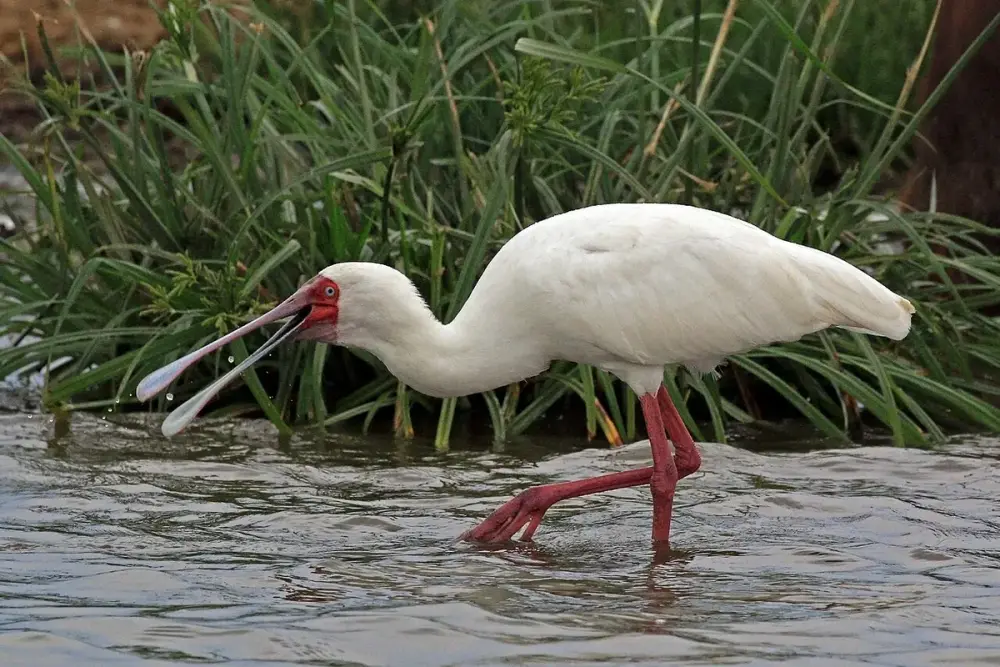
The bird measures 28 to 34 inches long, with a wingspan of 47 to 52 inches and a body mass of 2.6 to 4.0 pounds. Its legs, bill, neck, and spatulate bill all appear notably elongated relative to its body. Adults have a bare, greenish head that turns "golden buff" during breeding season, a white neck, back, and breast — with a tuft of pink feathers appearing at the center of the breast when breeding — and are otherwise a deep pink overall, with a gray bill. There is no significant difference in appearance between males and females.
The species' pink coloring comes entirely from its diet, the same way it does in the American flamingo. The carotenoid pigment canthaxanthin produces the color, while a second carotenoid, astaxanthin, is deposited in the flight and body feathers. Depending on age, breeding status, and location, the resulting color can range from pale pink to bright magenta. In flight, roseate spoonbills hold their necks outstretched, unlike herons, and alternate stiff, shallow wingbeats with glides.
Behavior and diet
Diet
Crustaceans, plant material, aquatic insects, mollusks, frogs, newts, and small fish
The roseate spoonbill feeds in shallow fresh or coastal water, swinging its bill side to side as it wades, often in groups, and using the spoon-shaped bill to sift easily through mud. Its diet includes crustaceans, bits of plant material, aquatic insects, mollusks, frogs, newts, and very small fish such as minnows — prey generally too small for larger wading birds to bother with. Research in Brazil found the diet there consisted of fish, insects, crustaceans, mollusks, and seeds, all foraged from freshwater habitats. This preference for particular foraging conditions, compared with the more flexible habits of the great egret, helps the two species avoid competing directly during breeding season. Roseate spoonbills do compete for food with other wading birds, including snowy egrets, great egrets, tricolored herons, and American white pelicans, and are often trailed by egrets that take advantage of the sediment the spoonbill's foraging stirs up — a relationship known as "beater-follower."
Spoonbills nest in shrubs or trees, often mangroves, laying two to five whitish eggs marked with brown. Immature birds have white, feathered heads and paler pink plumage than adults, with a yellowish or pinkish bill. Nestlings face several natural threats, including turkey vultures, bald eagles, raccoons, and invasive fire ants.
Range and habitat
Habitat
Shallow fresh or coastal waters, mangroves
In the United States, the roseate spoonbill is locally common in Texas, Florida, and southwest Louisiana. More broadly, it occurs across South America mostly east of the Andes, and through coastal regions of the Caribbean, Central America, Mexico, and the Gulf Coast of the United States, extending north along Florida's Atlantic coast at least as far as South Carolina's Myrtle Beach.
Plume hunting in the eighteenth and nineteenth centuries nearly drove the species to extinction, but decades of conservation work, along with the effects of climate change, have allowed its range to expand considerably in the 21st century. The species bred in Georgia for the first time in 2011, and its presence in South Carolina has grown substantially since the 1970s. It has also turned up well outside its typical range, including single sightings in Michigan and Wisconsin, a deceased specimen recorded in Wisconsin in 1845 and not seen again there until 2023, and reports in the summer of 2021 from Washington, D.C., upstate New York, and New Hampshire — including a large flock spotted at Huntley Meadows Park in Fairfax County, Virginia, that drew a large crowd. In Florida Bay, the species serves as an ecological and scientific indicator, with nest numbers tracking freshwater levels and seawater depth as wetlands there shift toward open ocean; nesting locations shifted noticeably farther north and inland between 2006 and 2020.
Conservation status
The roseate spoonbill is classified as Least Concern (LC) and is currently considered not threatened, despite having nearly gone extinct due to plume hunting in the eighteenth and nineteenth centuries. Little information exists on predation of adult birds. In 2022, an 18-year-old banded individual was found, making it the oldest known wild roseate spoonbill on record. In Florida, the species faces a newer threat from invasive snakes, including Burmese pythons, reticulated pythons, Central African and Southern African rock pythons, boa constrictors, and several anaconda species, which are known to eat spoonbills at various growth stages.
Where to see roseate spoonbill in the U.S.
17 zoos across 10 states
Find the closest one
Rank the 17 zoos holding roseate spoonbill by how far they are from you. Your location is used in your browser to sort this list and is never sent to us.
District of Columbia· 1
Florida· 3
Idaho· 1
Kansas· 2
Louisiana· 3
Missouri· 1
New Jersey· 1
New York· 2
Pennsylvania· 1
Texas· 2
AZAThe Association of Zoos and Aquariums. Accredited members have passed an independent inspection of animal care and welfare, safety, conservation and education, repeated every five years. Many smaller facilities never apply, so “not accredited” isn't a verdict on its own. What accreditation means · How we check this
Built from each zoo's own published animal list.
Roseate Spoonbill: common questions
Is the roseate spoonbill endangered?
No. It is classified as Least Concern (LC) and considered not currently threatened, though plume hunting nearly wiped it out in the 1700s and 1800s.
How big does a roseate spoonbill get?
It measures 28 to 34 inches long, with a wingspan of 47 to 52 inches, and weighs 2.6 to 4.0 pounds.
What does a roseate spoonbill eat?
Crustaceans, plant material, aquatic insects, mollusks, frogs, newts, and small fish, sifted from shallow water with its spoon-shaped bill.
How long do roseate spoonbills live?
At least 18 years — the age of the oldest known banded wild bird, identified in 2022.
Where do roseate spoonbills live in the wild?
Across South America east of the Andes, the Caribbean, Central America, Mexico, and the Gulf Coast of the U.S., with U.S. populations concentrated in Texas, Florida, and southwest Louisiana.
Which U.S. zoos have roseate spoonbills?
6 zoos in the Feather & Fang directory list roseate spoonbills, including the Houston Zoo, the Saint Louis Zoo, and the Brevard Zoo.