- Where to see one
- 8 U.S. zoos in our directory hold african spoonbill, confirmed against each zoo's own animal list.
- Native range
- Widespread across Africa and Madagascar, including Botswana, Kenya, Mozambique, Namibia, South Africa, and Zimbabwe
About the African spoonbill
The African spoonbill is a long-legged wading bird in the ibis and spoonbill family, Threskiornithidae. It belongs to the genus Platalea, which also includes the black-faced spoonbill, the Eurasian spoonbill, and the roseate spoonbill. Its range is wide, spanning much of Africa and Madagascar, with populations recorded in Botswana, Kenya, Mozambique, Namibia, South Africa, and Zimbabwe.
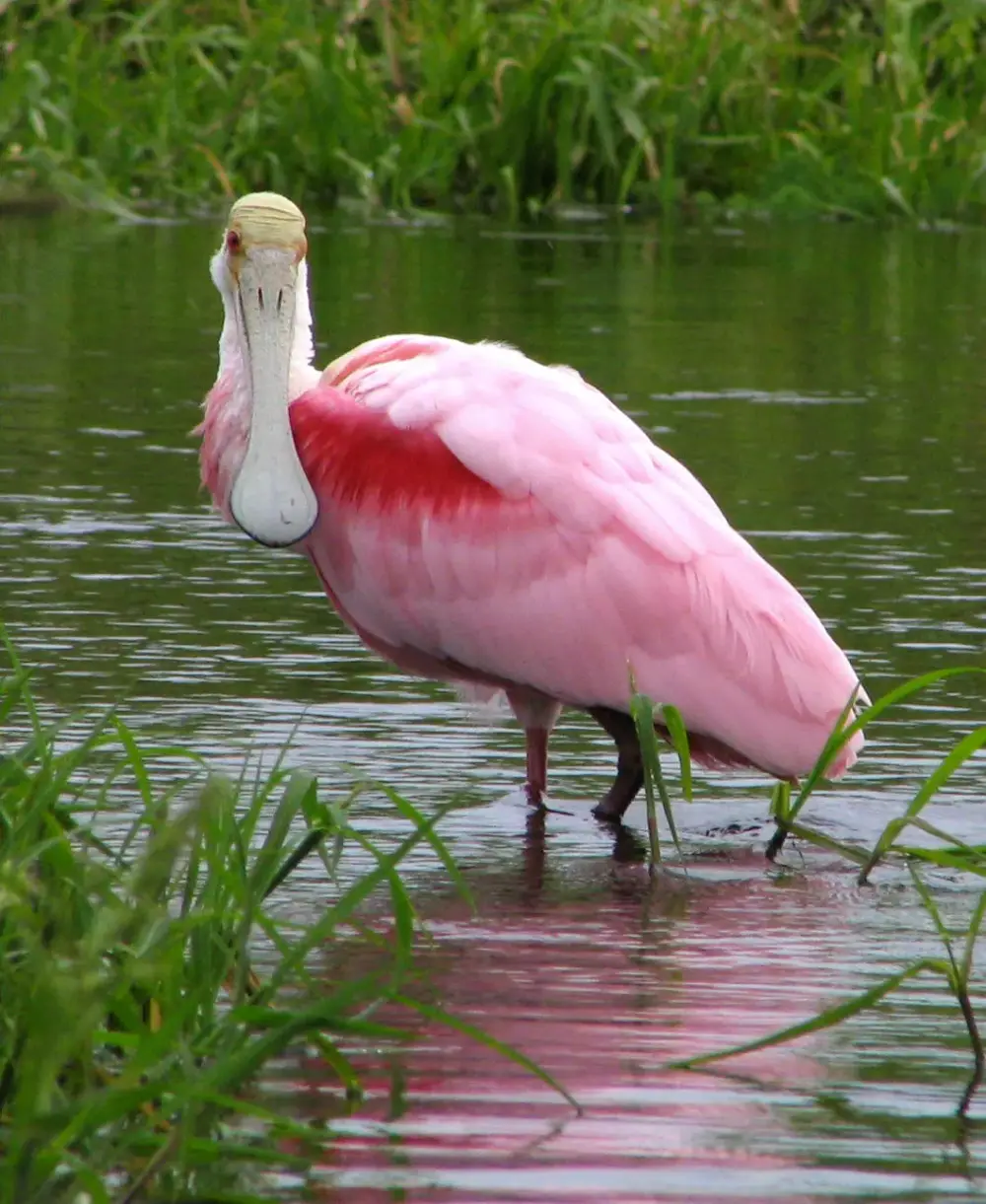
The species is almost unmistakable through most of its range. A breeding adult is entirely white apart from red legs, a red face, and a long, gray, spoon-shaped bill — the feature that gives the family its name. Unlike the related common spoonbill, it has no crest. Immature birds lack the red face and carry a yellow bill instead. Juveniles are also born with shorter bills that gradually lengthen and flatten into the adult's distinctive spatulate shape as they mature. In flight, spoonbills hold their necks outstretched, a posture that distinguishes them from herons, which fly with the neck tucked in.
Behavior and diet
Diet
Fish, mollusks, amphibians, crustaceans, and insects
The African spoonbill lives in marshy wetlands with patches of open shallow water and nests in colonies, either in trees or in reedbeds. It generally avoids sharing colonies with storks or herons. It feeds by sweeping its flat bill from side to side through shallow water, snapping the bill shut the instant it detects prey — fish, mollusks, amphibians, crustaceans, and insects. Long legs and thin, pointed toes let it wade easily through water of varying depth in search of food.
Breeding begins in winter and runs into spring. During the season, adult males grow more elaborate plumage and brighter coloration. The nest is built in trees above water from sticks and reeds and lined with leaves. The female lays three to five eggs, typically in April or May, and both parents share roughly 29 days of incubation. After hatching, the young are cared for by both parents for another 20 to 30 days before they're ready to leave the nest, and they begin flying about four weeks after that. The African spoonbill is one of the species covered by the Agreement on the Conservation of African-Eurasian Migratory Waterbirds (AEWA).
Range and habitat
Habitat
Marshy wetlands with some open shallow water
The African spoonbill's range covers much of sub-Saharan Africa and Madagascar, with confirmed populations in Botswana, Kenya, Mozambique, Namibia, South Africa, and Zimbabwe. It favors marshy wetlands that include some open shallow water, the setting it needs both for nesting in nearby trees or reedbeds and for sweep-feeding along the water's edge.
Conservation status
The African spoonbill is listed as Least Concern (LC), meaning it is not currently considered at risk of extinction across its range. No specific threats or protection programs are detailed here.
Where to see african spoonbill in the U.S.
8 zoos across 6 states
Find the closest one
Rank the 8 zoos holding african spoonbill by how far they are from you. Your location is used in your browser to sort this list and is never sent to us.
California· 3
Florida· 1
Illinois· 1
Maryland· 1
Michigan· 1
Oregon· 1
AZAThe Association of Zoos and Aquariums. Accredited members have passed an independent inspection of animal care and welfare, safety, conservation and education, repeated every five years. Many smaller facilities never apply, so “not accredited” isn't a verdict on its own. What accreditation means · How we check this
Built from each zoo's own published animal list.
African Spoonbill: common questions
Is the African spoonbill endangered?
No. It's listed as Least Concern, the lowest level of conservation concern on the IUCN scale.
What does an African spoonbill eat?
Fish, mollusks, amphibians, crustaceans, and insects, caught by sweeping its bill side to side through shallow water.
Where do African spoonbills live in the wild?
Across much of Africa and Madagascar, including Botswana, Kenya, Mozambique, Namibia, South Africa, and Zimbabwe, in marshy wetlands with some open shallow water.
How does an African spoonbill find food?
It sweeps its flat, spoon-shaped bill from side to side through the water and snaps it shut the moment it detects prey.
Which U.S. zoos have African spoonbills?
Seven zoos in our directory currently list one, including the Los Angeles Zoo, Lincoln Park Zoo, and The Maryland Zoo in Baltimore.